
Contents
- When a Wave Refuses to Spread
- The Physicists Who Tamed Nonlinearity
- A Wave That Carries Itself: The Idea Before the Equations
- From Intuition to Formalism: Inside the NLS Equation
- The Epistemological Turn: What Does a Soliton Tell Us About Reality?
- Contested Terrain: The Historical Debate Over Nonlinear Quantum Mechanics
- Legacy: From Fiber Optics to the Quantum Frontier
- What is the nonlinear Schrödinger equation used for?
- The Open Question
- References and Further Reading
When a Wave Refuses to Spread
Drop a pebble into still water. The ripples expand, weaken, and vanish — this is what waves do. They disperse. Now imagine a pulse of light fired down a glass fiber that does not spread. It holds its shape for hundreds of kilometers, arriving at the far end as compact and coherent as when launched. This is not a thought experiment; it is the principle behind modern long-haul telecommunications. The mathematics explaining it is the nonlinear Schrödinger equation, and its implications reach far beyond fiber optics — into deep water, plasma physics, Bose–Einstein condensates, and the ancient puzzle of wave-particle duality.
The ordinary, linear Schrödinger equation lies at the heart of quantum mechanics. It governs the evolution of a quantum wave function in free space or an external potential. But once the medium responds to the wave’s own intensity and the wave reshapes the landscape it travels through, linearity breaks down. The resulting equation is deceptively similar in form to its quantum ancestor. Yet it describes a different regime of physics: one where waves can trap themselves, where dispersion and self-focusing wage a tug-of-war, and where localized structures called solitons emerge as victors.
The Physicists Who Tamed Nonlinearity
No single name can be attached to the nonlinear Schrödinger equation as Schrödinger’s name is to its linear counterpart. The equation appeared independently across several fields throughout the twentieth century, wherever physicists encountered waves propagating through media that pushed back. Its deepest mathematical structure was cracked open in 1972 by Vladimir Zakharov and Alexei Shabat, two Soviet physicists in Novosibirsk. Their achievement was not to write down the equation — others had done that — but to solve it exactly using a technique called the inverse scattering transform. What Zakharov and Shabat showed was remarkable: this nonlinear equation, which should have been analytically intractable, could be linearized in a certain mathematical sense. They demonstrated that the NLS equation is integrable — it has an infinite number of conserved quantities, and its solutions can be constructed by a procedure transforming the problem into one resembling scattering theory in quantum mechanics. This was the mathematical bridge connecting the study of wave particles in nonlinear media to the deep algebraic structures of integrable systems.
The context matters. By the early 1970s, solitons had already been observed in shallow-water experiments and studied numerically in the famous Fermi–Pasta–Ulam–Tsingou problem of 1955. The Korteweg–de Vries equation, which governs shallow-water waves, had been solved by the inverse scattering method in 1967 by Gardner, Greene, Kruskal, and Miura. Zakharov and Shabat extended that method to the NLS equation, revealing that soliton behavior was not a peculiarity of water waves but a deep structural feature of an entire class of nonlinear systems. Their work opened the floodgates for applications in optics, plasma physics, and condensed matter. Wherever the nonlinear Schrödinger equation appeared, exact solutions could now be pursued.
A Wave That Carries Itself: The Idea Before the Equations
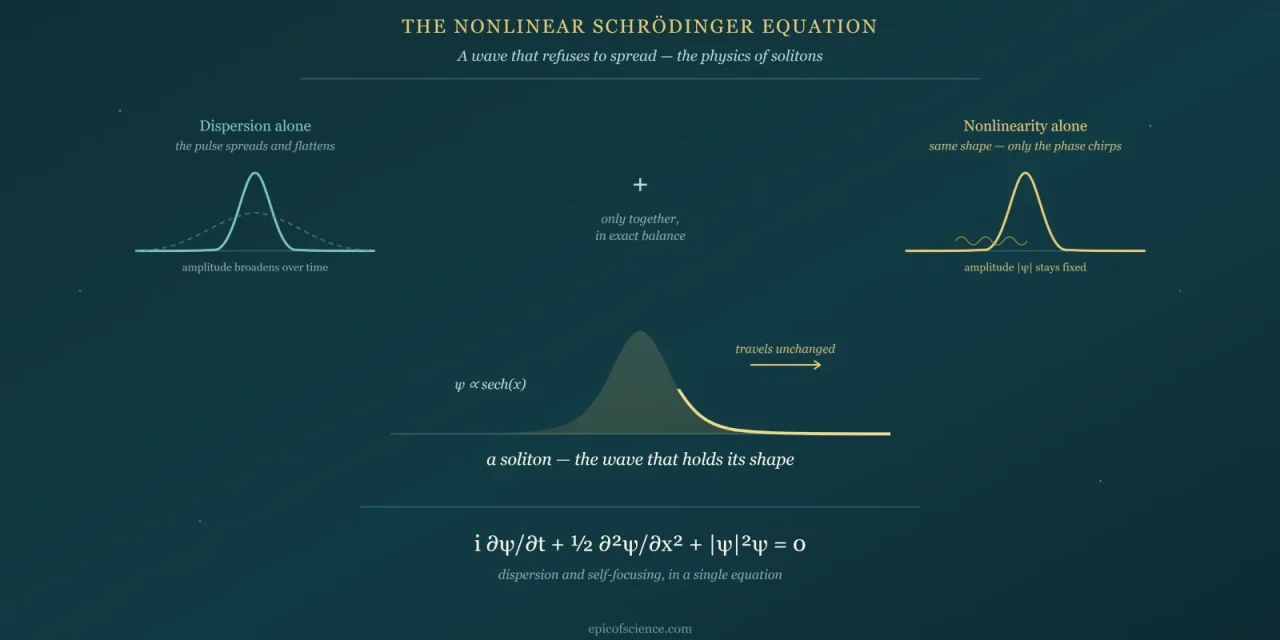
The best way to understand the nonlinear Schrödinger equation is to think about two competing tendencies in wave propagation. The first is dispersion: different frequency components of a wave packet travel at different speeds, so the packet spreads out over time. If you have watched ocean swells arrive at shore — long-period waves first, shorter ones trailing behind — you have seen dispersion at work. The second tendency is nonlinearity: in certain media, the wave’s own intensity changes the medium’s properties, which in turn affects the wave. In optical fibers, the refractive index increases slightly with light intensity. In deep water, the wave speed depends weakly on amplitude.
Normally these two effects have nothing to do with each other. But the nonlinear Schrödinger equation describes the special regime where they are in exact balance. Dispersion tries to spread the wave; the nonlinear response tries to focus it. When these two forces are precisely matched, the wave packet holds its shape indefinitely. This self-trapped wave is a soliton — a localized, particle-like entity born entirely from wave dynamics.
Here is where an analogy helps but must be carefully bounded. Think of a marathon runner on a moving sidewalk at an airport. If the sidewalk is too slow, she outruns it and stumbles off the end. If it is too fast, she is swept backward. At exactly the right speed, she stands still relative to the ground — a stable, localized “excitation” on an otherwise featureless conveyor. A soliton is like that runner: it exists only because two opposing effects cancel. This analogy breaks down in an essential way. The runner and the sidewalk are separate entities; the soliton is not separate from the wave — it is the wave, self-consistently maintaining the nonlinear conditions that permit its own existence. There is no external conveyor. The wave builds its own road as it travels, and that self-referential quality is what makes quantum nonlinear waves so profoundly different from anything in everyday experience.
From Intuition to Formalism: Inside the NLS Equation
The standard form of the nonlinear Schrödinger equation governs the evolution of a complex envelope function \( \psi(x,t) \), which represents the slowly varying amplitude of a wave packet. In its simplest one-dimensional form, the equation reads:
Each term carries a distinct physical meaning. The first term, \( i \partial \psi / \partial t \), governs temporal evolution. It is the same first-order time derivative that appears in ordinary quantum mechanics, reflecting the wave-like character of the solution. The second term, \( \frac{1}{2} \partial^2 \psi / \partial x^2 \), is the dispersive term. It encodes how different frequency components travel at different speeds, causing the wave packet to spread. In the linear Schrödinger equation, this term alone governs a freely dispersing quantum particle. The third term, \( |\psi|^2 \psi \), changes everything. It is the cubic nonlinearity — the wave function’s own intensity, \( |\psi|^2 \), acts as an effective potential that feeds back into the wave’s evolution. This self-interaction can counterbalance dispersion.
The sign in front of the nonlinear term matters enormously. With the sign shown above (called the focusing or attractive case), the equation admits bright soliton solutions — localized humps of amplitude that propagate without changing shape. With the opposite sign (the defocusing case), the equation admits dark solitons — localized dips in an otherwise uniform background. The NLS equation in the focusing case has the celebrated single-soliton solution \( \psi(x,t) = \eta \, \mathrm{sech}[\eta(x – vt)] \, e^{i(vx + \phi(t))} \), where \( \eta \) sets the amplitude and width, \( v \) is the velocity, and \( \phi(t) \) captures the phase evolution. The hyperbolic secant profile is the hallmark of the soliton: a bell-shaped pulse whose width is inversely proportional to its amplitude — taller solitons are narrower, embodying the link between energy and localization.
Two bright solitons of the nonlinear Schrödinger equation: the taller pulse is narrower and travels faster — a direct visual consequence of the sech profile’s amplitude-width relationship.
What does experiment say? In 1980, Linn Mollenauer, Roger Stolen, and James Gordon at Bell Labs demonstrated optical solitons in glass fiber for the first time, confirming the predictions of the NLS equation in the nonlinear optical regime. This was not a quantum measurement in the Bohr–Heisenberg sense. It was a classical wave phenomenon governed by an equation that structurally resembles the quantum one. The distinction is critical. The \( \psi \) in the NLS equation for optics is a classical electric field envelope, not a quantum probability amplitude. It satisfies the same mathematical equation, but the physical ontology is entirely different. Conflating these two uses of the same formalism is one of the most common sources of confusion in discussions of wave particle duality: the mathematics is shared, but what the mathematics refers to is not.
In the quantum domain — specifically, in Bose–Einstein condensates — the NLS equation reappears as the Gross–Pitaevskii equation, where \( \psi \) is the macroscopic wave function of a many-body quantum state, and the nonlinearity arises from interatomic interactions. Here the wave function nonlinear character is genuinely quantum-mechanical. Solitons have been observed in ultracold atomic gases, confirming that the NLS framework spans both classical and quantum physics.
The Epistemological Turn: What Does a Soliton Tell Us About Reality?
The nonlinear Schrödinger equation forces an uncomfortable question upon us: what is the relationship between the mathematics we write and the reality we claim to describe? The same equation governs light in a fiber, waves in the ocean, and the collective quantum state of a million rubidium atoms cooled to nanokelvin temperatures. In each case, the soliton solution looks the same on paper. But in one case \( \psi \) is a classical field, in another a fluid-dynamical envelope, and in another a quantum order parameter. The equation is identical; the things it is about are not. So what, exactly, has the equation taught us about nature?
Eugene Wigner wrote famously of “the unreasonable effectiveness of mathematics in the natural sciences,” and the NLS equation is a striking case study. Its integrability — the fact that it admits exact solutions via the inverse scattering transform — is a property of the mathematics itself, not of light, water, or atoms. Nature, in some sense, is not required to produce solitons; the equation is. Yet nature does produce them in wildly different physical contexts. The most defensible reading, I think, is that the NLS equation captures a structural fact about the interaction between dispersion and nonlinearity — a fact that recurs across domains because the pattern is universal, even if the material substrate is not. The equation describes a relationship, not a substance.
This raises a second, more unsettling question. When a soliton propagates unchanged through a medium, behaving for all practical purposes like a particle — possessing a definite position, a definite velocity, conserving its energy in collisions — is it a particle? The traditional framing of wave particle duality, inherited from the debates between Bohr and Einstein in the late 1920s, treats “wave” and “particle” as complementary but mutually exclusive descriptions of quantum entities. But the soliton does not fit this framework. It is a wave — it is nothing but a solution to a wave equation — and yet it exhibits every operational criterion we associate with particles: localization, persistence, elastic scattering. The duality is not between two incompatible descriptions; it is dissolved. The soliton is both, simultaneously, without contradiction.
Bas van Fraassen, the philosopher of science who developed constructive empiricism, would point out that this dissolution may be less about nature and more about our categories. Van Fraassen argues that a scientific theory need not describe unobservable reality accurately; it need only be empirically adequate — it must “save the phenomena.” From this perspective, the NLS equation is spectacularly empirically adequate. But whether the soliton is “really” a particle or “really” a wave is not a question science can answer, because the distinction is one we imposed, not one nature recognizes. I find this unsettling because it suggests that wave-particle duality — perhaps the most iconic conceptual puzzle of twentieth-century physics — may not be a puzzle about the physical world at all. It may be a puzzle about the poverty of our ontological vocabulary. We have two words where nature has one phenomenon, and no amount of experimental cleverness can fix a linguistic deficiency.
And yet we cannot simply dismiss the question as verbal. The measurement problem in quantum mechanics — the problem of how and whether the wave function collapses — depends critically on whether \( \psi \) refers to something real or merely encodes our knowledge. In the quantum NLS equation for a Bose–Einstein condensate, \( \psi \) is measurable: its modulus squared gives the atomic density, which can be imaged. The wave function nonlinear dynamics are experimentally accessible in a way that single-particle quantum mechanics rarely permits. Does this make the wave function more “real” in the condensate case? Or does it simply mean that the condensate is large enough for the quantum-classical boundary to blur?
Contested Terrain: The Historical Debate Over Nonlinear Quantum Mechanics
It is worth pausing over a myth that clings to this subject: the idea that the nonlinear Schrödinger equation is somehow an extension or generalization of quantum mechanics itself — that nature might be fundamentally nonlinear at the quantum level. This idea was explored seriously. In the 1970s and 1980s, physicists including Iwo Bialynicki-Birula and Jerzy Mycielski, and later Steven Weinberg, investigated whether adding nonlinear terms to the quantum-mechanical Schrödinger equation could produce a self-consistent theory. Weinberg’s 1989 paper in Annals of Physics systematically tested the consequences and found that nonlinear modifications to quantum mechanics generically lead to violations of causality or the ability to send superluminal signals — pathologies so severe that they effectively ruled out the program.
The lesson is important: the NLS equation as used in optics and fluid dynamics is not a modification of quantum mechanics. It is a classical or semiclassical equation that happens to share the mathematical form of the Schrödinger equation. The nonlinearity arises from the medium, not from any failure of the superposition principle at the quantum level. As discussed in detail in the Scholarpedia article on nonlinear Schrödinger systems, the NLS equation is best understood as a universal amplitude equation — a generic description of weakly nonlinear, dispersive wave systems — rather than as a statement about quantum foundations.
Those who resisted this conflation were not being pedantic. They were protecting a crucial distinction: quantum linearity — the superposition principle — is one of the most precisely tested features of nature. Experiments searching for nonlinear corrections to quantum mechanics have placed extraordinarily tight bounds on any such effects. The NLS equation’s power comes precisely from its classical or mean-field character, and confusing it with fundamental quantum nonlinearity leads to conceptual errors that are surprisingly difficult to undo once established.
Legacy: From Fiber Optics to the Quantum Frontier
The practical legacy of the nonlinear Schrödinger equation is immense. Optical solitons, predicted theoretically and confirmed experimentally in the 1980s, became the basis for high-capacity fiber-optic communication systems. The ability of solitons to propagate without dispersive broadening meant that signals could travel transoceanic distances with minimal distortion — a technological triumph rooted directly in the mathematics of the NLS equation. Today, soliton concepts inform the design of ultrafast lasers, frequency combs, and photonic devices.
In fundamental physics, the equation’s reach continues to grow. Solitons in Bose–Einstein condensates provide a laboratory for studying quantum nonlinear waves in regimes inaccessible to classical optics. Rogue waves — extreme, short-lived peaks in wave amplitude — have been modeled using higher-order solutions of the NLS equation, connecting abstract mathematics to the real danger faced by ships at sea. The equation also appears in the study of plasma turbulence, in models of energy transport in biological molecules, and in the mathematical theory of integrable systems, where it sits alongside the Korteweg–de Vries and sine-Gordon equations as a canonical example.
What is the nonlinear Schrödinger equation used for?
The nonlinear Schrödinger equation describes wave propagation in media where dispersion and self-interaction compete. It is used in fiber optics to model soliton pulses, in physics to describe Bose–Einstein condensates, in oceanography to study rogue waves, and in plasma science. Its soliton solutions explain how wave packets can travel without spreading.
The same formalism that promotes a wavefunction to an operator — the machinery of second quantization — is what turns the classical-looking nonlinear Schrödinger equation into the Gross–Pitaevskii equation governing a real quantum condensate. For readers who want to go further into that formalism and the open questions it raises about what a quantum field actually is, Quantum Mechanics Advanced — Topics Beyond the Undergraduate Level picks up exactly where this equation leaves off.
The Open Question
The nonlinear Schrödinger equation sits at an intersection that physics has not yet fully mapped. It is a classical equation that mimics quantum structure. It produces particle-like objects from purely wave-like dynamics. It is exactly solvable in one dimension but chaotic and turbulent in higher dimensions, where the phenomenon of wave collapse — the blow-up of solutions in finite time — remains one of the deepest open problems in mathematical physics. What happens when a focusing NLS wave packet in two or three dimensions tries to compress itself to a point? The equation predicts a singularity — infinite amplitude in finite time — but nature does not permit infinities. Something else must intervene: higher-order dispersion, saturation of the nonlinearity, quantum effects below some critical scale. We do not fully know. The soliton, so elegant in one dimension, becomes in higher dimensions a question mark — a reminder that the most powerful equations in physics are also confessions of ignorance, maps that faithfully chart the known terrain and then, at their edges, simply stop.
References and Further Reading
V.E. Zakharov and A.B. Shabat, “Exact Theory of Two-Dimensional Self-Focusing and One-Dimensional Self-Modulation of Waves in Nonlinear Media,” Soviet Physics JETP, Vol. 34, 1972.
L.F. Mollenauer, R.H. Stolen, and J.P. Gordon, “Experimental Observation of Picosecond Pulse Narrowing and Solitons in Optical Fibers,” Physical Review Letters, Vol. 45, 1980.
S. Weinberg, “Testing Quantum Mechanics,” Annals of Physics, Vol. 194, 1989.
“Nonlinear Schrödinger equation,” Wikipedia. Link
“Nonlinear Schrödinger systems: continuous and discrete,” Scholarpedia. Link
E. Wigner, “The Unreasonable Effectiveness of Mathematics in the Natural Sciences,” Communications in Pure and Applied Mathematics, Vol. 13, 1960.
B. van Fraassen, The Scientific Image, Oxford University Press, 1980.




Very Interesting article , it helps me understand better the Nonlinear Schrödinger Equation.