A Light That Refuses to Spread
On May 16, 1960, in a laboratory at Hughes Research Laboratories in Malibu, California, a rod of synthetic pink ruby sat inside the coil of a photographic flashlamp. Theodore Maiman and his assistant Irnee D’Haenens fired the lamp and watched an oscilloscope. As the voltage climbed, the trace changed: the output stopped behaving like ordinary fluorescence and began to spike. Something in that small crystal started to emit light in a way nothing on Earth had before. What is a laser, physically? It is whatever changed inside that ruby during the fraction of a second when the trace jumped.
Ordinary light is a crowd. Every atom in a candle flame, a filament, or the Sun radiates on its own schedule, in its own direction, at its own wavelength, with no reference to its neighbors. The result is light that spreads, blurs, and washes out within meters. A laser is light that has been forced to abandon that independence. Its photons travel in step, at a single wavelength, along a single direction, and they stay that way over distances where ordinary light has long since dissolved into a glow.
That difference is not a matter of brightness or better engineering. It follows from one quantum process that Albert Einstein introduced in 1917 for reasons unrelated to building anything, and that sat for four decades as a mathematical necessity before anyone made a device of it. The story of the laser is the story of that process, of the conditions matter must be forced into before it will cooperate, and of a name that has been quietly wrong since the day it was coined.
What Is a Laser, Stripped of Its Acronym
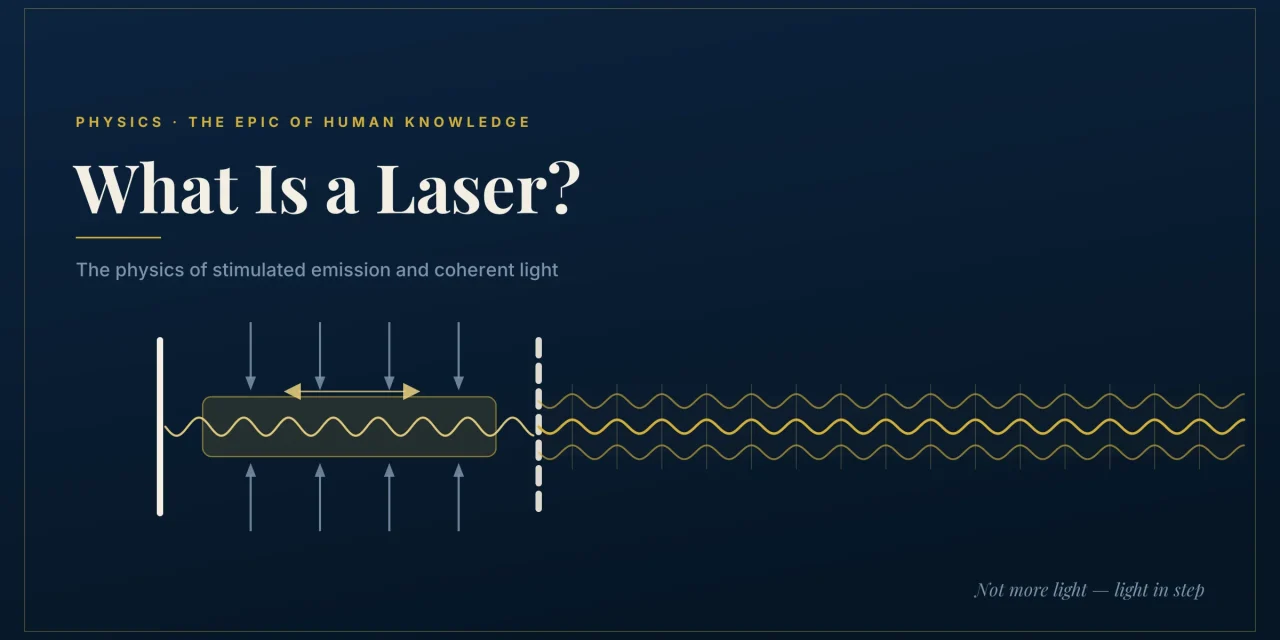
A laser is a device that produces light by stimulated emission: an incoming photon triggers an excited atom to release a second photon identical in wavelength, phase, polarization and direction. To make this dominate over absorption, the material must be driven into population inversion, a non-equilibrium state where more atoms occupy the upper energy level than the lower one. Mirrors then feed the light back through the material repeatedly, so one frequency builds up and emerges as a narrow, coherent beam.
Three ingredients are therefore indispensable and together form the shortest honest description of what a laser contains. A gain medium supplies the atoms, ions or molecules that will emit. A pump supplies the energy that drives those atoms into the upper state, whether by light, electric discharge, chemical reaction or current injection. And an optical cavity, usually a pair of mirrors, returns light to the medium repeatedly so the amplification compounds instead of escaping after a single pass.
The Third Process Einstein Needed
The physics begins with a paper that was not about lasers and could not have been. In 1917 Einstein published Zur Quantentheorie der Strahlung in Physikalische Zeitschrift, having circulated the argument the previous year. His target was Planck’s blackbody radiation law, which he wanted to derive from statistical assumptions about how atoms exchange energy with a radiation field instead of the ad hoc reasoning that had produced it.
Einstein considered a gas of atoms with discrete energy levels in equilibrium with radiation and asked what processes kept that equilibrium stable. Two were familiar: an atom can absorb a photon and climb to a higher level, and an excited atom can spontaneously drop back down and emit one. Einstein found these two alone would not reproduce Planck’s law. Instead, they gave the older Wien distribution, which experiments had shown to fail at long wavelengths. A third process was required, in which radiation already present induces an excited atom to emit. He called it stimulated emission and assigned the three processes probability coefficients physicists still call the Einstein A and B coefficients.
Einstein did not predict a machine. He introduced stimulated emission because without it thermodynamic bookkeeping did not balance, and the historical record suggests he regarded the second half of the same paper, on the momentum an atom recoils with during emission and the directional character of radiation quanta, as the more significant result. He founded laser physics only in retrospect and only in the sense that every later device rests on a term he was obliged to invent for other reasons. Forty-three years separated the equation from the ruby rod.
One detail of Einstein’s result mattered enormously and is why a laser is harder to build than it sounds. He showed the coefficients governing stimulated emission and absorption are locked together, each weighted by the statistical weight of its level.
\[ g_1 B_{12} = g_2 B_{21} \]
Where the two levels are non-degenerate, so that \( g_1 = g_2 \), this reduces to plain equality: an atom in the lower state is as likely to swallow a passing photon as an atom in the upper state is to be triggered into releasing one. Whether a beam grows or shrinks through a material depends on nothing but how the atoms are distributed between the two states.
Why No Two-Level System Can Ever Lase
In any material at thermal equilibrium, the upper level is the emptier one. The populations follow the Boltzmann distribution, which for two levels separated by energy \( \Delta E \) at temperature \( T \) weights each level by its statistical weight \( g \).
\[ \frac{N_2}{N_1} = \frac{g_2}{g_1}\,e^{-\Delta E / k_B T} \]
What matters for gain is not the raw headcount but the population per state, \( N_2/g_2 \) against \( N_1/g_1 \), and at equilibrium that comparison always favors the lower level. For a transition in the visible range at room temperature the exponential is brutal, so the excited population is vanishingly small. Shine light into such a material and absorption wins overwhelmingly; the beam is attenuated, which is the ordinary behavior of glass, air and everything else. Amplification requires the opposite arrangement, \( N_2 \gt N_1 \), called population inversion. Because no equilibrium state can produce it, inversion must be imposed and maintained from outside.
Here Einstein’s equality bites. Suppose you try to create inversion in a material with only two levels by pumping it with light at the transition frequency. Every photon you send in is as likely to stimulate an excited atom downward as to lift a ground-state atom upward. As the upper population grows, the downward process grows with it, and the two rates converge. The best achievable outcome is equality of the two populations, never inversion. The obstacle is structural, not technical: the symmetry Einstein derived forbids it. The precise statement matters because it is often stretched too far. What is ruled out is steady-state inversion between two levels pumped on the lasing transition itself. Lasing without inversion, where gain comes from atomic coherence rather than a population majority, is an established line of research in multi-level systems. None of it rescues the simple two-level picture.
The escape is to use more levels. In a three-level scheme, the pump lifts atoms from the ground state to a broad upper band from which they decay rapidly into a metastable state, an excited level with an unusually long lifetime where population can accumulate instead of leaking away immediately. The lasing transition then runs from that metastable level back down to the ground state. Maiman’s ruby is exactly this: chromium ions in a sapphire lattice, pumped by a flashlamp through absorption bands in the blue and green, accumulating in a metastable level, and emitting at 694.3 nanometers in the deep red.
Three-level schemes carry a punishing cost. Because the lower lasing level is the ground state where almost every atom starts, inversion demands pumping more than half the entire population out of it, which is why the first laser ran in pulses rather than continuously. Four-level schemes, used by neodymium-doped crystals and, as a working idealization, by the helium-neon laser at 632.8 nanometers, place the lower lasing level slightly above the ground state, where it stays nearly empty because atoms drain out rapidly. Inversion is then achieved against an almost empty level, the threshold pump power falls sharply, and continuous operation becomes practical. The idealization deserves naming as one: in the helium-neon laser the emptied level feeds a metastable state that clears only slowly, by collisions with the capillary wall, and that step is the real bottleneck in the cycle.
The Mirror Trap That Makes a Beam
Population inversion gives a material gain: light passing through it leaves stronger than it entered. On its own this produces an amplifier, not a beam. A single pass through a few centimeters of inverted medium multiplies the light by a modest factor and that is all. What converts gain into the thing people recognize is feedback, and feedback is what the laser cavity provides.
Place the gain medium between two facing mirrors and light bounces back and forth, amplified on every crossing. One mirror is partially transmitting, so a fraction of the circulating light escapes as usable output; Maiman’s ruby rod had its end faces silvered for this purpose. The cavity does more than accumulate intensity. Because only wavelengths that fit a whole number of half-waves between the mirrors survive repeated round trips without destroying themselves by interference, the cavity selects a narrow set of frequencies from the broader range the medium could emit, and the geometry of the mirrors fixes the shape of the beam. That is why laser light is directional at all.
Oscillation begins only when gain exceeds loss. Every round trip loses light through the output mirror, absorption, scattering, and diffraction at the edges of the optics. Below the point where amplification compensates all this, nothing happens beyond ordinary fluorescence. Above it, a single spontaneously emitted photon traveling along the cavity axis seeds an avalanche of stimulated copies that builds until the medium cannot supply gain fast enough. That threshold is the dividing line between a glowing rod and a laser, and the most practical answer to what is a laser as opposed to a merely bright lamp.
This brings us to the misnomer. The acronym promises light amplification, but a device that generates its own light from spontaneous emission inside a resonator is not an amplifier. It is an oscillator, the optical counterpart of an electronic oscillator built from an amplifier with positive feedback, and specialists distinguish laser amplifiers from laser oscillators. The observation has long been made, half in jest, that LOSER, for light oscillation by stimulated emission of radiation, would describe most of these devices more accurately. Almost everything called a laser in ordinary speech, from a pointer to a surgical instrument, is an oscillator.
The Race to the First Beam and the Myths It Left
The route from Einstein’s coefficient to Maiman’s ruby ran through microwaves. In 1951 Charles Townes conceived using stimulated emission at microwave frequencies inside a resonant cavity, and working at Columbia with James Gordon and Herbert Zeiger he built an ammonia device that first operated in 1953 and whose results were published in 1954. They named it the maser, for microwave amplification by stimulated emission of radiation. It worked and immediately raised the question of whether the same trick could be pushed to the vastly shorter wavelengths of visible light.
Three independent attempts at that question converged in little more than a year. On November 13, 1957, Gordon Gould, a graduate student at Columbia, wrote out his design in a notebook headed with calculations on the feasibility of a LASER, light amplification by stimulated emission of radiation. That heading is the first recorded use of the word, and Gould had the pages notarized. In December 1958, Arthur Schawlow and Townes published a detailed theoretical proposal in Physical Review titled “Infrared and Optical Masers”; they had filed a patent that July, granted on March 22, 1960. At the Lebedev Institute in Moscow, Nikolai Basov and Alexander Prokhorov had been working the same territory from a different direction, proposing a three-level pumping scheme in 1955. Then Maiman, who had been told by others that ruby fluoresced too inefficiently to work, measured it himself, concluded otherwise, and built the device that actually produced a beam.
What followed is a useful corrective to the idea that inventions have single authors. Maiman’s announcement was rejected by Physical Review Letters; a shorter version appeared in Nature in August 1960, after Hughes had announced the result at a press conference at the Delmonico Hotel in New York on July 7. The 1964 Nobel Prize in Physics went to Townes, Basov and Prokhorov for the quantum electronics underlying the maser and laser principle; Maiman, who built the first working one, did not share it. Gould spent decades in litigation, and in 1973 a United States court found the Schawlow-Townes patent too general; his own principal patent was issued in 1977, twenty years after the notebook.
The invention also produced a line that has outlived most people in this story. The laser was called a solution looking for a problem, and the joke circulated for years. Its authorship is less settled than it sounds: historian Jeff Hecht attributes it to D’Haenens, while the earliest printed versions, from 1964, put it in Maiman’s mouth. Either way it was not original, the same phrase having appeared in 1951 in the title of a review of a book on atomic power. What makes it worth remembering is that it was accurate at the time and spectacularly wrong within a decade, which is a more interesting fact about forecasting than about lasers.
What Laser Light Actually Is
The properties that make laser light useful all descend from the same source: stimulated emission produces photons that copy the one that triggered them. Because the copies share a phase, the output is coherent, and coherence has two independent senses that are often collapsed into one. Temporal coherence describes how long the wave keeps a predictable phase relationship with itself, and it is set by the spectral width of the emission through the coherence length \( L_c \approx \lambda^2 / \Delta\lambda \). Spatial coherence describes phase agreement across the width of the beam at a single instant, and it is what allows laser focusing down to a spot limited only by diffraction.
Both of these are routinely overstated. Laser light is extremely monochromatic but never perfect: every emission line has a finite width, broadened by the motion of emitting atoms, the finite lifetime of the states, and the properties of the cavity. The fluorescence line of ruby is about half a nanometer wide at room temperature, and that width set the gain band Maiman had to work inside. A laser emits more narrowly than its own gain line, and it was precisely that narrowing above threshold that told him the device had begun to lase. Even so, no laser reaches a single frequency: a stabilized modern source whose linewidth is measured in kilohertz still emits over a range, not a point. Nor is a beam perfectly parallel: diffraction guarantees any beam of finite width spreads, and the best a laser achieves is the diffraction limit, small but not zero. The familiar image of a visible shaft of light crossing a room is misleading too. What the eye registers is light scattered sideways by dust or smoke, not the beam itself, which carries its energy forward and would be invisible from the side in clean air.
Understanding what a laser does differently therefore means being precise about the comparison. Asked plainly, what is a laser has a deflationary answer: a laser is light of a very particular kind, not a different substance and not a beam of unlimited concentration. It is ordinary electromagnetic radiation whose photons have been forced into agreement by a process Einstein wrote down to balance an equation, in a material driven far from equilibrium, inside a box of mirrors that sends the light back through the gain again and again until one frequency wins. The acronym names the wrong half of that mechanism. The physics underneath it, in which photons are created and destroyed in identical copies, belongs to the formalism of quantized fields explored in Quantum Mechanics Advanced, where the operators that make and annihilate photons are the mathematical machinery behind every line of this account.
What laser light offers, in the end, is not power but order. A hundred-watt bulb radiates more energy than most laboratory lasers. What it cannot do is put that energy into a single wavelength, a single direction and a single phase, and it is order rather than quantity that cuts steel, carries internet traffic down a fiber,
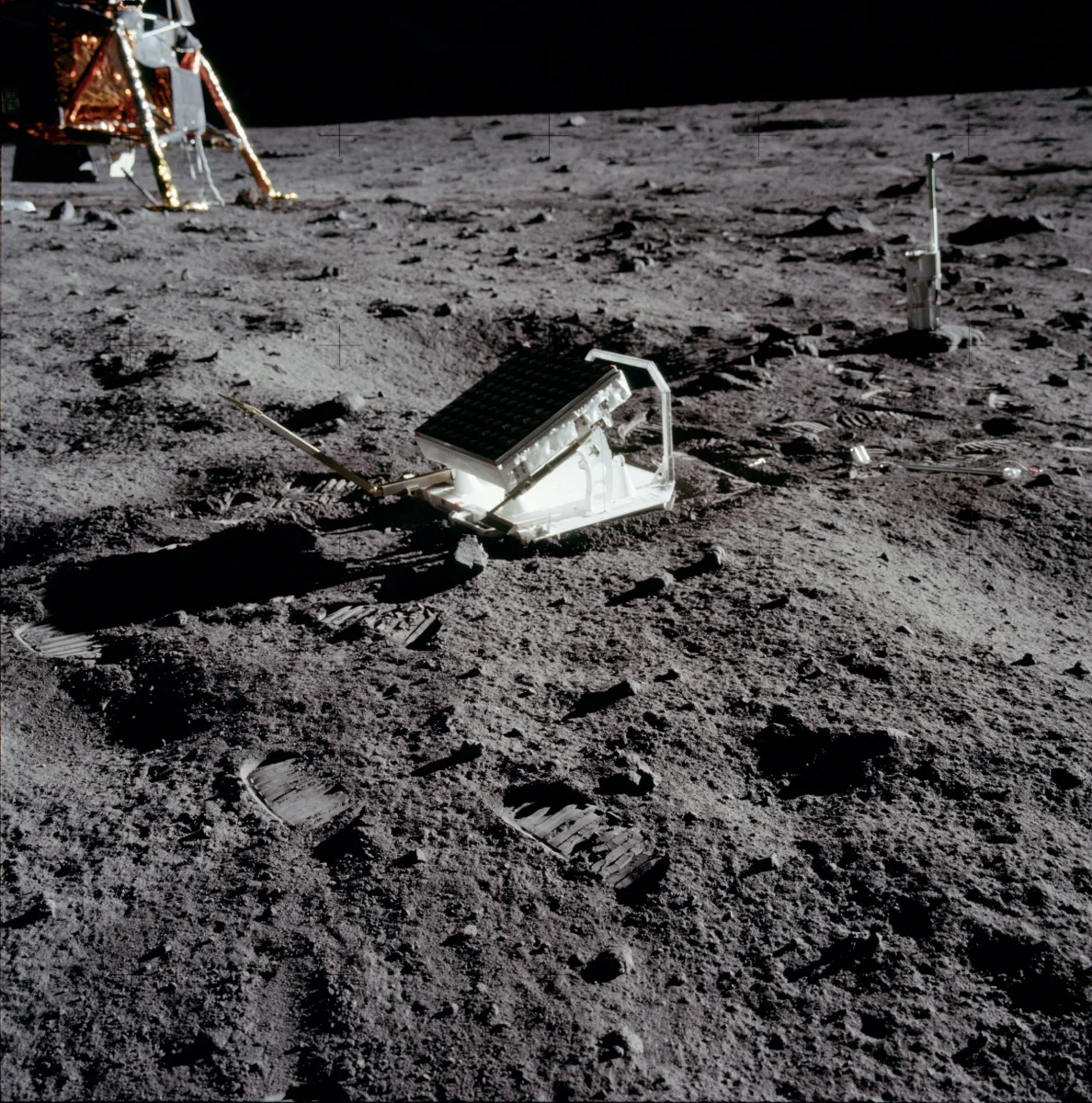
Image: NASA (AS11-40-5952), public domain.
The retroreflector panel left on the Moon in July 1969, with the lunar module standing behind it. The ground stations that first caught its echo fired pulses from ruby lasers — the same material as the rod in Malibu nine years earlier.
measures the distance to the Moon, and cools atoms to within millionths of a degree of absolute zero. Everything the laser turned out to be good for followed from that one asymmetry, which is why the solution found so many problems so quickly once anyone bothered to look.
References
- Einstein, “Zur Quantentheorie der Strahlung,” Physikalische Zeitschrift, vol. 18 (1917), pp. 121–128.
- H. Maiman, “Stimulated Optical Radiation in Ruby,” Nature, vol. 187 (1960), pp. 493–494.
- L. Schawlow and C. H. Townes, “Infrared and Optical Masers,” Physical Review, vol. 112, no. 6 (1958), p. 1940.
- P. Gordon, H. J. Zeiger and C. H. Townes, “Molecular Microwave Oscillator and New Hyperfine Structure in the Microwave Spectrum of NH3,” Physical Review, vol. 95 (1954), p. 282.
- E. Siegman, Lasers (University Science Books, 1986), on the distinction between laser amplifiers and laser oscillators.
American Physical Society, “December 1958: Invention of the Laser”, APS News.
HRL Laboratories, “The First Laser,” archival account of the demonstration at Hughes Research Laboratories, Malibu, May 16, 1960, including Maiman’s own description of the output trace (hrl.com/about/laser).