Contents
A Slim Book with Big Cosmic Ambitions
You have seen Astrophysics for People in a Hurry on every airport bookshelf, every “recommended reads” list, and probably on the nightstand of at least one friend who swears it changed how they see the night sky. Neil deGrasse Tyson’s compact bestseller, published by W. W. Norton in 2017, promises to distill the biggest ideas in modern astrophysics into something you can absorb during a lunch break. But does it deliver? Is this the right entry point into the cosmos for you, or should you spend your time and money — elsewhere?
This review gives you an honest, chapter-aware assessment of what the book covers, how well it communicates, where it falls short, and who will get the most out of it. Whether you are a curious adult who has not taken a science class in years, a student looking for supplementary reading, or someone deciding between this book and a more rigorous introduction to astrophysics for people serious about going deeper, the next few minutes should settle the question for you.
The Short Verdict
Astrophysics for People in a Hurry by Neil deGrasse Tyson is a genuinely entertaining, well-written overview of modern astrophysics that covers an impressive range of topics — from the Big Bang and dark matter to exoplanets and the cosmic perspective — in roughly 200 pages. It is best suited for readers with little or no background in physics who want a taste of the big ideas, delivered with personality and wit. It is not a textbook, not a deep dive, and not a substitute for a structured course.
If you want a single, accessible book that makes you feel smarter about the universe in a weekend, this is a strong choice. If you want to actually learn astrophysics — to solve problems, engage with the mathematics, or build a foundation for further study — you need something else. The book earns its popularity honestly, but you should know exactly what it is and what it is not before you buy it.
What Makes a Good Popular Science Book — and What to Expect Here
A good popular science book does three things simultaneously: it conveys real, substantive scientific ideas without distorting them; it makes those ideas feel vivid and meaningful to a non-specialist reader; and it respects the reader’s intelligence without demanding specialized training. The best examples — Carl Sagan’s Cosmos, Richard Feynman’s QED, Brian Greene’s The Elegant Universe — manage to balance accessibility with depth, leaving readers not just entertained but genuinely more informed. The worst examples sacrifice accuracy for wow-factor, or spend so many pages on the author’s personality that the science gets lost.
Astrophysics for People in a Hurry by Neil deGrasse Tyson falls closer to the good end of this spectrum, though its brevity creates trade-offs worth understanding. Tyson, who directs the Hayden Planetarium in New York City, is arguably the most visible science communicator in the United States. He brings decades of experience explaining cosmic phenomena to general audiences, and his voice — conversational, witty, occasionally grandiose — is recognizable from television, podcasts, and social media. The book reads like an extension of that public persona: warm, confident, and eager to provoke wonder. Whether that voice delights or occasionally grates depends on your taste, and this review will address that honestly.
The book contains twelve short chapters, each largely self-contained, covering topics that range from the first moments after the Big Bang to the philosophical implications of our place in the cosmos. There are no equations, no problem sets, and no bibliography for further study — three details that tell you a great deal about what the book is designed to do and what it deliberately leaves out.
What the Book Covers — and How Well It Covers It
The opening chapter plunges straight into the first seconds after the Big Bang, tracing the emergence of fundamental forces and particles in a compressed, energetic narrative. Tyson handles this notoriously difficult topic with real skill, giving the reader a sense of the staggering temperatures, timescales, and phase transitions involved without ever pausing for a mathematical aside. He conveys the essential idea — that the universe’s earliest moments determined the physical laws and particle zoo we observe today — in a way that feels both dramatic and scientifically responsible. It is one of the strongest chapters in the book, and it sets a pace that the rest of the work mostly sustains.
From there, the book moves through a tour of major astrophysical themes. Chapters on dark matter and dark energy are among the most important for a general reader, since these topics dominate modern cosmology yet remain poorly understood even by many educated people. Tyson does a good job conveying the observational evidence — galaxy rotation curves, the accelerating expansion of the universe — and he is honest about how much remains unknown. He does not pretend that dark matter is a solved problem, which is a mark of intellectual integrity that some popular treatments lack.
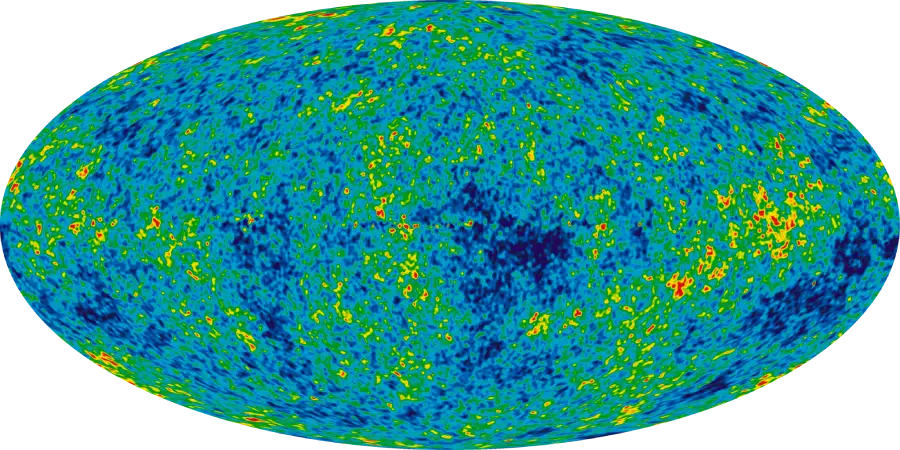
A chapter on the cosmic microwave background radiation manages the impressive feat of making a map of faint microwave signals feel genuinely exciting. Tyson explains why this relic radiation from the early universe is one of the most important pieces of evidence in all of cosmology, and he does so without dumbing down the core physics. Similarly, his treatment of the periodic table — tracing the origin of chemical elements from stellar nucleosynthesis to supernova explosions — is vivid and informative, connecting abstract nuclear physics to the tangible fact that the atoms in your body were forged inside dying stars.
The Oldest Light in the Universe
This is the map Tyson describes in the book — the oldest light in the universe, its faint temperature variations marking the seeds from which every galaxy eventually grew.
Image: NASA / WMAP Science Team, public domain.
The book also addresses the search for life beyond Earth, the nature of light across the electromagnetic spectrum, and the large-scale structure of the universe. Each chapter functions almost like a standalone essay. This makes the book easy to pick up and put down but leaves little narrative arc connecting one topic to the next. If you like a building argument where each chapter deepens what came before, this structure may feel fragmented.
The final chapter, “Reflections on the Cosmic Perspective,” is the most explicitly philosophical section, and it is where Tyson’s rhetorical instincts are on fullest display. He argues that understanding our cosmic insignificance should inspire humility, cooperation, and a sense of shared humanity. It is stirring prose, and for many readers it will be the emotional high point of the book. Others may find it somewhat sermon-like, a tendency that occasionally surfaces in Tyson’s public communication more broadly.
Where the Book Falls Short
The most significant limitation of Astrophysics for People in a Hurry is, paradoxically, the very quality that makes it appealing: its brevity. At roughly 200 pages of generously spaced text, the book cannot go deep on any single topic. Dark energy gets a chapter, but a reader who finishes it will not have a clear picture of the competing theoretical models or the specific observational programs designed to constrain them. Stellar evolution is sketched rather than explained. General relativity, the theoretical backbone of modern cosmology, appears as an occasional guest star rather than a sustained subject.
The absence of any suggested reading list or bibliography is a missed opportunity. For a book explicitly aimed at people who are curious but busy, pointing them toward the logical next step would have been a tremendous service. You finish the book knowing a little about a lot but without a clear path for going further. This is a gap that more thoughtful popular science books routinely fill.
Tyson’s voice is another potential drawback, depending on your preferences. His humor is frequent and generally effective, but some moments let the wisecracking persona edge out the science. A few passages feel more like material from a talk-show appearance than from a considered written work. This is a minor complaint. The book is fun to read, and Tyson’s enthusiasm is genuine. But readers who prefer the quieter authority of a writer like Sagan or the rigorous playfulness of Feynman may occasionally wish Tyson would step back and let the universe speak for itself.The book has attracted both enthusiastic praise and measured criticism. The praise tends to focus on its accessibility and Tyson’s charm; the criticism tends to focus on its lack of depth and its occasionally self-congratulatory tone. Both responses are fair. Kirkus Reviews called it “a sublime introduction to some of the most exciting ideas in astrophysics that will leave readers wanting more.”
Who Should Read This — and Who Should Look Elsewhere
If you are a complete newcomer to astrophysics — someone who did not study physics beyond high school, or who has not thought much about cosmology — this book is an excellent starting point. It will give you a working vocabulary, a sense of the major open questions, and enough context to follow news about space discoveries with genuine comprehension. It is the kind of book you can read on a plane and arrive at your destination feeling legitimately more informed about the universe. For that reader, the book earns a strong recommendation.
If you are a college student considering a physics or astronomy major, the book may spark your enthusiasm but will not prepare you for coursework. Think of it as motivation, not preparation. You will need actual textbooks with equations, derivations, and problem sets for that purpose. In this sense, Astrophysics for People in a Hurry is a gateway, not a destination.
Parents and educators should also know about Astrophysics for Young People in a Hurry, a companion edition adapted for younger readers. It covers much of the same territory in language calibrated for middle-school audiences, and it includes illustrations that the adult version lacks. If you are considering a gift for a scientifically curious teenager, the young-readers edition is worth evaluating alongside the original; some teens will prefer the adult version’s more sophisticated tone, while others will benefit from the adapted text’s pacing and visual elements.
If you have already read a few popular astrophysics books — say, anything by Kip Thorne, Sean Carroll, or Katie Mack — you will find relatively little new material here. The book does not break ground in its explanations; it packages well-known ideas with admirable clarity and personality, but it rarely offers a perspective you will not have encountered elsewhere. For the reader who already has a shelf of popular cosmology, this is a pleasant but redundant addition.
Finally, if what you want is genuine depth — a real understanding of general relativity, quantum field theory, or observational cosmology — this is emphatically not the right book. No 200-page trade paperback can deliver that. You should look toward structured introductory texts or university-level courses, and you can explore our broader Resources section for guidance on where to go next.
What to Do Next
If this review has convinced you the book is right for you, getting a copy is straightforward. It is widely available in hardcover, paperback, e-book, and audiobook formats from all major retailers. The audiobook, narrated by Tyson himself, is worth special mention. His vocal delivery is polished from years of broadcasting, and many readers report that the audiobook is the best way to experience the material. It is an ideal companion for a commute or a long walk.
If you read the book and want more, your next step depends on your goals. For another accessible but slightly more substantive popular treatment, consider Sean Carroll’s The Big Picture or Katie Mack’s The End of Everything. For a younger reader excited by the material, Astrophysics for Young People in a Hurry provides a tailored version of the same cosmic tour. For those ready to engage with actual physics at an introductory level, a first-year university astronomy textbook will give you the quantitative foundation that Tyson’s book deliberately omits.
A question that frequently arises: is Astrophysics for People in a Hurry good for someone with no science background at all? Yes — this is precisely the audience the book is designed for. Tyson assumes no prior knowledge of physics, chemistry, or mathematics. If you can read a newspaper, you can read this book. The only prerequisite is curiosity.
The Final Word
Astrophysics for People in a Hurry earns its place on the bestseller lists not because it is the most rigorous or the most original popular science book available. Still, it does something genuinely valuable: it makes the biggest ideas in the universe feel approachable, exciting, and relevant to everyday life. Neil deGrasse Tyson writes with warmth and confidence, and his book delivers exactly what its title promises — a fast, engaging tour of the cosmos for readers who do not have time or inclination for a deep dive.
Know what you are getting. This is a conversation starter, not a textbook. It is a doorway, not the room behind it. Within those limits, it is one of the better doorways available, and for the right reader — curious, busy, new to the subject — it is easy to recommend with confidence.
References
Neil deGrasse Tyson, Astrophysics for People in a Hurry (W. W. Norton, 2017).
Hayden Planetarium, American Museum of Natural History.
Goodreads community reviews: https://www.kirkusreviews.com/book-reviews/neil-degrasse-tyson/astrophysics-for-people-in-a-hurry/