The Question That Split Physics in Two
In the autumn 1927, the most celebrated physicists gathered at the Hôtel Métropole in Brussels for the fifth Solvay Conference. The photograph from that meeting has become iconic: Einstein, Bohr, Heisenberg, Schrödinger, Dirac, Born, Planck, and others, frozen in formal rows.
But beneath that composed exterior, a war of ideas was fought that would define the philosophy of quantum mechanics for the rest of the century and beyond. What did their astonishingly successful equations actually mean? Did the mathematics describe an underlying physical reality or merely predictions about what experimenters would observe? Was nature, at its deepest level, fundamentally random?
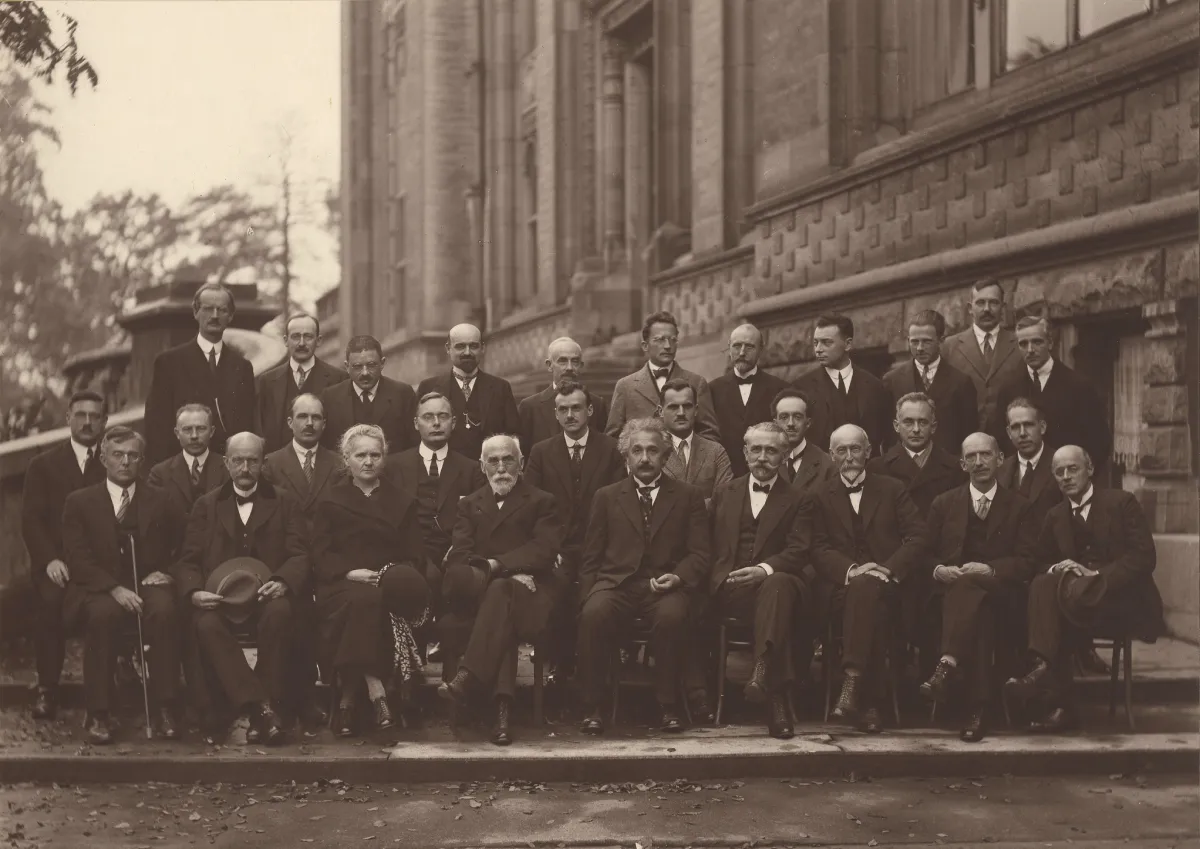
The fifth Solvay Conference, October 1927. Twenty-nine physicists — seventeen of them future Nobel laureates — gathered in Brussels to debate the meaning of the new quantum theory. Photo: Benjamin Couprie, Institut International de Physique Solvay (public domain).
The Core of the Quarrel
Quantum mechanics is the most successful predictive framework in the history of science, yet its founders could not agree — and physicists still cannot agree — on what it says about reality. The philosophy of quantum mechanics asks whether the theory describes a world that exists independently of observation, or only the results of measurements, and different interpretations offer radically different answers with no experiment yet devised to distinguish between them.
That single unresolved question—does the quantum formalism describe reality or just our knowledge of it?—has generated at least a dozen competing interpretations, each consistent with every known experiment and each painting a profoundly different picture of what exists. The debate is not about the math, which everyone agrees works spectacularly. It is about what the math is telling us. The fact that this question remains open is one of the most remarkable features of modern science.
The World the New Physics Overthrew
To understand why interpreting quantum mechanics became so contentious, you must understand the world it replaced. For more than two centuries after Newton, physics rested on assumptions so deeply embedded that most scientists did not see them as assumptions. The universe was deterministic: given complete knowledge of every particle’s present state, the future could be calculated with certainty. Physical properties—position, momentum, energy—were attributes objects possessed at all times, whether measured or not. Measurement was a passive act, a window onto a pre-existing reality. The relationship between quantum mechanics and philosophy barely existed as a distinct field because classical physics seemed to need no philosophical interpretation. The equations spoke for themselves.
This confidence was not naive. Classical mechanics sent cannonballs along predicted arcs, tracked planetary orbits with extraordinary precision, and enabled the industrial revolution. Thermodynamics, electromagnetism, and the kinetic theory of gases all fit within a framework where nature was a vast clockwork and the physicist’s job was to read its gears. Even when debates arose about the ether or the statistical character of entropy, they concerned details within a broadly shared picture of reality: material, deterministic, observer-independent.
The first cracks appeared at the turn of the twentieth century. Max Planck’s 1900 proposal that energy came in discrete quanta was, by his own account, an act of desperation to solve the blackbody radiation problem, not a deliberate revolution. Einstein’s 1905 paper on the photoelectric effect pushed the idea further by treating light as particles—photons—but even Einstein saw this as a provisional, almost heuristic move. When Niels Bohr proposed his model of the hydrogen atom in 1913, with electrons jumping between fixed orbits without traversing the space between, the strangeness deepened. Each step was taken cautiously, almost reluctantly, in response to experimental facts the old framework could not accommodate. No one set out to overthrow the classical worldview. The evidence dragged them.
The Debate That Would Not Die
The full crisis arrived in the mid-1920s when Werner Heisenberg and Erwin Schrödinger, working independently and from very different philosophical instincts, produced two mathematical frameworks: matrix mechanics and wave mechanics, which turned out to be formally equivalent. Heisenberg’s approach, developed in 1925, dealt in observable quantities and avoided visualization. Schrödinger’s wave equation, published in 1926, offered a more intuitive picture: particles as waves described by a continuous mathematical function. But what was waving? Schrödinger initially hoped it was a real physical wave, a smeared-out distribution of charge. Max Born, in 1926, offered a different answer: the wave function described not the particle itself but the probability of finding the particle in a given state upon measurement. This was a radical move. Probability had entered physics before—in statistical mechanics—but there it was a shortcut, a way of managing ignorance about a deterministic underlying reality. Born’s probability was different. It seemed to be fundamental.
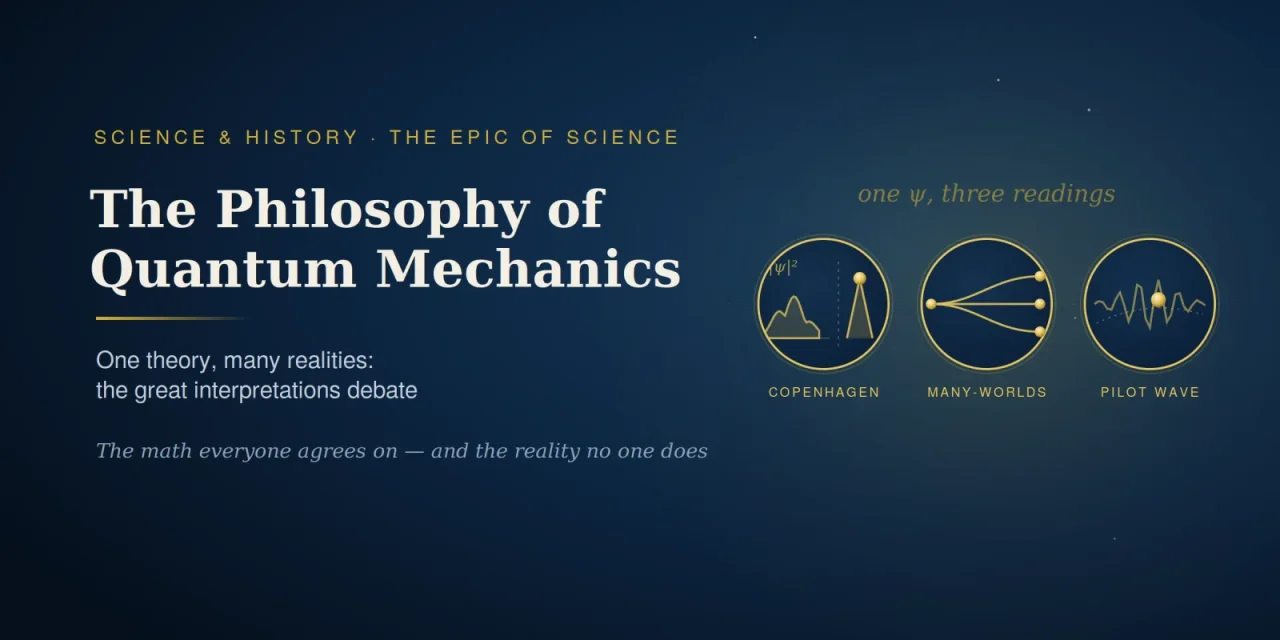
It was Niels Bohr, along with Heisenberg and others working in Copenhagen, who forged these insights into what became known as the Copenhagen interpretation — though historians such as Adam Becker have emphasized that this label covers a range of views rather than a single monolithic doctrine. At its core, the Copenhagen interpretation held that the quantum formalism does not describe an objective reality independent of measurement. Before a measurement is made, it is meaningless to ask what value a particle’s position or momentum “really” has. The act of measurement does not reveal a pre-existing fact; it participates in creating the outcome. As the Stanford Encyclopedia of Philosophy’s entry on the Copenhagen interpretation explains, Bohr’s own version of this view was subtle. It evolved, grounded in his principle of complementarity — the idea that quantum objects exhibit mutually exclusive properties (wave-like and particle-like behavior, for instance) depending on the experimental arrangement, and that no single classical picture can capture the whole truth.
Einstein resisted this view almost from the beginning, and the famous Bohr-Einstein debates — conducted in person at the Solvay conferences of 1927 and 1930, and continued by correspondence for decades — remain among the most celebrated intellectual confrontations in the history of science. Einstein did not dispute the mathematical predictions. What he disputed was the claim that quantum mechanics was a complete description of physical reality. His deepest objection was philosophical: he could not accept that the universe was, at bottom, governed by irreducible chance. The line often attributed to him — “God does not play dice” — appears in various forms in his correspondence, most notably in a December 1926 letter to Born, where he wrote in German that he was convinced “He does not play dice” (daß der nicht würfelt) — the same letter in which he spoke of “the secret of the Old One.” It captures a genuine conviction, though it is often quoted more neatly than Einstein actually wrote it.
In 1935, Einstein, Boris Podolsky, and Nathan Rosen published their famous EPR paper, arguing that quantum mechanics was incomplete because it could not simultaneously assign definite values to certain pairs of properties (like position and momentum) that, they argued, must both have real, determinate values. Bohr’s response, published the same year, rejected the EPR paper’s assumptions about what counts as “physical reality.” The exchange was civil but profound: two fundamentally different philosophies of science, each internally coherent, each claiming the authority of reason.
Meanwhile, a third path had already been sketched. In 1927, Louis de Broglie proposed a pilot wave theory at the very same Solvay Conference where Bohr’s views were gaining ascendancy. In de Broglie’s picture, particles were real, had definite positions at all times, and were guided by a real wave — restoring determinism and quantum ontology at the cost of a strange, nonlocal guiding field. The idea received a lukewarm reception, partly because of technical objections raised by Wolfgang Pauli, and de Broglie himself abandoned it for years. It was revived and extended by the American physicist David Bohm in 1952, who showed how a fully deterministic, hidden-variable theory could reproduce all the predictions of standard quantum mechanics. Bohm’s work was largely ignored or dismissed by the physics mainstream. As Adam Becker documents in What Is Real?, the reasons for this neglect were not purely scientific — they were sociological and political, intertwined with Cold War pressures and the institutional dominance of the Copenhagen school.
The most radical alternative appeared in 1957, when Hugh Everett III, a graduate student at Princeton, proposed what is now called the many-worlds interpretation. Everett’s idea was breathtaking in its simplicity and terrifying in its implications: the wave function never collapses. Every quantum measurement results in a branching of the universe into multiple branches, each realizing one possible outcome. There is no randomness, no special role for the observer — just an endlessly proliferating tree of equally real worlds. Everett’s thesis advisor, John Archibald Wheeler, supported the work but also brokered revisions to soften its language, and Bohr’s circle in Copenhagen received it coolly. Everett left academic physics shortly after, and his interpretation languished for years. It was the physicist Bryce DeWitt who, in the 1970s, championed and popularized the many-worlds idea, giving it the vivid name by which it is now known. David Deutsch, in The Fabric of Reality, later became one of its most prominent advocates, arguing that many worlds is the only interpretation that takes the quantum formalism seriously as a description of reality.
Has the Debate Been Settled?
The honest answer is: no. This is one of the most striking features of quantum physics and philosophy — a theory whose predictions have been confirmed to extraordinary precision, yet whose meaning remains genuinely contested among serious scientists and philosophers. No experiment performed to date can distinguish between the Copenhagen interpretation, the many-worlds interpretation, and the pilot wave theory; all three (and several others, including decoherence-based approaches, quantum Bayesianism or QBism, and relational quantum mechanics) reproduce the same empirical predictions. The debate is, in the strict sense, empirically underdetermined.
That said, the intellectual landscape has shifted significantly since the mid-twentieth century. The dominance of the Copenhagen interpretation, once so thorough that questioning it was sometimes treated as a mark of confusion rather than serious inquiry, has eroded considerably. John Bell’s celebrated 1964 theorem and the subsequent experimental tests of Bell inequalities—most famously by Alain Aspect and collaborators in the early 1980s and later with increasing rigor by others—demonstrated that no local hidden-variable theory can reproduce the predictions of quantum mechanics. This ruled out a large class of theories that Einstein might have preferred, though it did not rule out nonlocal hidden-variable theories like Bohm’s pilot wave. The result deepened rather than resolved the philosophical puzzle. Nature, it seemed, was either nonlocal or indeterminate or both, and the choice between these options was a matter of interpretation, not experiment.
Surveys of physicists — such as those conducted at conferences on the foundations of quantum mechanics — consistently show a plurality of views, with no single interpretation commanding a majority. Popular memory often presents the Copenhagen interpretation as the “standard” view, and in pedagogical contexts it remains dominant, but this reflects historical inertia and the sociology of physics education as much as any philosophical consensus. The many-worlds interpretation has gained significant support among cosmologists and quantum information theorists, while the pilot wave theory, once dismissed as a curiosity, has attracted renewed interest from both physicists and philosophers concerned with quantum ontology—the question of what, if anything, quantum theory says exists.
Historians have also complicated the narrative. The idea that Bohr “won” the debate with Einstein, once a commonplace of physics textbooks, looks far less clear-cut today. As Becker and other historians have argued, the marginalization of alternative interpretations owed as much to institutional power, personal authority, and the pragmatic culture of postwar physics as to the force of argument. Einstein’s objections, often caricatured as the stubbornness of an ageing classical thinker, are now widely recognized as deeper and more prescient than his contemporaries acknowledged.
Why It Still Matters
The debate over interpretations is sometimes dismissed as “mere philosophy”—a luxury that working physicists can safely ignore while they calculate. But this misunderstands both the history and the current state of physics. Every major advance in quantum foundations—Bell’s theorem, quantum decoherence, quantum information theory, quantum computing—has been driven, at least in part, by people who took the foundational questions seriously. David Deutsch has argued explicitly that his work on quantum computation was motivated by taking the many-worlds interpretation literally. The relationship between quantum mechanics and philosophy is not a sidebar to physics; it is, at crucial moments, its engine.
The debate also matters because it exposes something important about the nature of science itself. We are accustomed to thinking of science as a process that converges on truth — and in many domains it does. But the debate over interpretations shows that empirical success alone does not always determine what a theory means. The philosophy of quantum mechanics is a living reminder that science is a human activity, shaped by what people are willing to believe, what institutions reward, and what questions a culture considers worth asking. What is the philosophy of quantum mechanics? It is the field that asks what the most successful physical theory in history actually tells us about reality. It examines whether the quantum world is fundamentally random or deterministic, whether observation plays a special role in nature, and whether competing interpretations — Copenhagen, many worlds, pilot wave, and others — can ever be distinguished by experiment or remain forever a matter of philosophical commitment.
The Unfinished Argument
There is a temptation, in writing about the history of science, to find the ending — to identify the moment when the fog cleared, and the right answer stood revealed. The interpretation of quantum mechanics denies us that satisfaction. Nearly a century after the Solvay debates, the theory’s mathematical structure is not in dispute, its experimental predictions are confirmed beyond any reasonable doubt, and yet the most basic question — what is it telling us about what exists? — remains genuinely open. The physicists who built quantum theory were not confused. They understood the formalism better than anyone, and they still disagreed about what it meant. Their successors, armed with new theorems, new experiments, and new philosophical tools, continue to disagree.
Perhaps the deepest lesson of quantum physics and philosophy is not any particular interpretation but the fact that the question persists. It tells us that knowledge is not a warehouse of settled answers but an ongoing negotiation between evidence, imagination, and the stubborn limits of human understanding. The argument continues — and that, too, is part of the epic.
References
Stanford Encyclopedia of Philosophy — “Copenhagen Interpretation of Quantum Mechanics.” https://plato.stanford.edu/entries/qm-copenhagen/
David Deutsch, The Fabric of Reality (London: Allen Lane, 1997).
Adam Becker, What Is Real? The Unfinished Quest for the Meaning of Quantum Physics (New York: Basic Books, 2018).https://plato.stanford.edu/entries/qm-copenhagen/