Contents
- The Coin That Speeds Up as It Dies
- What Is Euler’s Disk?
- The Motion: What You Actually See
- The Physics: Angular Momentum, Precession, and Energy Dissipation
- The Finite-Time Singularity — A Debate in Nature
- Euler’s Disk vs. a Spinning Coin: What Is the Difference?
- Who Was Leonhard Euler?
- Applications, Records, and Curiosities
- A Toy That Contains a Universe
- References
The Coin That Speeds Up as It Dies
Spin a coin on a table and watch what happens. At first, it rotates smoothly, balanced on its rim. Then it begins to tilt, wobbling in wider circles. The sound starts low — a soft hum — then rises rapidly to a shrill, high-pitched whirring. The coin seems to accelerate as it falls, the motion becoming frantic and chaotic before it slams flat against the table in a sudden, dramatic stop.
This is one of the most counterintuitive phenomena in classical physics: an object that appears to speed up as it loses energy. When that object is an Euler’s disk — a precision-engineered chrome steel disk spinning on a concave mirror — the effect is so dramatic, prolonged, and mesmerizing that it has puzzled physicists, sparked debates in Nature, and captivated everyone from elementary school students to MIT professors.
What is really happening? Why does the precession rate increase as energy drains away? And what finally brings the disk to its abrupt, silent halt? This article explores the full physics of Euler’s disk — from the basics of angular momentum to a genuine mathematical singularity hiding inside a tabletop toy.
What Is Euler’s Disk?
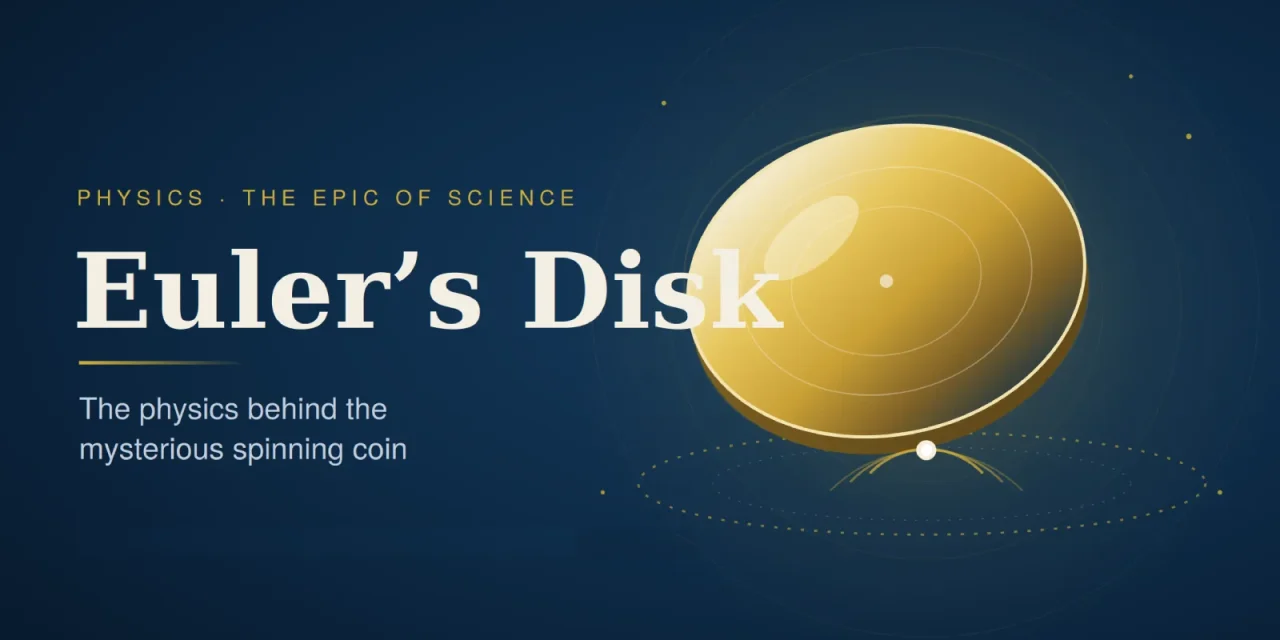
Euler’s disk is a trademarked scientific educational toy invented between 1987 and 1990 by Joseph Bendik, an engineer at the Hughes Aircraft Carlsbad Research Center in California. The story of its invention is a small gem of scientific curiosity: Bendik noticed the fascinating spinning motion of a heavy polishing chuck he set spinning on his desk during a lunch break. He became intrigued and spent years developing the phenomenon into a commercial product, first marketed by the Tangent Toy Company.
The commercial toy consists of a solid, homogeneous, chrome-plated steel disk — not hollow, not a ring, but a dense, uniform object. The disk measures 3 inches (7.6 cm) in diameter and half an inch (1.27 cm) thick, weighing approximately 730 grams (1.61 lbs). One edge is carefully machined to a smooth, precise radius. The disk comes with a concave mirror base, which provides an ultra-low-friction surface and keeps the disk from “wandering” off the edge — the gentle curve of the mirror acts as a natural boundary.
Bendik named the toy after the Swiss mathematician and physicist Leonhard Euler (1707–1783), whose work on the dynamics of rigid bodies laid the mathematical foundation for understanding this type of motion. The name is fitting: Euler spent decades developing the equations that describe exactly how a spinning disk moves through space.
One important clarification: any disk spun on a flat surface — including an ordinary coin — exhibits essentially the same type of motion as Euler’s disk. The difference is time. The precision engineering of the disk’s edge and the low-friction mirror base allow the motion to continue for up to two minutes, compared to a few seconds for a typical coin. This extended duration makes all the physics visible, turning a fleeting glimpse into a long, observable experiment.
The Motion: What You Actually See
To understand what is happening physically, it is important to be precise about the disk’s motion because it is often misunderstood. This is not a spinning top. The disk does not rotate around a fixed vertical axis. Instead, it rolls on its rim.
The sequence unfolds in stages. The disk is given a push and begins rolling on its circular rim, tilted at a significant angle relative to the table surface. The point of contact between the disk’s rim and the mirror traces circles on the surface: the disk’s own face rotates slowly on its axis, but it is the contact point that moves fast. Meanwhile the axis of symmetry of the disk sweeps out a cone shape around the vertical, a motion called precession.
Then the character of the motion changes. As energy is lost, the disk flattens toward the mirror, and the angle between the disk and the table — call it α — grows smaller and smaller. As α decreases, the precession rate increases dramatically: the contact point circles faster and faster, and the sound rises in pitch. In the final moment the disk is nearly horizontal, the contact point racing in tiny, frantic circles, the whirring sound reaching a crescendo — and then, suddenly, silence. The disk lies flat.
Video: “Euler’s disk” by Ankermast, via Wikimedia Commons, licensed under CC BY-SA 4.0. No modifications made to the original file.
The Physics: Angular Momentum, Precession, and Energy Dissipation
The Moment of Inertia — Why the Disk’s Solidity Matters
The first key physical fact: Euler’s disk is solid, homogeneous, and uniform. This is not a trivial detail. For a solid disk, the moment of inertia around its central axis is
\[ I = \frac{1}{2}mr^2 \]
Compare this to a ring or hollow disk, where all the mass is concentrated at the rim:
\[ I_{\text{ring}} = mr^2 \]
The solid disk therefore carries half the rotational inertia of a ring of the same mass and radius, distributing its mass toward the center. This distribution is part of what lets the commercial disk store and release its energy so smoothly over such a long settling time.
Precession and the Rising Whirr
As the disk rolls on its rim, the point of rolling contact P describes a circle with angular velocity Ω. In the idealized, non-dissipative theory, Ω is constant and the motion would persist forever — in stark conflict with what we actually observe. In reality, as the tilt angle α shrinks, the precession rate Ω grows without bound, following a power law as the disk approaches its final rest. This is the mathematical heart of the phenomenon: the geometry of a rolling disk forces the precession to accelerate as the disk flattens, which is why the whirring sound climbs in pitch right up to the abrupt stop.
The Finite-Time Singularity — A Debate in Nature
In a brief but influential letter to Nature on 20 April 2000, the mathematician H. K. Moffatt showed that the motion of Euler’s disk concludes in a finite-time singularity. As time t approaches a particular finishing time t₀, the precession rate Ω — in his model — diverges toward infinity. Moffatt argued that viscous dissipation in the thin layer of air trapped between the disk and the table was sufficient to account for the observed abruptness of the settling process.
The singularity is never actually reached in practice. The vertical acceleration required for Ω to truly diverge would exceed the acceleration due to gravity, so the disk loses contact with the surface before infinity can arrive. What we see is a quasi-singularity: a dramatic but finite acceleration, cut off at the last instant.
Moffatt’s letter sparked a lively international debate. Subsequent experiments — including some conducted in a vacuum — partially contradicted his explanation, showing that rolling friction, not air viscosity, is the dominant dissipation mechanism through most of the motion. The current scientific consensus is a nuanced picture: rolling friction dominates throughout most of the spin; air resistance becomes significant only in the very final instants, when the disk is nearly flat and the air layer is extremely thin; and micro-impacts caused by tiny geometric imperfections of the disk and surface also contribute, as later research has shown. Moffatt’s elegant theory was not the last word — but it was the spark that turned a desk toy into a decade of physics.
Euler’s Disk vs. a Spinning Coin: What Is the Difference?
As we noted earlier, any disk spun on a flat surface exhibits the same basic motion as Euler’s disk. So what makes the commercial toy special? The answer lies in precision engineering and material choice.
At 730 grams, the disk stores far more kinetic energy than a coin, and more energy means a longer spin. Its 3-inch diameter and half-inch thickness are chosen to optimize spin time, since the ratio of radius to thickness affects how energy is distributed between spinning and rolling. The rim is ground to a smooth, precise radius, because a rough edge would introduce additional rolling friction and shorten the motion. And the slightly concave mirror base both prevents the disk from wandering off the surface and provides a very smooth, low-friction contact — where a rough table would introduce far more rolling friction.
Want to try the experiment at home? Spin a large, thick coin (a 50-cent piece works well) on a smooth glass surface. You will see the same physics — the same precession acceleration, rising sound, and abrupt stop — compressed into a few seconds instead of two minutes.
Who Was Leonhard Euler?
The disk bears the name of one of the most extraordinary mathematicians in history. Leonhard Euler was born on April 15, 1707, in Basel, Switzerland, and died in Saint Petersburg, Russia, on September 18, 1783. In a productive career spanning more than six decades, he published more than 800 papers and books — a rate of roughly one mathematical paper every week of his adult life.
Euler made fundamental contributions to virtually every branch of mathematics known in the 18th century: analysis, number theory, graph theory, geometry, mechanics, optics, and astronomy. He introduced much of the mathematical notation still in use today — the function notation f(x), the constant e (Euler’s number), the symbol π for the ratio of a circle’s circumference to its diameter, and the imaginary unit i. His identity
\[ e^{i\pi} + 1 = 0 \]
is regularly voted the most beautiful equation in mathematics.
Most relevant to our story, Euler developed the foundational equations for the dynamics of rigid bodies — the mathematical framework for describing how a solid object moves, rotates, and precesses in three-dimensional space. These are exactly the equations needed to describe the motion of a spinning disk. Bendik named his toy well.
Euler continued producing mathematics even after losing sight in both eyes — first his right eye in 1738, and his left in 1766. He reportedly said that his blindness reduced distractions and allowed him to focus more completely on mathematics; his output actually increased after he went fully blind.
To explore more of Euler’s mathematical legacy, see our articles on Graph Euler Explained — Paths, Circuits and the Königsberg Bridge and Euler’s Theorem Explained — Number Theory, Graph Theory and Applications.
Applications, Records, and Curiosities
Euler’s disk has become a standard demonstration tool in physics education at the high school and university level. In a single object, it illustrates angular momentum, precession, energy dissipation, friction, and the concept of a mathematical singularity. It is the rare physical toy that simultaneously engages intuition and confounds it, making it an ideal starting point for discussion.
Researchers have also discovered that the sound emitted by the disk in its final phase — the rising whirr — is a remarkably accurate measurement tool. The frequency of the sound is directly related to the precession rate Ω, so by recording the sound with a smartphone microphone and analyzing the frequency spectrum, students can reconstruct the full time evolution of the precession and test whether it follows the predicted power law. This turns an ordinary desk toy into a precision physics instrument.
In a striking recent development, physicists have noted that the vibrations of the disk in its final phase share mathematical features with the gravitational waves emitted by merging black holes: both show frequency and amplitude increasing with time in a characteristic pattern. The analogy is imperfect — the physical mechanisms are entirely different — but the mathematical similarity is striking enough to appear in peer-reviewed publications.
As for endurance, on surfaces with very low friction coefficients such as Teflon, Euler’s disk has been recorded spinning for more than 51 seconds, while the mirror base included with the commercial toy typically yields spin times of 60 to 120 seconds.
A Toy That Contains a Universe
Euler’s disk is a remarkable object. On the surface, it is a chrome steel disk spinning on a mirror — a desk toy, a curiosity, a conversation piece. But contained within that simple setup is a rich collection of some of the deepest ideas in classical physics: the conservation of angular momentum, the geometry of precession, the competition between rolling friction and viscous dissipation, and a genuine mathematical singularity that the physical world refuses to actually reach.
It is also a story about science itself — about how a brief letter in Nature can spark international debate, about how careful experiments in a vacuum can overturn an elegant theory, and about how an engineer spinning a polishing chuck on his desk at lunchtime can stumble onto a problem that keeps physicists busy for decades.
And behind it all stands Leonhard Euler — blind, relentless, and endlessly productive — whose equations of rigid-body dynamics, written in the 18th century, perfectly describe a toy that would not be invented for another two hundred years. Science, as Euler might have said, is not finished yet.
References
Moffatt, H. K. (2000). Euler’s disk and its finite-time singularity. Nature, 404, 833–834.
Caps, H., et al. (2004). Rolling and slipping motion of Euler’s disk. Physical Review E.
Leine, R. I. (2009). Experimental and theoretical investigation of the energy dissipation of a rolling disk. Nonlinear Dynamics.
Várkonyi, P. L. (2017). Imperfections, impacts, and the singularity of Euler’s disk. Physical Review E.