Contents
- What Is a Diamond? The Stone That Shouldn’t Exist on the Surface
- The Single Idea That Explains Everything
- Two Faces of the Same Element
- Inside the Lattice: How Carbon Becomes Indestructible
- From Burning Diamonds to Building Them: The Story of Discovery
- Why It Matters: Far More Than a Gemstone
- A Crystal Caught in Time
- References
What Is a Diamond? The Stone That Shouldn't Exist on the Surface
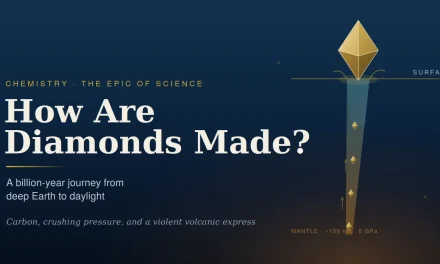
Pick up a diamond and you are holding something that has no business being in your hand. It formed perhaps a hundred miles below your feet, where mantle pressure and heat crush carbon into its densest form. So what are diamonds made of? By every thermodynamic argument, this stone should have reverted to graphite, the soft, dark stuff inside a pencil, the moment it reached the surface. Yet here it sits, transparent, impossibly hard, catching light as no other natural substance can.
The answer is simple and astonishing: a diamond is nothing but carbon, the same element that forms soot, charcoal, and the graphite in your morning pencil. There is no secret ingredient or exotic mineral hidden inside the lattice. The entire spectacle — the hardness, the fire, the near-indestructibility — arises from how carbon atoms arrange themselves under unimaginable pressure and heat, then survive a violent journey to the surface in a state that is not even thermodynamically stable at ambient conditions.
The Single Idea That Explains Everything
A diamond is pure carbon in which every atom is bonded to four neighbors in a rigid, three-dimensional tetrahedral lattice — the strongest arrangement of covalent bonds found in any natural material. This geometry, locked in place under extreme mantle pressures and preserved by the slowness of the reverse transformation, is what makes a diamond a diamond.
So what are diamonds made of? Carbon and nothing more, yet everything else — the hardness that can scratch any other mineral, the remarkable optical brilliance, the thermal conductivity that dwarfs metals — follows directly from that architecture. Understanding diamond means understanding why the same element can be the darkest smear on a page or the most dazzling stone on Earth, depending on how its atoms are connected. The rest of this article earns that understanding, atom by atom.
Two Faces of the Same Element
What are diamonds made of, and why does the same element behave so differently in a pencil and in a ring? To appreciate what a diamond is at the deepest level, you first have to grasp allotropy, the ability of a single element to exist in radically different physical forms. Carbon is the supreme example. In graphite, each carbon atom bonds to three neighbors in flat, hexagonal sheets. Those sheets are held together only by weak van der Waals forces, which is why graphite cleaves easily, feels slippery, and leaves dark marks on paper. It conducts electricity along those sheets because the fourth valence electron on each carbon is delocalized across the plane, free to drift when a voltage is applied.
Diamond could not be more different. Same element, same six protons in every nucleus, same four valence electrons — but the bonding topology transforms every property. In the diamond lattice, each carbon atom uses all four valence electrons to form sp3 hybrid covalent bonds with four neighbors arranged at the corners of a tetrahedron. There are no free electrons left for electrical conduction, no weak planes for easy cleavage, no darkness. The result is a colorless, electrically insulating crystal of extraordinary hardness. The contrast is so stark that before the chemical identity of diamond was established, no one would have guessed that graphite and diamond share the same composition. Knowing what diamond is made of — a single element — only deepens the mystery of how geometry alone can dictate such divergent destinies for the same atoms.
Think of it this way: if carbon atoms are letters, graphite and diamond are two entirely different words written with the same alphabet. The meaning changes because the arrangement changes, and in the case of diamond, that arrangement produces the hardest naturally occurring substance known to science.
Inside the Lattice: How Carbon Becomes Indestructible
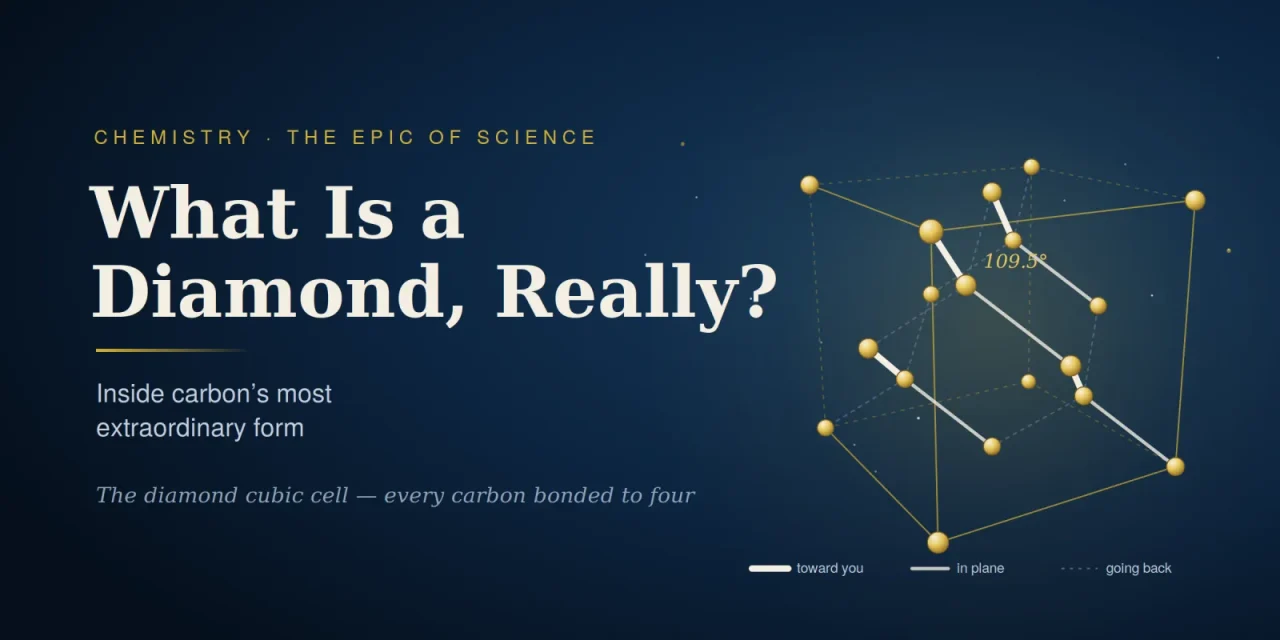
Bonds drawn toward the viewer are bold; bonds receding into the page are thin and dashed.
Original illustration by Epic of Science.
The diamond cubic unit cell: every carbon atom bonds to four neighbors in a rigid tetrahedral lattice. Bonds drawn toward the viewer are bold; bonds receding into the page are thin and dashed.
Original illustration by Epic of Science.
The core of diamond science lies in the architecture of its crystal lattice and rewards a patient look. Every carbon atom in a diamond sits at the center of a tetrahedron formed by its four nearest neighbors. The angle between any two bonds is approximately 109.5°, the tetrahedral angle predicted by sp3 hybridization. Each bond is a sigma bond, a direct, head-on overlap of hybrid orbitals, and is very short, about 1.54 ångströms (0.154 nanometers). Short bonds mean strong bonds: the C–C bond in diamond has a bond energy of roughly 346 kJ/mol, and every electron in the structure is locked into one of these bonds. There are no loose electrons, no delocalized clouds, no weak layers.
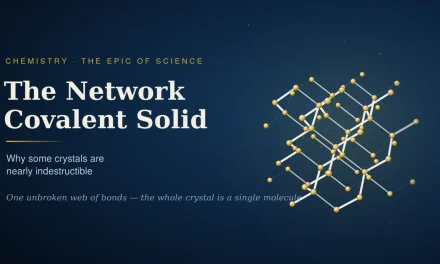
This is the answer to what makes a diamond a diamond. The lattice extends in all three dimensions with perfect uniformity, creating an enormous covalent network, effectively a single giant molecule. To scratch a diamond, you must break a plane of these covalent bonds simultaneously, which requires more force than virtually any other material can deliver. That is why diamond sits alone at the top of the Mohs hardness scale, rated 10, a position it has held since Friedrich Mohs devised the scale in 1812.
The optical properties follow the same logic. Because every electron is tightly bound in a sigma bond, the energy gap between the valence band and the conduction band in diamond is very large, about 5.5 electron volts. Visible light, with photons carrying only about 1.7 to 3.1 eV, does not have enough energy to excite electrons across that gap. The crystal is therefore transparent to visible light. Meanwhile, diamond’s high refractive index, approximately 2.42, and its strong dispersion, the tendency to split white light into its component colors at different angles, create the fire that gemologists prize. These are not mystical qualities; they are direct consequences of the electronic structure of the diamond lattice. The Gemological Institute of America (GIA), a leading authority on diamond characterization, details how these physical properties underpin every aspect of gemological grading, from brilliance to color.
One of the most remarkable fact about diamonds is their thermal conductivity. Diamond conducts heat roughly four to five times better than copper, yet it is an electrical insulator. This seems paradoxical until you realize heat in diamond is carried not by electrons, as in metals, but by phonons, quantized vibrations of the stiff, lightweight lattice. Because the bonds are rigid and the carbon atoms light, phonons travel through diamond with minimal scattering, making it the best thermal conductor of any bulk material known. This property has made diamond invaluable in industrial applications as a heat sink for high-power electronics, far beyond its role as a gemstone.
And yet, despite all of this apparent perfection, there is a thermodynamic irony at the heart of every diamond you have ever seen. At the atmospheric pressures and temperatures of Earth’s surface, diamond is not the stable form of carbon — graphite is. The free energy of graphite at standard conditions is very slightly lower than that of diamond. In principle, every diamond on the planet is slowly transforming into graphite. In practice, “slowly” is an understatement of geological proportions: the activation energy barrier for the diamond-to-graphite conversion at room temperature is so immense that the process has no measurable rate. A diamond will sit on a ring for billions of years without changing. Diamond is metastable — thermodynamically doomed but kinetically immortal, trapped behind an energy barrier it can never surmount at ordinary temperatures. This is one of the most striking illustrations in all of chemistry of the difference between thermodynamic favorability and kinetic accessibility.
From Burning Diamonds to Building Them: The Story of Discovery
For most of human history, no one had the faintest idea what was in a diamond. It was classified alongside precious stones and metals, assumed to be some unique mineral. The first real clue came in 1694, when the Italian scientists Giuseppe Averani and Cipriano Targioni, working in Florence under the patronage of Cosimo III de’ Medici, focused sunlight through a large lens onto a diamond and watched it vanish. A diamond — supposedly indestructible — simply disappeared. The result was sensational but poorly understood: where had it gone?
The decisive experiment came roughly a century later. In 1772, the French chemist Antoine Lavoisier, working with other chemists including Pierre-Joseph Macquer, one of France’s foremost chemists, and Louis-Claude Cadet de Gassicourt, placed a diamond inside a sealed glass vessel and burned it using a powerful lens. The gas produced was identified as “fixed air” — what we now call carbon dioxide, CO2. If burning a diamond produced the same gas as burning charcoal, the implication was startling: the world’s most prized gem and a lump of charcoal might share the same essential substance. The English chemist Smithson Tennant is generally credited with confirming this conclusion around 1797, demonstrating quantitatively that a given mass of diamond yields the same amount of CO2 as an equal mass of charcoal when combusted, thereby establishing that diamond is pure carbon.
The realization that diamonds are made of carbon — the same element found in living things, in coal, in the soot of a candle — was one of the great surprises of eighteenth-century chemistry. It overturned centuries of classification and posed a new puzzle: if diamond is merely carbon, what creates diamonds in nature? The answer — extreme pressure and temperature deep in the Earth — only became clear much later, and it opened a tantalizing question: could we make diamonds ourselves?
As Robert M. Hazen recounts in The Diamond Makers, the quest to synthesize diamond consumed scientists and charlatans alike from the late nineteenth century onward, littered with fraudulent claims and honest failures. Success came in 1954–1955, when a team at General Electric — including Tracy Hall, Herbert Strong, and others — produced the first reproducible synthetic diamonds using a high-pressure, high-temperature (HPHT) apparatus. Hall’s press achieved pressures above roughly 10 gigapascals at temperatures exceeding 1,400°C, conditions that mimicked the diamond stability field in the Earth’s mantle. The achievement was a triumph of both engineering and thermodynamics, confirming that nothing exotic was needed: give carbon enough pressure and enough heat, and it will build a diamond.
Why It Matters: Far More Than a Gemstone
So what are diamonds made of, and why does it matter beyond the jewelry box? Understanding what diamonds are made of transforms them from mystical objects into comprehensible chemistry — and that comprehension opens doors. Once you know what diamond is made of, its double life as both gemstone and industrial workhorse makes perfect sense. Because diamond is simply carbon in an extraordinary arrangement, it turns out to be far more than jewelry. Industrial diamonds — most of them now synthetic — are embedded in cutting tools, drill bits, and grinding wheels that shape everything from surgical instruments to highway concrete. Diamond thin films serve as heat spreaders in high-performance electronics. Researchers are exploring diamond as a platform for quantum computing, exploiting point defects in the lattice (nitrogen-vacancy centers) to create qubits that operate at room temperature. And chemical vapor deposition (CVD) techniques now grow gem-quality diamonds atom by atom in laboratories, raising fascinating questions about what we mean by “natural” and “real” when the composition and structure are identical.
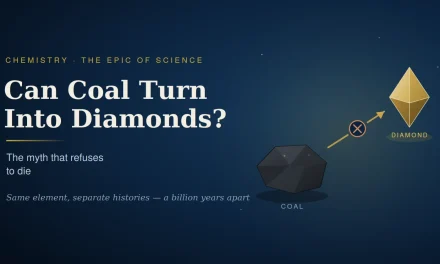
One of the most persistent misconceptions about diamond composition is that coal somehow transforms into diamonds deep in the Earth. While it is true that diamonds are made under immense pressure — absolutely — the carbon source for most natural diamonds is not coal. Coal is a sedimentary rock formed from ancient plant matter near the Earth’s surface, whereas most diamonds crystallized in the mantle from carbon that was present in the deep Earth long before land plants evolved. The two share an element but not a history. Whether surface carbon can become diamond at all, and under what rare conditions, is examined in our article on the question of coal turning into diamonds.
What element is a diamond made of? Carbon — element number six, the backbone of organic life, the stuff of pencil lead, and the only ingredient in the hardest natural material on the planet. That a single element can achieve such extremes depending solely on the arrangement of its atoms is one of the most elegant demonstrations of structure–property relationships in all of chemistry.
A Crystal Caught in Time
What is a diamond, in the end? There is something almost philosophical about the answer. It is carbon that nature compressed into its most ordered state and then flung to the surface in a volcanic eruption so fast that the atoms had no time to relax back into graphite. Every diamond is, in a thermodynamic sense, a memory of conditions that no longer exist — a snapshot of the deep Earth, preserved by nothing more than the stubbornness of covalent bonds refusing to let go. The next time you see one catch the light, remember that you are looking at pure carbon, six protons per atom, four bonds per atom, arranged in the most relentless geometry in nature. Nothing has been added. Nothing needs to be. The architecture is the miracle, and the element is as common as life itself.
References
GIA (Gemological Institute of America) — Diamond science and gemological grading resources. https://www.gia.edu
USGS Mineral Commodity Summaries — Diamond. U.S. Geological Survey. https://www.usgs.gov
Hazen, R. M. The Diamond Makers. Cambridge University Press, 1999.