Is a Quantum Physics Degree the Right Move for You?
If you are considering a quantum physics degree, you probably have many questions: What do you study? Which universities are worth applying to? Will the degree lead to a stable, well-paying career, or will you end up overqualified and underemployed? These are fair questions, and the answers are more nuanced than any university brochure will admit.
This guide is for three types of readers. First, undergraduates (or prospective undergrads) who love physics and wonder how to build a path toward quantum research. Second, students weighing the commitment of a master’s or doctoral program in quantum physics. Third, career-changers and lifelong learners who want an honest look at where this field leads and what it demands. We will walk through the academic trajectory from a quantum physics major through a PhD, highlight the strongest university programs based on recent QS World University Rankings for Physics and Astronomy, and lay out career paths with realistic expectations about timelines and compensation.
The Short Answer
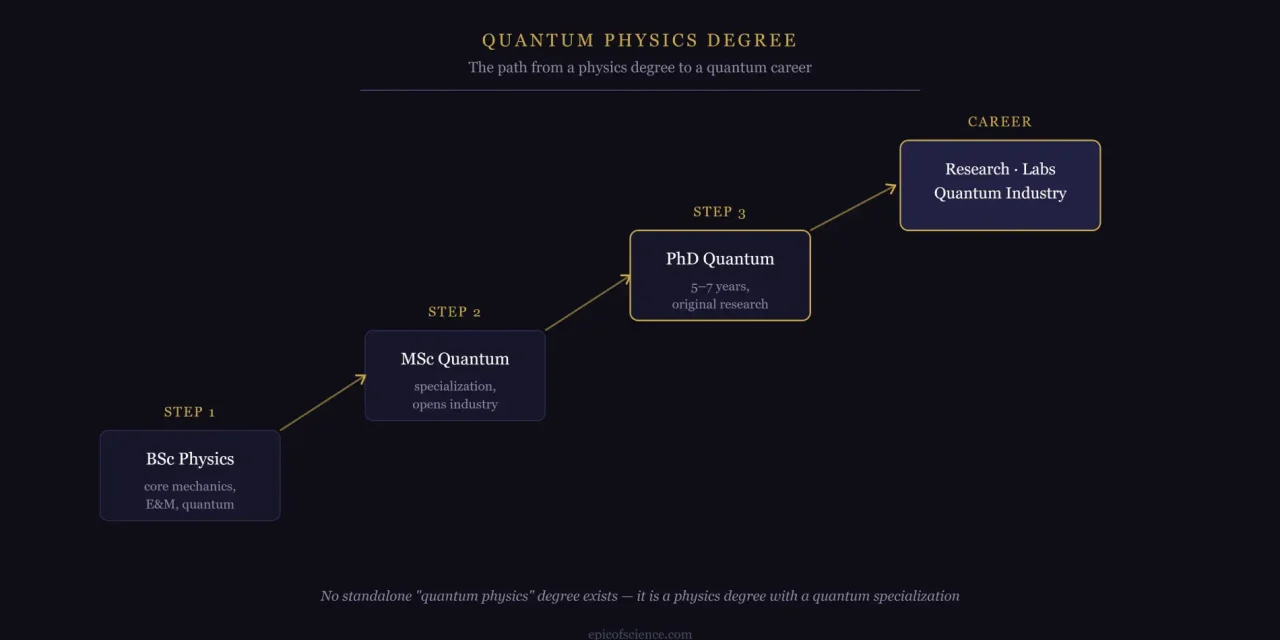
A quantum physics degree typically means earning a bachelor’s in physics with electives in quantum mechanics, then pursuing a master’s or PhD specializing in quantum mechanics. The field offers strong career prospects in academia, national laboratories, and the expanding quantum technology industry but demands years of advanced study and mathematical maturity. If you want research roles or faculty positions, a PhD is effectively required. For industry roles in quantum computing or engineering, a master’s can open doors, though a doctorate remains the stronger credential.
The best programs for this path, according to the recent QS rankings, include MIT, Caltech, Harvard, Stanford, and Cambridge, though excellent research opportunities exist well beyond that elite tier. Read on for the full picture.
What a “Quantum Physics Degree” Actually Means
There is an important clarification to make at the outset: very few universities offer a standalone degree called “quantum physics.” What you will find is a physics degree — at the bachelor’s level, typically called a physics major or a quantum mechanics degree track — with increasing specialization as you advance. The real quantum specialization happens at the graduate level, where you choose a research group focused on quantum information, quantum optics, condensed matter, quantum field theory, or a related subfield.
At the undergraduate level, a strong quantum physics major includes core coursework in classical mechanics, electrodynamics, thermodynamics, statistical mechanics, linear algebra, differential equations, and at least two semesters of quantum mechanics. The mathematics is non-negotiable: you need fluency in linear algebra and complex analysis at minimum. Comfort with group theory and functional analysis will serve you well later. Students who struggle with or avoid mathematics will find quantum physics frustrating, not because the ideas are inaccessible, but because the field’s language is mathematical at its core.
A quantum physics doctorate typically takes five to seven years in the United States after a bachelor’s degree. European programs often require a master’s first and may have a shorter doctoral phase of three to four years but a similar total timeline. During this time, you take advanced coursework, pass qualifying exams, and conduct original research culminating in a dissertation. It is a long commitment, and you should enter it aware of the opportunity cost.
What to Study, Where to Study, and Where It Leads
The Curriculum: From Foundations to the Frontier
An undergraduate pursuing a quantum physics major should expect a four-year curriculum that begins with introductory physics and calculus-based mechanics, then progresses through intermediate courses in electromagnetism and waves before culminating in quantum mechanics, usually in the junior year.
The best programs supplement this with computational physics, giving students experience coding simulations, a skill indispensable in academic and industry quantum research. By senior year, many students take a second quantum mechanics course covering perturbation theory, scattering, and basics of many-body systems. An undergraduate thesis or research experience, while not always required, dramatically strengthens graduate school applications and gives a realistic taste of research life.
At the graduate level, a masters degree in quantum physics (typically conferred as a Master of Science in Physics with a quantum focus) usually involves one to two years of coursework in advanced quantum mechanics, quantum field theory, and electives in your area of interest — quantum computing, quantum optics, condensed matter, or particle physics. Some programs are coursework-only, while others require a research thesis. If your goal is a PhD in quantum physics, the thesis-based master’s is far more valuable because it demonstrates research ability. In the U.S., many doctoral programs admit students directly from a bachelor’s and award the master’s en route to the PhD.
Best Universities for Quantum Physics
According to the recent QS World University Rankings for Physics and Astronomy, the top programs globally include MIT, Harvard, Stanford, Caltech, the University of Cambridge, the University of Oxford, and ETH Zurich. These are not surprising names, and they are genuinely excellent: MIT’s physics department, for instance, has been at the forefront of quantum information science, with major research groups in quantum computing, quantum error correction, and quantum simulation. Caltech, with its deep historical connection to Feynman’s legacy, maintains world-class programs in quantum optics and theoretical physics. These are among the best universities quantum physics students can aspire to.
That said, fixating only on the top five is a mistake many applicants make. Universities like the University of Maryland (home to a leading quantum information center), the University of Colorado Boulder (JILA), the University of Waterloo (home to the Institute for Quantum Computing), TU Delft, and the Max Planck institutes in Germany host outstanding quantum research groups. What matters more than the university’s brand is the specific research group: the advisor, funding, publication record, and post-graduation trajectory of former students. A well-funded, productive group at a less famous university can be a better launchpad than a prestigious name with a distracted advisor and overcrowded lab.
Career Paths: Where a Quantum Physics Degree Actually Leads
The career landscape for quantum physics graduates has shifted significantly over the past decade. The traditional path of postdoctoral research followed by a tenure-track faculty position remains an option but is brutally competitive. The number of permanent academic positions in physics is far smaller than the number of PhDs produced each year. Candidates often spend five to ten years in postdoctoral positions before securing a faculty role, if they secure one at all. Anyone pursuing a PhD in quantum physics solely to become a professor should understand these odds clearly.
The brighter side of the picture is the growing quantum technology industry. Companies including IBM, Google, Microsoft, Amazon (AWS), IonQ, Rigetti Computing, and PsiQuantum are actively hiring physicists with quantum expertise for roles in quantum hardware engineering, quantum algorithm development, quantum error correction, and quantum software. National laboratories such as Los Alamos, Sandia, Brookhaven, and Argonne, as well as organizations like CERN, also employ physicists at various levels. According to CERN’s careers information, opportunities range from research fellowships and technical positions to applied engineering roles, and they recruit from a global pool of candidates with graduate-level physics training.
Compensation varies widely by sector and level. Early-career industry roles for PhD holders in quantum computing typically start in the six-figure range in the U.S., with senior positions at major tech firms reaching higher. Academic postdoctoral salaries are substantially lower, often in the mid-five-figure range, a genuine downside. National lab positions fall between the two. Holders of a masters degree in quantum physics without a doctorate can access industry roles in quantum engineering, technical consulting, and data science, though the most research-intensive positions prefer or require a PhD. Many physics graduates also move into adjacent fields like finance (quantitative analysis), defense, semiconductor engineering, and software development, where their mathematical and computational skills command strong salaries.
Matching the Right Path to the Right Person
If you are an undergraduate who loves quantum mechanics but is unsure about committing to a doctorate, the wisest move is to get research experience as early as possible through a summer REU (Research Experience for Undergraduates) program, an honors thesis, or by volunteering in a faculty member’s lab. This experience is the best way to discover whether you enjoy the day-to-day reality of research, which involves more debugging, failed experiments, and painstaking data analysis than the elegant theory in your textbook. If you love it, pursue a quantum physics doctorate. If you find it tedious, you will have learned something valuable before investing half a decade.
If you already hold a bachelor’s in physics or a related field and are deciding between a master’s and a PhD, consider your goals honestly. A master’s degree is faster, less risky, and opens doors in industry, especially in the growing quantum computing sector. But if your ambition is to lead original research — whether in academia, at a national lab, or in an industry R&D team — the PhD is the standard credential, and a master’s alone may leave you reporting to someone with one. In the U.S., applying directly to PhD programs from a bachelor’s is common and often financially advantageous, since doctoral students in physics typically receive tuition waivers and stipends, while master’s students frequently do not.
For career changers from engineering, computer science, or mathematics, the transition to quantum physics is feasible but demanding. Your mathematical background will serve you well, but you will need to fill gaps in electrodynamics, statistical mechanics, and quantum theory specifically. Some universities offer bridge programs or professional master’s degrees designed for this purpose. Be realistic about the time investment — a two-year master’s at minimum, and likely longer if prerequisite coursework is needed.
What to Do Next
Start by auditing your mathematical preparation. If you are not comfortable with linear algebra, differential equations, and at least introductory complex analysis, shore up these foundations before applying to any graduate program. Textbooks like Griffiths’ Introduction to Quantum Mechanics or Shankar’s Principles of Quantum Mechanics are widely used at the advanced undergraduate level and will give you a clear sense of whether you find the material engaging or impenetrable.
Next, research specific faculty and research groups at the universities you are considering. Read their recent papers, look at where their graduates end up, and reach out to current students if possible. The fit between you and your advisor matters at least as much as the university name. Check the QS rankings and program websites, but do not let prestige alone drive your decision.
For a broader view of what resources are available — from textbook guides to career tools — explore the Resources section on Epic of Science, where we regularly cover the books, programs, and tools that support physics students at every level. One question we hear frequently is: Can I get a quantum physics degree online? At the undergraduate level, accredited online physics degrees exist but are rare and often lack laboratory components critical to a strong foundation. At the graduate level, some universities offer online or hybrid master’s programs in physics, though fully online doctoral programs in quantum physics are essentially nonexistent. For serious specialization, in-person programs remain the standard.
Your Path Forward
A quantum physics degree is one of the most intellectually demanding paths you can choose, and also one of the most rewarding. The field is at an inflection point: quantum technologies are moving from laboratory curiosities to engineered systems, and the demand for people who deeply understand quantum mechanics — not just as a set of recipes, but as a way of thinking — is growing in ways that were hard to imagine even a decade ago. Whether you pursue a master’s, a doctorate, or use an undergraduate quantum mechanics degree as a launchpad into industry, the key is to be honest with yourself about what you want, to choose your program and advisor with care, and to build the mathematical and computational skills that will make you genuinely valuable. The path is long, but for the right person, it leads somewhere extraordinary.
References
QS World University Rankings — Physics & Astronomy 2024. topuniversities.com
MIT Department of Physics. physics.mit.edu
California Institute of Technology — Division of Physics, Mathematics, and Astronomy. pma.caltech.edu
CERN Careers. careers.cern