
A Circle, a Rope, and a Problem That Would Not Close
Long before National Pi Day existed, a clay tablet from the Old Babylonian period, inscribed between 1900 and 1600 BCE, records a method for finding a circle’s area: take three times the square of the radius. Nothing in the tablet suggests its scribe was chasing an abstract constant. The method was a practical shortcut for fields, canals, and storage pits. It worked well enough for its purposes, even though it was off by more than four percent compared to the true value. A separate tablet excavated near Susa applies a closer figure to a similar problem: 3.125, written as the fraction twenty-five over eight. This reading was first published by historian of mathematics E. M. Bruins in 1950 and given fuller treatment with M. Rutten in 1961. Later scholars have questioned parts of Bruins’s interpretation of the tablet’s cuneiform. It remains debated among specialists in Mesopotamian mathematics whether the value reflects a scribe’s deliberate refinement or simply a different method suited to a different problem. What is not disputed is that together, the two documents mark the earliest surviving evidence that humans were measuring, however imperfectly, the number now honored every March 14 on National Pi Day. The Babylonians did not have the concept of pi as we understand it: a single, unchanging ratio that holds for every circle, worth isolating and studying in its own right. They had a working procedure that happened to encode an approximation of it, indistinguishable in practice from treating pi as equal to 3. Today that same number appears everywhere, including in the small, almost private ritual of National Pi Day, when for one afternoon each March a number born of grain pits and boundary stones gets a cake.
This is the story of that number: how ancient surveyors bracketed it without knowing what they were chasing, how a Greek geometer proved it could be squeezed but never caught, how a Welsh mathematics teacher gave it the symbol we now take for granted, and how a nineteenth-century German professor finally proved why it could never be caught at all.
Not a Number So Much as a Boundary
Pi is not simply the ratio of a circle’s circumference to its diameter. It is a record of every civilization that tried to measure that ratio and eventually had to admit that the true value lay just beyond whatever tool it had brought to the problem. The history of pi is less a history of a number than a history of increasingly honest approximations, each one a confession of the last one’s limits.
That confession runs in an unbroken line from Babylonian clay to Greek geometry, Chinese polygon calculations, the infinite series of Indian mathematics, the symbol adopted in eighteenth-century Europe, and a nineteenth-century proof that explained why the chase could never end. National Pi Day, four thousand years later, celebrates the number without much fanfare about that history. No other constant in mathematics has demanded contributions from so many unconnected civilizations, each rediscovering in its own notation that a circle holds a secret its straight edges cannot express.
What Babylon and Egypt Actually Knew
The Babylonian value of 3, from treating a circle’s area as three times the square of its radius, appears repeatedly in tablets from the Old Babylonian period, roughly 1900 to 1600 BCE. It served its purpose: for canals, granaries, and field boundaries, an error of about four percent was tolerable. But at least one surviving tablet, excavated near Susa and studied extensively by historians of Mesopotamian mathematics, applies the more refined value of 3.125 to a circle problem. This suggests some scribes recognized the cruder value as an approximation rather than a truth.
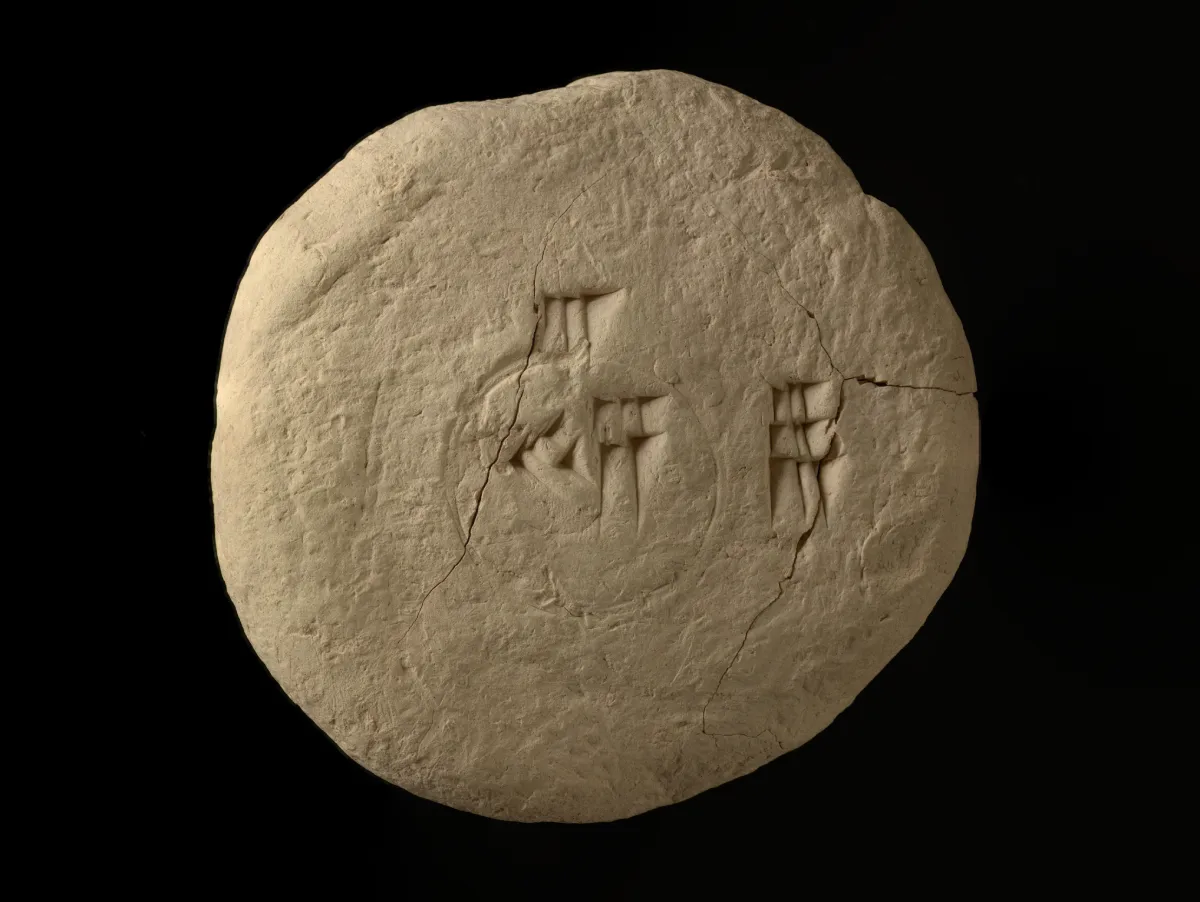
Old Babylonian tablet YBC 7302 (YPM BC 021367), showing a circle problem in cuneiform. Yale Peabody Museum, Babylonian Collection. CC0 / Public Domain. peabody.yale.edu
There is no evidence of a proof behind either number. Both were empirical, arrived at by measuring and comparing, in the same spirit a carpenter today might eyeball a curve and correct it by experience rather than theorem.
Egypt approached the problem independently and did slightly worse. The Rhind Papyrus, a mathematical text copied around 1650 BCE by a scribe named Ahmes from an older source, calculates the area of a circular field using a method equivalent to a pi value of about 3.16, derived by squaring eight-ninths of the diameter. Like the Babylonian figures, this was a working rule rather than a proven relationship, refined by trial against real fields and granaries until accurate enough to be useful. Neither civilization asked, as far as surviving texts tell us, what the true value might be if pursued without limit. That question would wait for Greece.
Archimedes and the Method That Could Not Be Wrong
Around 250 BCE, Archimedes of Syracuse did something neither Babylon nor Egypt had attempted: he built a method that did not rely on measuring a physical circle and could, in principle, be pushed as far as patience allowed. He inscribed a regular polygon inside a circle and circumscribed another outside it, reasoning that the circle’s circumference had to fall between the perimeters of the two polygons. A hexagon gave a rough bound. Archimedes then doubled the number of sides to twelve, then twenty-four, then forty-eight, then ninety-six, recalculating the perimeters by hand at each stage using only the geometry of chords and the Pythagorean theorem. By the time he reached a ninety-six-sided polygon, he had trapped pi between 3 10/71 and 3 1/7, or roughly 3.1408 and 3.1429 in decimal terms.
What made this a turning point in mathematics was not the precision, though remarkable for hand computation without decimal notation. It was the method itself: a proof that pi could be approximated to any desired accuracy, with the error shrinking predictably as the polygon’s sides multiplied. Archimedes had not measured pi. He had bracketed it mathematically from both directions at once and laid groundwork that would resurface two thousand years later in the language of limits and calculus. His bounds remained the tightest available in the Mediterranean world for most of a millennium.
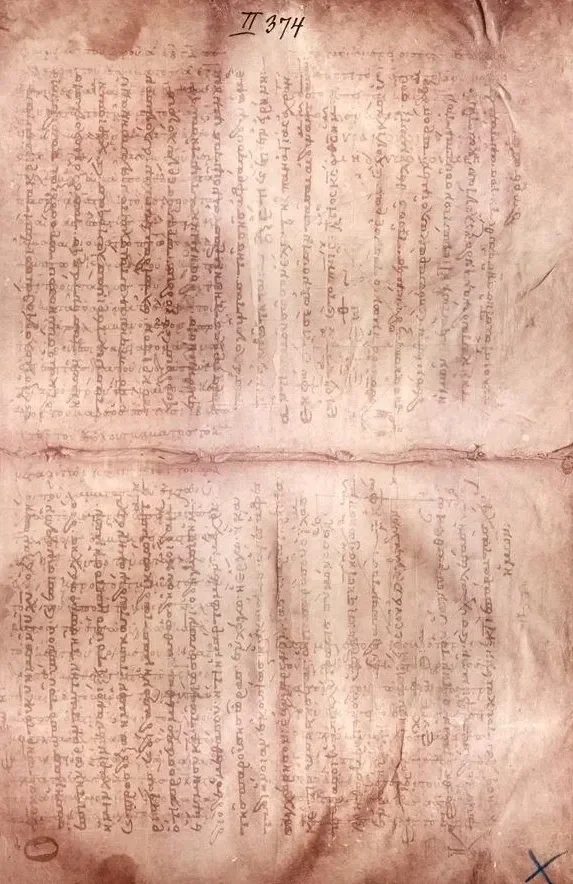
An unfolded page from the Archimedes Palimpsest, a 13th-century manuscript containing several of Archimedes’ treatises, including Measurement of the Circle. Photo: The Walters Art Museum, via Wikimedia Commons (CC BY 3.0).
The Relay Race Across Continents
Archimedes’ polygon method did not stay in Greece. Chinese mathematicians took it up independently, refining it beyond his ninety-six sides. In the third century CE, Liu Hui pushed the technique to a 3,072-sided polygon and arrived at 3.1416. He noticed something Archimedes had not written explicitly: the differences between successive polygon estimates formed a predictable, shrinking pattern, which let him accelerate the calculation rather than simply grinding through more sides. Two centuries later, Zu Chongzhi carried the method further, reaching seven-decimal accuracy of 3.1415926, a precision not exceeded anywhere in the world for roughly nine hundred years. Zu Chongzhi’s own writings on the subject have been lost. What survives is secondhand testimony to a result whose method can only be inferred, but the number itself checks out against modern calculation to seven places.
India took a different route entirely. In the fourteenth or fifteenth century, the mathematician Madhava of Sangamagrama, working in what is now Kerala, developed infinite series that could generate pi to as many decimal places as one had the patience to sum. This was a genuinely different strategy from polygon-bracketing and anticipated, by roughly two centuries, the calculus-based series that Newton and Leibniz later became famous for in Europe. None of these advances were coordinated. Babylon, Egypt, Greece, China, and India each arrived at their improvements to pi in isolation, without correspondence or shared texts. This is part of why the number has such an unusually long and geographically scattered paper trail compared to most mathematical constants.
The symbol π itself is a much later and more mundane story. For most of history, mathematicians described the ratio in words, often clumsy ones; one seventeenth-century Latin description translates roughly as “the quantity which, when the diameter is multiplied by it, produces the circumference.” In 1706, a largely self-taught Welsh mathematics teacher named William Jones used the Greek letter π, the first letter of the Greek word for perimeter, to represent the ratio in a textbook titled Synopsis Palmariorum Matheseos. The choice did not catch on immediately. It took the towering reputation of Leonhard Euler, who adopted the symbol in his widely read publications starting in 1737, to make π the standard notation it remains today. Jones is rarely remembered outside footnotes; Euler, who did not invent the symbol, is popularly credited with it anyway, a small irony in the history of a number defined by precision.
Proving the Chase Could Never End
For all this progress, one question remained unresolved well into the nineteenth century: was pi merely difficult to calculate exactly, or was it impossible in principle, a number that no finite process of ordinary arithmetic could fully capture? The distinction mattered enormously because it bore directly on one of the oldest unsolved problems in geometry, squaring the circle: constructing, using only a compass and an unmarked straightedge, a square with the same area as a given circle. Generations of mathematicians and amateurs alike had tried and failed.
The answer came in 1882, when the German mathematician Ferdinand von Lindemann proved that pi is transcendental, meaning it is not the root of any polynomial equation with rational coefficients. Building on techniques the French mathematician Charles Hermite had developed for proving the transcendence of the number e, Lindemann showed that pi belongs to an even more exclusive category than the irrational numbers already known to defy exact fractions. An irrational number cannot be written as one whole number divided by another; a transcendental number cannot even be constructed as the solution to any algebraic equation, however elaborate. The proof did more than settle an abstract classification. It proved, once and for all, that squaring the circle with compass and straightedge is impossible, closing a door that geometers had been quietly testing for over two thousand years. Pi was not merely hard to pin down. It had been, provably, unpinnable from the start.
The chase for more digits continued anyway, transcendence proof or not, because a longer decimal expansion was still useful for testing calculation methods even after the philosophical question was settled. In 1873, the British mathematician William Shanks published a hand calculation of pi to 707 decimal places, the product of more than two decades of intermittent labor. It stood unchallenged for over seventy years until 1944 and 1945, when D. F. Ferguson, working with nothing more than a mechanical desk calculator, discovered that Shanks had made an error at the 528th digit, quietly invalidating the last fifth of his life’s work. The correction did not take long to become obsolete. In 1949, the ENIAC, one of the first general-purpose electronic computers, calculated pi to 2,037 places in about seventy hours, a task that made Shanks’s decades of pencil work look, in retrospect, almost quaint. Computers have not stopped since; by December 2025, the record stood at more than 314 trillion digits, a figure with no practical application beyond testing the computers themselves. NASA’s Jet Propulsion Laboratory, asked in 2016 how many decimal places its own spacecraft-navigation calculations actually require, put the number at fifteen; JPL engineer Marc Rayman has noted separately that even a circle the size of the observable universe would need only about 37 to 40 digits of pi to be accurate to within the width of a single hydrogen atom. Everything past that is, by Rayman’s own account, a demonstration of computing power rather than a mathematical necessity.
From Susa to San Francisco
It is a long way from a Babylonian storage-pit calculation to a museum exhibit hall in San Francisco, but that is precisely the distance covered by the history of Pi Day. The story of who invented Pi Day, as it turns out, has nothing to do with ancient mathematics at all. In 1988, a physicist and technical curator named Larry Shaw was attending a staff retreat at the Exploratorium. In this science museum, he worked in the aftermath of founder Frank Oppenheimer’s death three years earlier. Shaw noticed that the American date format for March 14, written 3/14, matched the first three digits of pi. That pi’s next digits, 159, matched the time 1:59. He organized an impromptu celebration: a circular parade around the museum, fruit pies and tea for the staff, and a brass “Pi Shrine” installed in a circular classroom built, fittingly, of circular cinderblocks. The date also happened to be Albert Einstein’s birthday, which the parade came to mark as well, circling the shrine 3.14 times while singing to him.
The celebration stayed local for years before spreading well beyond the Exploratorium’s walls, and in March 2009 the United States House of Representatives formally recognized March 14 as National Pi Day — turning a 3.14 Pi Day office party into a mathematical Pi Day on the federal calendar. Why is Pi Day celebrated on March 14 specifically, and not on some date closer to pi’s true value? Because Larry Shaw was looking at a calendar and a clock at the same time, and pi, for once in its four-thousand-year history, cooperated. It is a fittingly informal origin for a number that has spent most of its documented life resisting exactly that kind of neatness. One of the more surprising facts about Pi Day is how little it has to do with formal mathematics at all — ask how we celebrate Pi Day and the honest answer involves a boombox parade, not a proof. The scribes of Susa, Archimedes with his polygons, Zu Chongzhi with his lost calculations, and Lindemann with his proof that the chase could never end were all, in their own centuries, doing something far more serious than Shaw’s boombox parade. But it is worth noticing that the same number drove all of it: an ancient, patient refusal to be fully known, eventually dressed up as an excuse for pie. For more on the numbers and thinkers who shaped mathematics, explore the rest of our Mathematics section.
References
Encyclopaedia Britannica — “Ferdinand von Lindemann.”
Patricia Rothman, “The Man Who Invented Pi,” History Today, Vol. 59, Issue 7 (July 2009)
M. Bruins and M. Rutten, Textes Mathématiques de Suse (Paris: Librairie Orientaliste Paul Geuthner, 1961).
NASA/JPL Edu — “How Many Decimals of Pi Do We Really Need?” (response by Marc Rayman).



Trackbacks/Pingbacks