
Contents
- The Fairy Tale Buried in Every Science Classroom
- The Short Answer
- Why the Myth Feels So Right
- What Actually Makes a Diamond
- Carbon’s Two Faces: Graphite and Diamond
- The Journey to the Surface
- Could Any Coal Seam Ever Produce a Diamond?
- How We Learned to Tell Them Apart
- Why Getting This Right Matters
- The Real Pressure
- References
The Fairy Tale Buried in Every Science Classroom
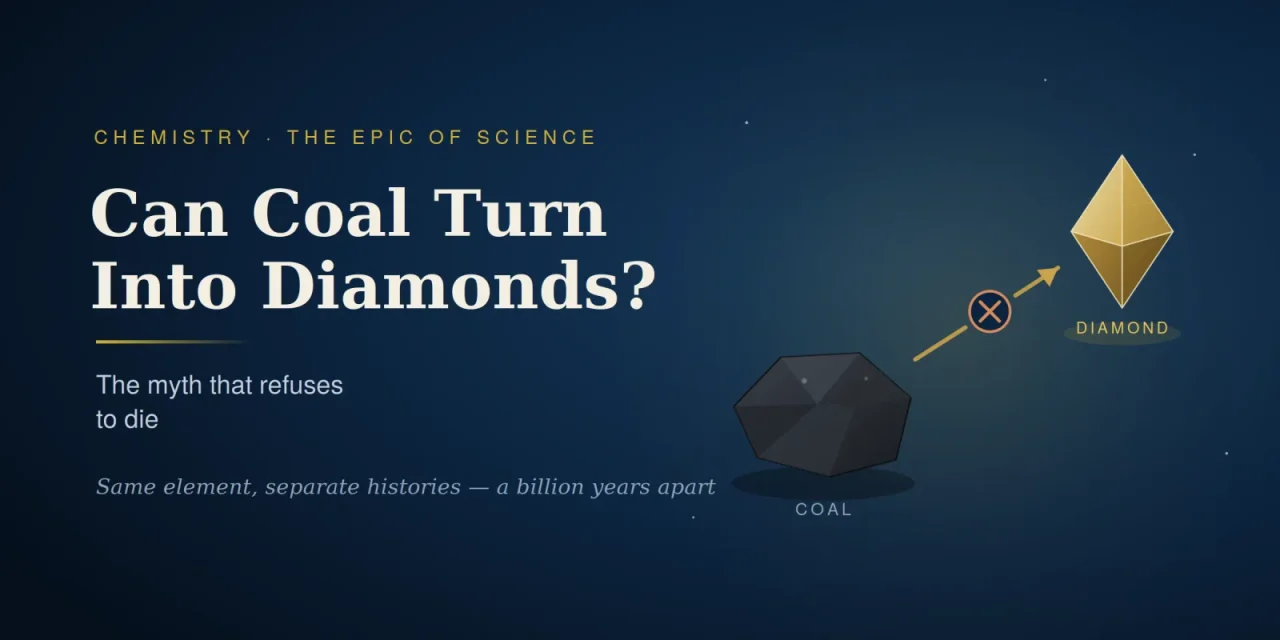
You have probably heard the story: a lump of coal, buried deep enough and squeezed hard enough by the weight of the Earth, eventually transforms into a dazzling diamond. It is a perfect parable — the ugly duckling of the mineral world, the idea that something dirty and cheap can become precious through pressure and time. It has been repeated in children’s books, motivational posters, Superman comics, and even some geology textbooks. The question — can coal turn into diamonds? — seems to have an obvious answer. Of course it can. Everyone says so.
Except it cannot. More precisely, the story as usually told is almost entirely wrong. Coal and diamond are both made of carbon, the single grain of truth from which an enormous myth has grown. But their origins, geologies, and histories in the Earth are separated by billions of years and hundreds of kilometers of rock. Understanding why the coal-to-diamond myth persists and why reality is more interesting requires a journey into the deep Earth, the structure of carbon, and the surprisingly recent history of how we learned to tell these two materials apart.
The Short Answer
Can coal turn into diamonds? No — diamonds are not made from coal. Most natural diamonds formed over a billion years ago in the Earth’s mantle at depths of roughly 150 to 200 kilometers, long before the earliest land plants whose remains eventually became coal deposits. They share the element carbon, but their origins are entirely separate stories written in entirely different chapters of Earth’s history.
Why the Myth Feels So Right
The coal-to-diamond story has an almost irresistible internal logic. Pick up a piece of coal and you hold something dark, crumbly, and cheap — a fuel you burn and forget. Hold a diamond and you hold something transparent, hard, and valuable. Both are made of carbon. So does coal turn into diamonds if you add enough pressure and heat? The narrative writes itself: apply geological force to the humble material and out comes the extraordinary one. It fits perfectly with our cultural love of transformation — lead into gold, caterpillar into butterfly, coal into diamond. Are diamonds made from coal as the story claims? The idea that coal becomes diamond deep underground feels almost too neat to be false.
The myth is reinforced by a real chemical fact. Coal is rich in carbon, and diamond is pure crystalline carbon. Extremely high pressures and temperatures can convert one form of carbon into another. Laboratory experiments since the mid-twentieth century have shown that graphite — another carbon allotrope — can be pressed into diamond under the right conditions. So the underlying physics is not wrong; what is wrong is the geological story claiming that coal deposits played any meaningful role in forming the diamonds we mine.
The problem begins with time. Most natural diamonds are ancient — estimates place their formation between about one billion and 3.3 billion years ago, deep in the subcontinental lithospheric mantle. Coal, by contrast, is a product of dead plant matter, and the great coal-forming forests did not appear until the Carboniferous period, roughly 360 to 300 million years ago. The arithmetic disqualifies coal as a diamond source: most diamonds are older than coal by hundreds of millions, often billions, of years. They were locked in mantle rock before the first tree-like organism drew its first breath.
What Actually Makes a Diamond
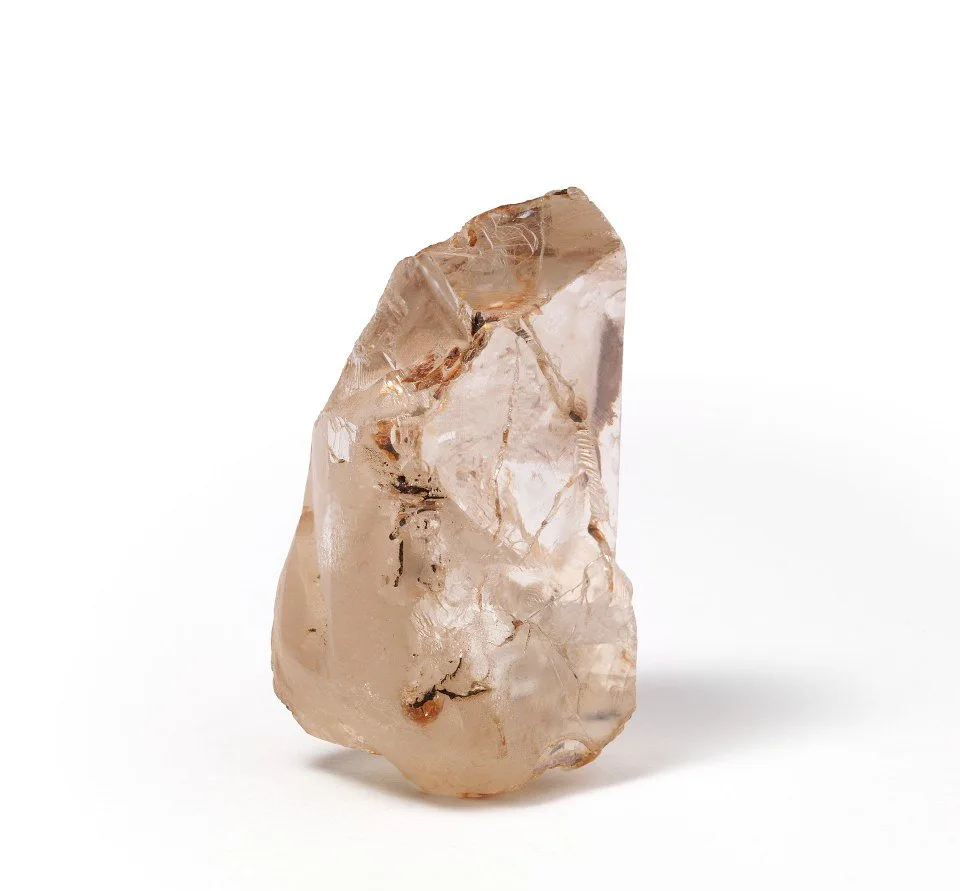
Long before any cutting or polishing, a diamond looks like this — a raw crystal shaped by pressure and time in the mantle, not by any process coal ever undergoes.
Image: Wikimedia Commons, public domain (CC0).
If coal seams sit only a few kilometers down, can coal turn into diamonds as the myth claims? To understand why diamonds come not from coal but from different carbon sources, we need to follow the real coal-to-diamond process the myth imagines and see where it breaks down. It begins far deeper than any coal seam reaches. Coal deposits form in sedimentary basins near the surface, typically at depths of a few kilometers at most. Diamonds crystallize in the Earth’s upper mantle, at depths of about 150 kilometers or more, where pressures exceed roughly 50 kilobars (about 50,000 times atmospheric pressure) and temperatures reach at least 1,000 degrees Celsius. These are conditions the shallow crust, where coal resides, simply never achieves.
The carbon that becomes diamond at those depths is not plant carbon. It is primordial carbon — carbon that was present in the Earth’s mantle since the planet’s formation, or carbon that was carried down into the mantle by the subduction of oceanic tectonic plates. Subducted carbon comes primarily from carbonate minerals in oceanic sediments and from organic carbon in marine sediments, not from terrestrial coal beds. As the Gemological Institute of America (GIA) explains, the carbon sources for natural diamonds include these deep-mantle and subducted materials, and the geological evidence does not support coal as a significant contributor.
Carbon’s Two Faces: Graphite and Diamond
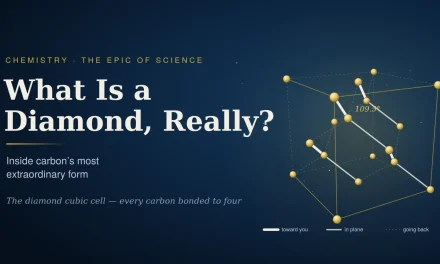
Both coal and diamond are forms of carbon, but the word “form” hides a huge structural difference. In diamond, every carbon atom bonds to four neighbors in a rigid three-dimensional tetrahedral lattice. Each bond is a strong covalent sigma bond, making diamond the hardest naturally occurring material. In graphite — another crystalline allotrope of carbon — each atom bonds to only three neighbors in flat sheets, held together by weak van der Waals forces, which is why graphite is soft enough to mark paper. Coal is not a single mineral; it is a complex, heterogeneous mixture of carbon compounds, mineral impurities, moisture, and partially decomposed ancient plant matter. Describing coal as “carbon” is like describing a forest as simply “wood” — technically related but a radical oversimplification.
The Journey to the Surface
Even after a diamond crystallizes in the mantle, it faces a problem: how does it reach the surface without being destroyed? Diamond is stable only at extreme pressures. At Earth’s crust pressures, the stable form is graphite. If a diamond were brought to the surface slowly — over millions of years of erosion and uplift — it would convert to graphite and arrive as nothing more than a dark smear.
The solution, it turns out, is violence. Diamonds reach the surface through rare, explosive volcanic eruptions that create narrow, carrot-shaped pipes of kimberlite (and less commonly, lamproite). These eruptions start deep in the mantle and blast upward at extraordinary speeds. Some estimates suggest magma ascends at tens of kilometers per hour, sometimes faster. The speed is critical: it brings diamonds through the graphite stability zone so quickly they do not convert. The diamond arrives at the surface as a metastable crystal — thermodynamically unstable but kinetically trapped in its brilliant form because conversion to graphite at surface temperatures is astronomically slow, effectively zero.
Could Any Coal Seam Ever Produce a Diamond?
This is a fair question, and intellectual honesty requires acknowledging its limits. A small number of diamond occurrences are associated with sedimentary environments — tiny diamonds have been found at meteorite impact sites, where transient shock pressures can convert carbon-bearing materials (potentially including coal) into diamond. These microdiamonds are typically too small to see without magnification and are geologically insignificant compared to mantle-derived diamonds that make up almost all gem and industrial diamonds. So while it is not impossible for coal carbon to become diamond under extraordinary circumstances, such as a meteorite impact on a coal seam, this is far from the popular myth. Does coal become diamond in any ordinary geological setting? The popular idea — that coal beds deep underground gradually become diamond deposits — has no geological support.
How We Learned to Tell Them Apart
The confusion between coal and diamond has a long intellectual history. Until the late eighteenth century, it was unclear that diamond was made of carbon. The breakthrough came in stages. In 1772, Antoine Lavoisier and collaborators showed that diamond could be burned — consumed entirely in combustion — suggesting it was made of a combustible element. Later experiments by Smithson Tennant around 1797 showed that the gas produced by burning diamond was carbon dioxide, in the same quantity per unit mass as the gas from burning charcoal. Diamond, in other words, was pure carbon — the same element found in soot, charcoal, and the carbon-rich rock we call coal.
This discovery was electrifying but also misleading because it encouraged the very conflation we are untangling. If diamond is carbon and coal is carbon, and the Earth applies pressure, then surely one becomes the other. But does coal turn into diamonds in the real Earth, and how does coal become diamond if the carbon source and timing never line up? The honest answer, obscured for over a century, is that it does not. The reasoning seemed airtight and for over a century, it was widely accepted.
The modern understanding that most diamonds far predate coal emerged gradually from advances in isotope geochemistry and mineral inclusion studies. Tiny mineral grains trapped inside diamonds during formation act as time capsules, recording pressure, temperature, and chemical environment of the mantle at crystallization. Radiometric dating of these inclusions — using samarium-neodymium and rhenium-osmium systems — has shown many diamonds are Archean in age, formed more than 2.5 billion years ago, when Earth’s continents were still assembling and complex life did not exist, let alone land plants. This evidence, refined over the late twentieth century by researchers studying diamond-bearing kimberlites on several continents, makes clear that the coal-to-diamond narrative is a geological impossibility for the overwhelming majority of natural diamonds.
Why Getting This Right Matters
The coal-to-diamond myth might seem harmless — a charming simplification not worth correcting. But it matters because it distorts our understanding of both materials and the Earth itself. Coal is a fascinating geological substance in its own right: a record of ancient forests, a driver of industrialization, and a central character in the story of climate change. Diamond is equally fascinating: a messenger from the deep mantle, carrying information about conditions hundreds of kilometers beneath our feet that we can access in no other way. Flattening both into a single fairy-tale transformation robs each of its real story.
It also matters for scientific literacy more broadly. The coal-to-diamonds story is a case study in how a plausible explanation, built on a single true fact (both contain carbon), can crowd out a richer and more accurate understanding. Are diamonds made from coal? The claim endures not because evidence supports it, but because the story is satisfying. Learning to question such stories — asking not just “is this possible in principle?” but “is this what actually happened?” — is the habit of mind that studying chemistry cultivates. Diamond’s real explanation lies in its atomic architecture: a rigid, three-dimensional lattice where every carbon atom is locked to four neighbors, the defining feature of what chemists call a covalent network solid — a structure that explains diamond’s hardness far more precisely than any story about pressure and coal ever could.
So, once and for all — can coal turn into diamonds? Are diamonds formed from coal, or do diamonds come from coal in any real sense? For all practical and geological purposes, no. Diamonds form from carbon sources deep in the Earth’s mantle — primordial carbon or carbon subducted from oceanic plates — at depths, pressures, and temperatures coal seams never experience, and on timescales that predate coal by eons. The two materials share an element but not a history.
The Real Pressure
There is something almost poetic about the truth, once you let go of the myth. A diamond is not a lump of coal that tried harder. It is a fragment of the deep Earth, crystallized in darkness at crushing pressure, then flung to the surface in a volcanic eruption so fast and so violent that the crystal did not have time to become the graphite it should, thermodynamically, want to be. It has been sitting on or near the surface ever since, patiently disobeying equilibrium — stable in practice, unstable in theory, a glittering act of kinetic defiance.
Coal, meanwhile, tells its own epic: of ancient swamp forests, of trunks and ferns falling into anoxic water, of slow burial and slow transformation over mere hundreds of millions of years. It is a record of life. Diamond is a record of the Earth’s interior. Confusing the two is like confusing a love letter with a core sample — both are written on the same planet, but they are documents of entirely different worlds. The next time someone tells you that coal becomes diamond, you can tell them the real story. It is, as it happens, far more interesting.
References
GIA — “Do Diamonds Come From Coal?” Gemological Institute of America. https://www.gia.edu
American Museum of Natural History — “Diamonds.” https://www.amnh.org
Smithsonian National Museum of Natural History — Geogallery. https://geogallery.si.edu



Trackbacks/Pingbacks