
Contents
The Glazier’s Quiet Piece of Evidence
Watch someone cut a pane of glass. At the working edge of the tool sits something harder than the glass itself, historically a diamond. Draw it across the surface and the glass breaks along the line. Now reverse it: drag the sharpest shard of window glass across a diamond and nothing happens. Not a mark, not a scratch. The reason is that a diamond is a network covalent solid, a crystal held together by a web of shared electrons that never stops.
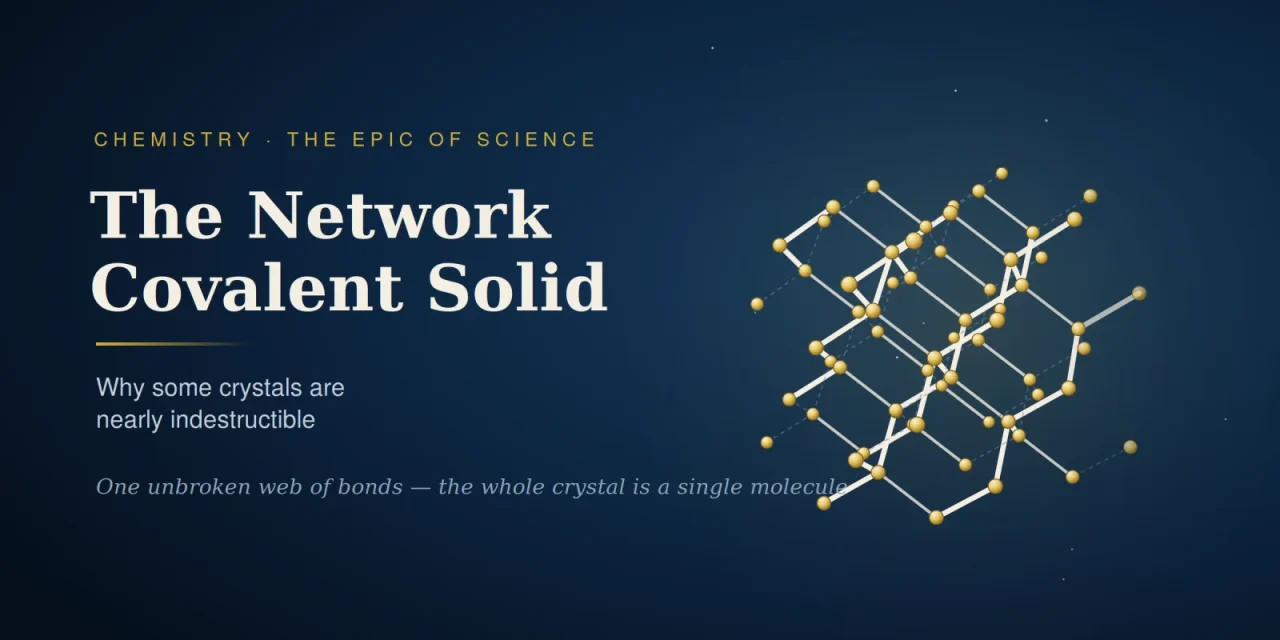
That asymmetry is a clue about how atoms hold each other together and points to the architecture chemists call a network covalent solid. In these substances the covalent bond, the same shared-electron connection that holds two oxygen atoms together in the air you are breathing, does something extravagant. Instead of joining a handful of atoms into a tidy molecule and stopping, it keeps going until a single unbroken web of bonds spans the entire crystal. There is no molecule. There is only the network. A substance built that way behaves unlike almost anything else on Earth.
The Heart of It
Key idea
Nearly every strange property of these materials follows from that architectural fact. Their extreme hardness, punishing melting points, refusal to dissolve in ordinary solvents, and stubborn silence as electrical insulators all trace back to a lattice with no seams and no weak points to exploit. Understanding covalent network bonding means understanding why continuity, rather than the strength of any individual bond, makes a crystal nearly indestructible.
Nearly every strange property of these materials follows from that architectural fact. Their extreme hardness, punishing melting points, refusal to dissolve in ordinary solvents, and stubborn silence as electrical insulators all trace back to a lattice with no seams and no weak points to exploit. Understanding covalent network bonding means understanding why continuity, rather than the strength of any individual bond, makes a crystal nearly indestructible.
Four Ways to Build a Solid
To see what makes covalent network bonding unusual, it helps to look at the alternatives because most solids are assembled on a fundamentally different plan. Chemists usually sort solids into four families according to what holds the particles in place, and the differences are not academic — you can feel them in your kitchen.
Molecular solids are the most familiar. Ice is the obvious case: discrete H2O molecules, each held by strong covalent bonds internally but attracted to neighbors only by weak intermolecular forces. Melting ice does not break a single O–H bond; it simply loosens molecules from one another, which is why a substance made of small molecules melts at a temperature you can reach in your hand. Sugar, wax, and solid carbon dioxide belong to the same family.
Metallic solids work differently. Their atoms sit in a lattice while some electrons roam freely across the whole structure, a mobile sea that conducts electricity and heat and lets the metal deform without shattering. That is why copper can be drawn into wire and gold hammered into leaf: the lattice can slide against itself, and the electron sea simply follows.
An ionic network is the third pattern and is closer in spirit to the covalent one. In table salt, sodium and chloride ions alternate in a rigid three-dimensional array held together by electrostatic attraction between opposite charges. The result is genuinely hard and high-melting — sodium chloride does not melt until well above 800 °C — but the bonding is non-directional, and shoving one layer of ions by a single position suddenly brings charges face to face. The crystal splits cleanly along that plane. Anyone who has cracked a salt crystal has watched an ionic network fail exactly as theory predicts.
The fourth family is the one this article is about and does something the other three do not: it abolishes the distinction between the particle and the crystal entirely.
One Crystal, One Molecule
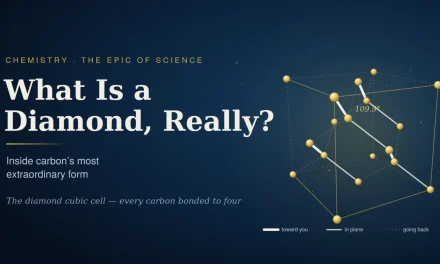
Consider diamond. Every carbon atom in it forms four covalent bonds, directed toward the corners of a tetrahedron at angles of roughly 109.5°, and each of those neighbors does exactly the same, and so on outward in every direction until the crystal runs out of atoms. Every one of those connections is an ordinary covalent bond, and nowhere in a network covalent solid is there a boundary where one unit ends and the next begins. A one-carat diamond is not a collection of carbon molecules stuck together; it is, in the most literal chemical sense, one molecule containing on the order of 1022 atoms.
Now the glazier’s evidence makes sense. To scratch a surface, you must displace atoms there, and in a network solid the covalent bond you must break is a real chemical bond, a shared pair of electrons in a directional orbital requiring hundreds of kilojoules per mole to sever. Scratching a molecular solid like ice or wax merely pushes molecules past one another. Scratching diamond means demolishing a plane of carbon–carbon bonds simultaneously. Almost nothing in nature can deliver that, which is why diamond sits alone at the top of the Mohs scale.
Melting behaves the same way. A molecular solid melts when thermal energy overcomes weak intermolecular attraction, so ice yields at 0 °C. A network solid has no intermolecular forces to overcome because it has no separate molecules. To make it flow, you must break the network itself, and the temperatures required are correspondingly brutal. Quartz softens and melts only above roughly 1,700 °C; silicon carbide does not melt at ordinary pressure but decomposes at temperatures above 2,700 °C. Chemistry teaching resources such as LibreTexts Chemistry use this contrast — melting points separated by thousands of degrees for substances made of similar elements — as the diagnostic signature of a covalent network.
Why Continuity Matters More Than Strength
Here is the subtlety most summaries miss. An individual carbon–carbon bond is strong but not uniquely strong; many ordinary molecules contain bonds of comparable or greater energy and are gases at room temperature. What distinguishes a network solid is not the strength of any single covalent bond in the network, but the fact that the bonds never stop. Continuity, not intensity, is the decisive property. A methane molecule also contains carbon bonded tetrahedrally to four neighbors, but those neighbors are hydrogen atoms with nothing left to bond to. The network terminates almost before it begins, and methane is a gas. Carbon bonded only to more carbon has no way to terminate at all.
The Same Element, Two Networks
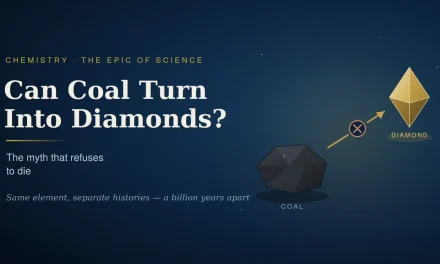
Graphite makes the point beautifully because it shows that a network can extend in two dimensions rather than three. Each carbon atom in graphite bonds strongly to only three neighbors, forming flat hexagonal sheets that are individually networks of remarkable strength. This bonding makes a single graphene layer famously robust. But the sheets themselves are held to one another only by weak dispersion forces. Slide them and they part, which is why graphite marks paper and lubricates machinery. The fourth valence electron on each atom is not locked into a localized bond but delocalized across the sheet, which is also why graphite conducts electricity while diamond does not. One element, two bonding topologies, and a chasm of difference in behavior, only one of which, the tetrahedral form, is a true network covalent solid in all three dimensions. This same structural distinction is what settles a much older piece of folklore: coal does not turn into diamond underground, no matter how much pressure is applied, precisely because coal’s carbon is never locked into this rigid tetrahedral network the way mantle-formed diamond is.
Quartz and Glass: The Same Bonds, Different Order
Silicon sits directly below carbon in the periodic table and inherits its taste for four bonds, so it builds networks too, though it prefers to do so through oxygen. In quartz, each silicon atom bonds to four oxygen atoms arranged tetrahedrally around it, and each oxygen bridges to another silicon, propagating the lattice indefinitely. The formula SiO2 is therefore a ratio, not a molecule: there is no discrete particle of silicon dioxide anywhere in a quartz crystal, only the endless alternation of silicon and oxygen.
The comparison between quartz and glass is one of the most instructive in solid-state chemistry because it isolates a single variable. Ordinary window glass is also built from silicon–oxygen networks, and the individual bonds are essentially the same as those in quartz. What differs is order. Quartz is crystalline: its tetrahedra repeat in a regular, periodic pattern that extends over the whole crystal. Glass is amorphous: the same tetrahedra connect into a network, but the network is disordered, frozen in a jumbled arrangement rather than a repeating one. Manufacturers further disrupt it deliberately by adding sodium and calcium compounds that interrupt some bridging oxygens and lower the working temperature enough to make the material practical to shape.
This is why the pairing of quartz and glass turns up so often in teaching: they isolate the single variable of long-range order while holding the chemistry constant. Nothing about the silicon–oxygen bond itself changes between them. What changes is whether the network repeats predictably or freezes in disarray, and that alone reshapes how the material grows, breaks, and bends light.
The consequences are visible to anyone. Quartz crystals grow with flat faces and sharp angles and cleave along defined planes, because the underlying order defines them. Glass has no such planes; it fractures along smooth, curved conchoidal surfaces that follow the stress rather than the structure. Quartz is also harder, rated 7 on the Mohs scale against roughly 5.5 for ordinary glass — which is why quartz-bearing sand scratches windows, and why the glazier’s diamond, harder than both, cuts either one without complaint.
Why This Idea Earns Its Keep
Recognizing a network solid is genuinely useful, and not only in a classroom. It explains why the crucibles in a laboratory furnace are made of silica or alumina rather than anything molecular, why silicon carbide ends up in brake discs and body armor, why abrasives from sandpaper to industrial grinding wheels are drawn from this same family, and why the semiconductor industry is built on silicon crystals grown with the network intact and almost perfectly ordered.
It also disciplines a common misconception. People often assume that hardness and high melting points mean “strong bonds,” full stop, and therefore that the hardest materials must contain some exotic super-bond. They do not. The bonds in quartz and diamond are ordinary covalent bonds of unremarkable individual strength. What is extraordinary is the geometry — the fact that each atom has enough bonding partners, pointed in enough directions, to propagate a lattice without end. Change the topology and the same element becomes a lubricant, or a gas.
What is a network covalent solid, then, in a sentence a reader can carry away? It is a substance in which covalent bonds extend continuously in one, two, or three dimensions so that the crystal itself is a single molecule, producing exceptional hardness, very high melting points, insolubility in common solvents, and — except where delocalized electrons exist, as in graphite — electrical insulation. Diamond, quartz, and silicon carbide are the standard examples of a covalent network solid; ice, salt, and copper are the instructive contrasts.
The Molecule You Can Hold
There is a pleasing vertigo in the realization that a quartz pebble on a beach is not a heap of anything. It is one object in the chemical sense as well as the visual one, a single connected structure of silicon and oxygen that has held its bonds since the granite it weathered out of cooled. The same is true of every diamond, every grain of industrial carbide, every wafer of silicon in the device you are reading this on. We are used to molecules being invisible, countable, small. Here is a class of substance where the molecule is the thing itself, large enough to pick up and turn over in your fingers.
And the next time you watch glass yield to a scoring wheel, you will know exactly what you are seeing: not a contest of hard against soft, but a disordered network of silicon and oxygen giving way to an ordered network of carbon — one continuous web of bonds, briefly and decisively winning against another.
References
LibreTexts Chemistry — Covalent (Network) Solids; Types of Crystalline Solids. chem.libretexts.org
Royal Society of Chemistry — Bonding, structure and properties resources. rsc.org
Pauling, L. The Nature of the Chemical Bond. Cornell University Press.
Mohs hardness values as compiled in standard mineralogical references; quartz 7, diamond 10.


Trackbacks/Pingbacks