Contents
- The Letter That Launched a Thousand Pages
- Why Read Biographies Instead of Textbooks?
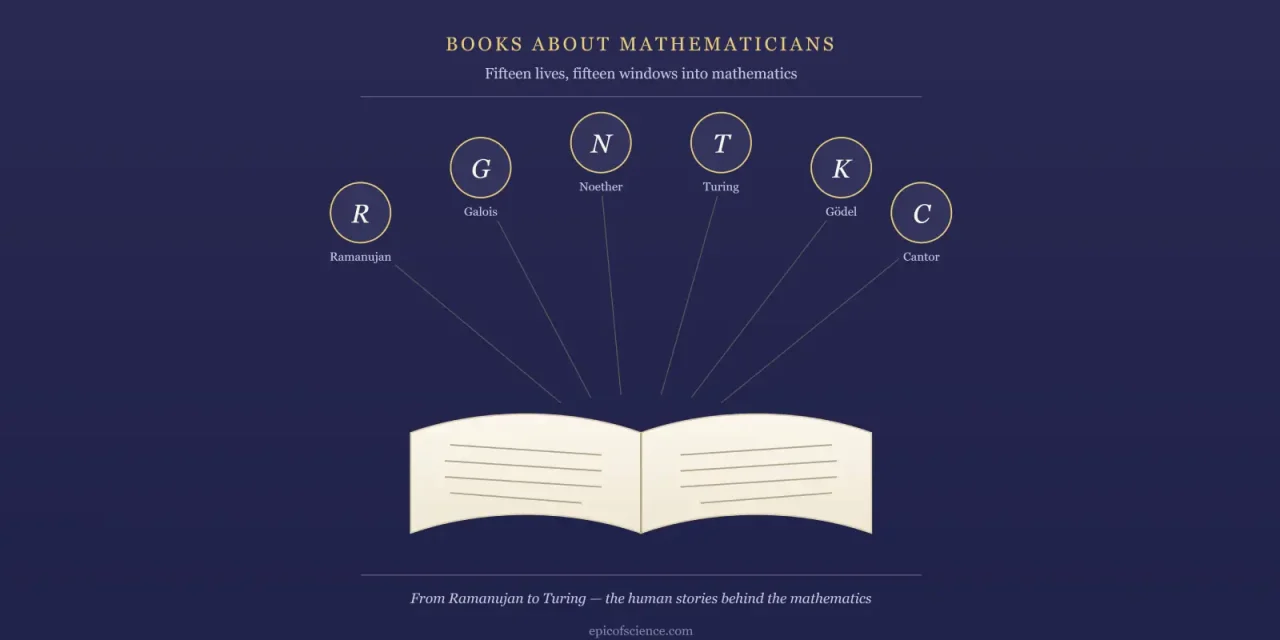
- Many Lives, Many Windows into Mathematics
- What Do These Lives Tell Us About Mathematical Truth?
- The Arguments Behind the Canon
- What makes a great books about mathematicians list?
- Where These Stories Lead
- The Notebook on the Nightstand
- References and Further Reading
What would you do if a letter arrived from an unknown clerk in India, filled with formulas that seemed to come from nowhere — results so strange they looked like the work of a genius or a fraud? That was the question G. H. Hardy faced in January 1913, and the answer he chose changed twentieth-century mathematics. We know this story today because someone wrote it down, not as a theorem but as a human drama. The best books about mathematicians do exactly this: they take the cold architecture of proof and reveal the warm, messy, sometimes tragic lives behind it. They show us that mathematics is not a solitary act of logic performed in a vacuum but a deeply human enterprise shaped by ambition, prejudice, loneliness, and flashes of inexplicable inspiration.
If you are looking for the most compelling mathematician biographies to read in 2025, this guide presents a selection of works that capture mathematics not as an abstract discipline but as a lived experience — books that will change how you think about numbers, genius, and what it means to understand the universe.
The Letter That Launched a Thousand Pages
Robert Kanigel did not set out to write a mathematics textbook. When he began researching The Man Who Knew Infinity, published in 1991, he traveled to Kumbakonam, the small town in Tamil Nadu where Srinivasa Ramanujan grew up in a modest Brahmin household, scribbling formulas on slate because paper was expensive. Kanigel walked the streets Ramanujan had walked, sat in the temple where Ramanujan claimed the goddess Namagiri whispered equations to him in dreams, and spent years reconstructing the social world of early-twentieth-century British academia that both elevated and destroyed the young Indian prodigy.
The result is arguably the finest Ramanujan book ever written — not because it explains every identity Ramanujan produced, but because it refuses to separate the mathematics from the mathematician. Kanigel paints Hardy as a complicated figure: an atheist who believed in mathematical truth with the fervor of a mystic, a man whose emotional reserve concealed a deep capacity for devotion. And Ramanujan emerges not as a savant performing parlor tricks but as a thinker grappling with ideas so far ahead of his time that mathematicians are still unpacking them more than a century later.
This is what the best biographies of mathematicians accomplish. They place you inside a specific moment — a cramped office in Trinity College, a sleepless night in a Madras port — and make you feel the weight of an idea struggling to be born. Kanigel’s book remains the gold standard for this kind of writing, and it belongs at the top of any reading list for 2025.
Why Read Biographies Instead of Textbooks?
There is a paradox at the heart of mathematical education. We teach theorems as if they arrived fully formed, pristine and inevitable, when in reality every theorem was once a conjecture scrawled in a margin, debated over coffee, abandoned for months, and resurrected in a flash of insight at three in the morning. Textbooks strip away the struggle. Biographies restore it. By restoring the struggle, they make the ideas more comprehensible — especially for readers looking for math for non mathematicians, people who want to understand what mathematics is about without mastering years of prerequisite notation.
Consider Euler’s identity, often called the most beautiful equation in mathematics: \( e^{i\pi} + 1 = 0 \). In a textbook, it appears as a consequence of the Taylor series expansion of the exponential function. In a biography of Euler, it appears as the culmination of a life spent believing the universe possesses a deep, hidden harmony — that the constants \( e \), \( \pi \), \( i \), 1, and 0 are not arbitrary symbols but fundamental characters in a cosmic story. The equation is the same in both cases. The understanding is not.
This is the case for the story of mathematics books: they provide context, motivation, and emotional resonance. They turn formulas from obstacles into revelations. They remind us that the history of mathematics is, at bottom, the history of human beings trying to make sense of patterns they did not create and cannot fully explain. If you have ever felt alienated by mathematics, the biographies on this list offer a different door into the subject — one that opens onto stories rather than exercises.
Many Lives, Many Windows into Mathematics
What follows is not a ranked list but a constellation of biographies of mathematicians that, taken together, trace the arc of mathematical thought from antiquity to the present. Each book earned its place here because it does what a textbook cannot: it makes you care about an idea by making you care about the person who had it.
Ramanujan and Hardy: The Improbable Partnership
Kanigel’s The Man Who Knew Infinity (1991) remains the essential Ramanujan book, but readers should pair it with Hardy’s own A Mathematician’s Apology (1940), a slim, elegiac meditation on creativity, aging, and the aesthetic dimension of proof. Hardy compared mathematical theorems to paintings and poems, arguing that a beautiful proof possesses the same inevitability as a sonnet by Shakespeare. Together, these two books form a dialogue across cultures: Ramanujan’s intuition and Hardy’s rigor, India’s colonial periphery and England’s intellectual center, faith and skepticism sitting side by side over the same equations.
Euler: The Master of Us All
William Dunham’s Euler: The Master of Us All (1999) does something few inspiring math books manage — it explains actual mathematics, step by step, while keeping the narrative energy of a biography. Euler produced more published pages of mathematics than any human in history, and he did much of it blind. Dunham guides the reader through Euler’s solutions to the Basel problem, which \( \sum_{n=1}^{\infty} \frac{1}{n^2} = \frac{\pi^2}{6} \) stunned the mathematical world, and his pioneering work in graph theory, number theory, and analysis. This is math for non mathematicians done right: rigorous but humane.
Galois: Revolution in Every Sense
Évariste Galois, circa 1826 — the only known portrait, drawn when he was about 15 (public domain).
The story of Évariste Galois — dead at twenty in a duel, scribbling his final mathematical testament the night before — has become legend. Mario Livio’s The Equation That Couldn’t Be Solved (2005) separates fact from myth while explaining how group theory, born in Galois’s feverish notes, became one of the most powerful frameworks in modern mathematics and physics. Galois showed that the general quintic equation has no solution by radicals, a result captured by the structure of what we now call the Galois group of a polynomial. His life is a reminder that mathematical genius does not guarantee time.
Emmy Noether: The Mother of Modern Algebra
For decades, Emmy Noether’s contributions were obscured by the sexism of early twentieth-century academia. She was denied a proper faculty position at Göttingen even as she reshaped the foundations of abstract algebra and proved a theorem — Noether’s theorem, linking symmetries to conservation laws — that Einstein called the most important result in mathematical physics since general relativity. The best account of her life for general readers remains the relevant chapters in Women in Mathematics by Lynn M. Osen (1974) and the more recent Emmy Noether’s Wonderful Theorem by Dwight E. Neuenschwander (2011), which demonstrates how the equation \( \frac{\partial \mathcal{L}}{\partial q} – \frac{d}{dt}\frac{\partial \mathcal{L}}{\partial \dot{q}} = 0 \) encodes a deep truth about the structure of physical law.
Alan Turing: The Architect of the Impossible
Andrew Hodges’s Alan Turing: The Enigma (1983) is not merely a biography but an act of justice. Hodges reconstructed Turing’s life with meticulous care — the invention of the theoretical computer, the wartime codebreaking at Bletchley Park, the prosecution for homosexuality that led to Turing’s death in 1954. The book reveals how Turing’s 1936 paper on computable numbers, which introduced what we now call Turing machines, arose from a question about the limits of mathematical proof: Hilbert’s Entscheidungsproblem, asking whether there exists a mechanical procedure to determine the truth or falsity of any mathematical statement. Turing showed the answer is no, and in doing so, laid the foundation for computer science.
John Conway: The Playful Genius
Siobhan Roberts’s Genius At Play (2015) captures a different kind of mathematical life. John Horton Conway — inventor of the Game of Life, discoverer of surreal numbers, tireless explorer of symmetry groups — approached mathematics with the spirit of a child playing with blocks, except the blocks were infinite-dimensional. Roberts followed Conway for years, recording his tangents, his jokes, his bouts of depression, and his insistence that mathematics should above all be fun. The book is a masterclass in mathematical portraiture, showing that rigor and play are not opposites but partners.
Gödel: The Limits of Reason
Rebecca Goldstein’s Incompleteness: The Proof and Paradox of Kurt Gödel (2005) tackles one of the most profound results in the history of thought. Gödel’s incompleteness theorems, published in 1931, demonstrated that any consistent formal system powerful enough to describe arithmetic contains true statements that cannot be proved within the system. Goldstein places this result in its philosophical context — the Vienna Circle, the rise of logical positivism, Gödel’s Platonism — and argues persuasively that the theorems are not merely technical curiosities but deep truths about the nature of mathematical knowledge itself.
Cantor, Erdős, Grothendieck, and More
The remaining books on this list fill out the panorama. Amir Aczel’s The Mystery of the Aleph (2000) tells the tragic story of Georg Cantor, who proved that some infinities are larger than others and spent his final years in a psychiatric hospital. Paul Hoffman’s The Man Who Loved Only Numbers (1998) paints the unforgettable portrait of Paul Erdős, the itinerant mathematician who owned nothing, traveled constantly, and collaborated with more co-authors than anyone in history. Cédric Villani’s Birth of a Theorem (2015) offers a rare first-person account of mathematical creation. Sylvia Nasar’s A Beautiful Mind (1998) chronicles John Nash’s battle with schizophrenia alongside his Nobel-winning work in game theory. And for readers drawn to the French avant-garde, the story of Alexander Grothendieck — who revolutionized algebraic geometry and then withdrew from mathematics entirely — is told with sensitivity in Winfried Scharlau’s ongoing biographical project. Each of these mathematician biography books reveals a different facet of what it means to devote a life to abstraction.
What Do These Lives Tell Us About Mathematical Truth?
Reading biographies of mathematicians long enough, a question begins to gnaw at you — one the biographies rarely address head-on but every story implicitly raises. When Ramanujan claimed the goddess Namagiri revealed formulas to him in dreams, and those formulas turned out correct, what exactly happened? When Cantor proved the set of real numbers is uncountably infinite — that \( |\mathbb{R}| > |\mathbb{N}| \) — did he discover a fact about the universe, or did he construct a new game with new rules and then observe its consequences?
This is the oldest question in the philosophy of mathematics, and the most honest answer is that it remains unresolved. But reading these many lives side by side pushes me toward a position I find intellectually unavoidable, even if philosophically uncomfortable: these mathematicians did not behave like inventors. They behaved like explorers. Hardy, in A Mathematician’s Apology, insisted that “mathematical reality lies outside us, that our function is to discover or observe it, and that the theorems which we prove, and which we describe grandiloquently as our ‘creations,’ are simply the notes of our observations.” Gödel went further, maintaining a strict Platonism throughout his life — the conviction that mathematical objects exist in a realm as real as the physical world, and that mathematical intuition is a kind of perception.
The most defensible reading of these lives, I believe, is that mathematical truth possesses a stubbornness that mere invention cannot explain. Ramanujan and Euler, working centuries apart on different continents with entirely different methods, converged on the same identities. The prime numbers refuse to rearrange themselves to suit our preferences. Gödel’s incompleteness theorems are not true because Gödel proved them — they were true before 1931, and they will remain true if every copy of Gödel’s paper is destroyed. This is what separates mathematical truth from empirical truth: it does not depend on observation, experiment, or the continued existence of the physical universe. As Plato argued in the Republic, mathematical objects belong to a realm apprehended by reason alone, unchanging and eternal. And while Imre Lakatos complicated this picture brilliantly in Proofs and Refutations (1976), arguing that mathematical knowledge grows through a quasi-empirical process of conjecture, counterexample, and revision — that proofs are not static monuments but living arguments — even Lakatos never denied that the truths arrived at through this messy process possess a durability that scientific theories do not.
Here is what I find genuinely unsettling about these biographies taken as a collective: several of the mathematicians described in them — Ramanujan, Galois, Cantor, Grothendieck — clearly did not fully understand what they had created. Ramanujan’s notebooks contain identities whose proofs were not supplied for decades. Galois’s group theory was not properly formalized until long after his death. Grothendieck’s vision of algebraic geometry was so vast that his own students spent careers unpacking its implications. This suggests something remarkable about the relationship between the human mind and mathematical reality: it is possible to reach further than you can see. It is possible to grasp a truth whose full meaning exceeds your own comprehension. If mathematics were merely a human invention — a language game, as Wittgenstein sometimes seemed to suggest — then the inventor should understand the invention. But these lives demonstrate, again and again, that the mathematician is more like a person who has stumbled upon a continent and mapped only its coastline. The interior remains.
The Arguments Behind the Canon
What makes a great books about mathematicians list?
The best books about mathematicians combine narrative craft, mathematical accuracy, and emotional honesty. They draw on extensive archival research, personal interviews, and original mathematical analysis, and they treat their subjects as complex human beings rather than plaster saints of rationality. The Mathematical Association of America holds its recommended biographies to this same standard, prizing titles that succeed not merely as hagiography but as literature.
Not every book on this list was welcomed with open arms upon publication. Hodges’s biography of Turing appeared at a time when Turing’s homosexuality was still a source of institutional embarrassment, and some reviewers questioned whether the subject’s personal life merited such detailed treatment. History has vindicated Hodges emphatically. Similarly, Kanigel’s Ramanujan book — the subject of our own closer look at Ramanujan biographies — faced initial skepticism from mathematicians who doubted that a journalist could do justice to deep number theory — skepticism that evaporated once the mathematical community saw how carefully Kanigel had rendered the ideas. Roberts’s Genius At Play divided readers for a different reason: Conway himself was a polarizing figure, and some felt the book was too sympathetic. But biography is not hagiography, and Roberts’s willingness to portray Conway’s flaws alongside his brilliance is precisely what gives the book its power.
The history of mathematics, like the history of science, was not built by consensus but by argument. These inspiring math books capture that dynamic — the rivalries, the priority disputes, the moments when an entire community had to decide whether a new idea was a breakthrough or a mistake.
Where These Stories Lead
Every biography on this list opens a door into a larger mathematical landscape. Read Kanigel on Ramanujan and you find yourself drawn into the theory of partitions, modular forms, and mock theta functions — ideas that now power research in string theory and black hole physics. Read Hodges on Turing, and you arrive at the foundations of artificial intelligence, computational complexity, and the question of whether a machine can think. Read Goldstein on Gödel, and you confront the limits of formal systems — limits that resonate in every conversation about the reliability of automated proof verification and the future of mathematics itself.
These connections are not accidental. Mathematics is the most interconnected of all human disciplines, and the life of any great mathematician inevitably touches dozens of fields. For readers who want to explore the broader sweep of mathematical history — from ancient geometry through the calculus wars to modern abstraction — our mathematics history section traces these threads across centuries and civilizations. The biographies recommended here serve as entry points, each one a trailhead leading into terrain that is vast, challenging, and profoundly beautiful.
What strikes me most about these books, taken together, is how they demolish the stereotype of the mathematician as a cold, asocial calculator. The people in these pages loved and suffered and doubted. They fought with colleagues and institutions. They experienced the kind of joy that comes only from understanding something no one has ever understood before — and the particular anguish of suspecting that what they understood might be beyond their ability to communicate. These are not stories about numbers. They are stories about human beings confronting infinity.
The Notebook on the Nightstand
Somewhere tonight, a teenager is reading one of these books for the first time. Maybe it is the Ramanujan book, and she is learning that a self-taught clerk once derived results that baffled Cambridge professors. Maybe it is the Turing biography, and he is realizing that the phone in his pocket descends from a thought experiment about undecidable propositions. The mathematics these books describe is eternal — the identities, the theorems, the proofs do not change. But the meaning of these books is not in the mathematics alone. It is in the encounter: a living mind meeting a dead one across the page, and recognizing something. Not just intelligence, but longing. The longing to see the pattern beneath the pattern, the structure beneath the structure, the truth beneath appearance. If you pick up even one of these books about mathematicians this year, you will not simply learn about a life. You will be asked a question that no biography can answer for you: what would you risk to understand something truly?
References and Further Reading:
Robert Kanigel, The Man Who Knew Infinity: A Life of the Genius Ramanujan (Charles Scribner’s Sons, 1991). Siobhan Roberts, Genius At Play: The Curious Mind of John Horton Conway (Bloomsbury, 2015). G. H. Hardy, A Mathematician’s Apology (Cambridge University Press, 1940). Andrew Hodges, Alan Turing: The Enigma (Simon & Schuster, 1983). Rebecca Goldstein, Incompleteness: The Proof and Paradox of Kurt Gödel (W. W. Norton, 2005). William Dunham, Euler: The Master of Us All (MAA, 1999). Mario Livio, The Equation That Couldn’t Be Solved (Simon & Schuster, 2005). Imre Lakatos, Proofs and Refutations (Cambridge University Press, 1976).


Trackbacks/Pingbacks