Is the BBC's The Secrets of Quantum Physics Worth Your Time?
If you have searched for a quantum physics documentary that makes the weirdness of the quantum world accessible without dumbing it down, then The Secrets of Quantum Physics has likely appeared in your results. Presented by physicist and broadcaster Jim Al-Khalili and produced by the BBC, this two-part series explains wave-particle duality, quantum entanglement, and the role quantum mechanics may play in biology, all in about two hours of television. But does it deliver? Is the science trustworthy? And who will get the most out of watching it?
This review covers what the series contains, how well it communicates the physics, its strengths and weaknesses, and whether it belongs on your watchlist — whether you are a curious newcomer, a student seeking supplemental material, or a science-documentary enthusiast looking for something more substantial than usual pop-science fare.
The Short Verdict
The BBC’s The Secrets of Quantum Physics is one of the best introductory quantum physics documentaries available. Jim Al-Khalili is a rare combination of working physicist and natural storyteller, and the series strikes an honest balance between accessibility and scientific accuracy. If you want a single film — or rather, a two-part series — to orient yourself in the quantum world before picking up a textbook, this is an excellent place to start. Its main limitation is that it stays at a conceptual level and devotes its entire second episode to quantum biology, which may frustrate viewers hoping for deeper coverage of foundational quantum mechanics. For that audience, additional resources are needed, but as a gateway, it earns a strong recommendation.
What Makes a Good Quantum Physics Documentary?
Science documentaries occupy a difficult middle ground. Lean too far toward entertainment and you get breathless narration over swirling CGI that tells the viewer almost nothing. Lean too far toward rigor and you lose everyone without a physics degree. The secrets of quantum physics are notoriously difficult to convey on screen because the subject resists everyday analogies. Electrons do not behave like tiny billiard balls, and “observation” does not mean a conscious mind peering at an atom. Any documentary relying on these clichés without complicating them does the viewer a disservice.
The best work in this genre shares a few qualities: a presenter who understands the material and can improvise rather than read a teleprompter; visual demonstrations or thought experiments that illuminate rather than decorate; honest acknowledgment of what remains uncertain or debated; and a structure that builds concepts in sequence so the viewer is not asked to accept conclusions without groundwork. It also helps if the documentary names the actual physicists — Planck, Einstein, Bohr, Schrödinger, Bell — and situates ideas in the history of their discovery, because quantum mechanics makes more sense as a story of problems solved than as a list of strange facts.
With these criteria in mind, let us look at how Jim Al-Khalili’s BBC series measures up.
A Closer Look at the Series
Structure and Scope
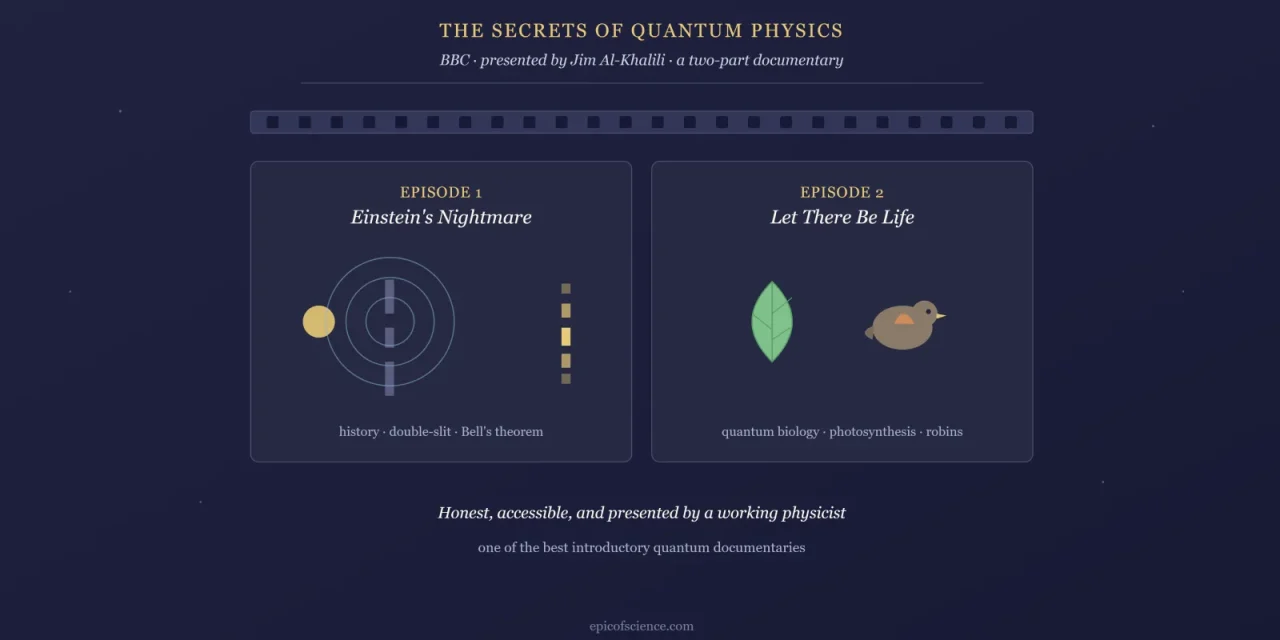
The series is divided into two episodes. The first, titled “Einstein’s Nightmare,” traces the historical development of quantum mechanics from the early twentieth century onward. Al-Khalili guides the viewer through the double-slit experiment, the concept of superposition, the Einstein-Bohr debates over quantum theory’s completeness, and the implications of Bell’s theorem and entanglement. The second episode, titled “Let There Be Life,” shifts to a more speculative but fascinating topic: quantum biology, exploring whether quantum effects play a role in photosynthesis, bird navigation, and the sense of smell.
This two-part structure is both a strength and a limitation. Foundational physics receives only about an hour of screen time before the series moves on to biology, which may leave viewers wanting deeper treatment of core quantum formalism or more time on the measurement problem, decoherence, and interpretations of quantum mechanics. On the other hand, the quantum biology content is unusual for a popular-level quantum physics film and gives the series a distinctive identity among its peers.
Jim Al-Khalili as Presenter
A large part of what makes this BBC quantum physics documentary work is its host. Jim Al-Khalili is a professor of theoretical physics at the University of Surrey and has authored several well-regarded popular science books, including Quantum: A Guide for the Perplexed. He brings genuine subject-matter authority to the screen — not an actor reading lines about physics, but a researcher explaining his own field. His on-camera manner is warm, unhurried, and occasionally playful. He is willing to pause and say “this is genuinely strange” without pretending the strangeness can be fully resolved in a neat analogy.
Al-Khalili’s background in quantum biology research is especially relevant to the second episode, where he discusses the work with enthusiasm and appropriate caveats. He does not overclaim. When discussing whether quantum coherence plays a role in photosynthesis, he frames it as an active area of investigation rather than a settled conclusion. This intellectual honesty is uncommon in popular science media and is one of the series’ most valuable qualities. For viewers familiar with Jim Al-Khalili’s written work, the documentary serves as a visual companion — covering much of the same conceptual territory as Quantum: A Guide for the Perplexed but with the added power of location filming, archival footage, and physical demonstrations.
Visual Quality and Production
The BBC’s production values are high. The series visits historically significant locations, uses archival material thoughtfully, and employs animations that clarify rather than dazzle. The double-slit experiment, for example, is demonstrated with a real apparatus and extended with clear graphics showing the interference pattern. These visual choices respect the viewer’s intelligence — they show what is happening rather than telling you to be amazed.
That said, the series is not visually groundbreaking like some bigger-budget productions. Viewers used to the cinematic scale of a large Netflix science series may find the look somewhat traditional. This is a minor point — substance matters more than spectacle in science communication — but it is worth noting for anyone whose decision to watch depends partly on production polish.
Scientific Accuracy and Limitations
Overall, the science in the series is carefully handled. The first episode presents the historical development of quantum mechanics accurately, and Al-Khalili avoids common pitfalls of popular quantum communication: he does not suggest “observation” requires consciousness, does not imply quantum mechanics validates mysticism, and portrays the Einstein-Bohr debate as a disagreement between two rigorous thinkers rather than a simple story of Einstein being wrong.
The second episode, on quantum biology, is more speculative and viewers should apply caution. The field has advanced since the series aired, and some early claims, especially about long-lived quantum coherence in photosynthesis, have been questioned or refined by later research. Al-Khalili is careful in his language, but the documentary format freezes the science at a moment in time. Viewers interested in quantum biology should treat the episode as an introduction to the questions, not a final account, and follow up with recent literature.
A broader limitation is what the series leaves out. It does not discuss quantum computing in depth, touches only lightly on various interpretations of quantum mechanics (Many Worlds, de Broglie-Bohm, and so on), and does not venture into quantum field theory or the Standard Model. These omissions are understandable given the two-hour runtime, but they mean a viewer finishing the series will have a good conceptual foundation in a few key quantum phenomena without a comprehensive map of the field.
Who Should Watch — and Who Should Look Elsewhere
If you are a complete newcomer to quantum mechanics — someone who has heard the buzzwords but never encountered the ideas systematically — this is an outstanding starting point. Jim Al-Khalili’s explanations build carefully from historical context, and you will come away understanding the double-slit experiment, superposition, and entanglement at a genuine conceptual level rather than just having heard the words. The series asks nothing mathematically and assumes no prior physics background. Writing in The Guardian, Julia Raeside captured the same appeal, describing how Al-Khalili leads viewers “down the rabbit-hole of true scientific bewilderment.”
If you are a student taking or about to take a quantum mechanics course, the first episode serves as a useful conceptual warm-up. It will not teach you the Schrödinger equation or Dirac notation, but it will give you the physical intuition many textbooks assume and few provide. Pair it with a proper textbook — Griffiths, Shankar, or Sakurai depending on your level — and you will enter your course with a clearer sense of what the mathematics describes.
If you are a science-documentary enthusiast who has already seen many quantum physics films, the first episode may cover familiar ground, but the second episode on quantum biology is likely to offer genuinely new material. It is the distinguishing feature of this series relative to competitors like PBS’s various quantum specials or the older BBC Horizon episodes on the subject.
If you are looking for an in-depth treatment of the interpretations of quantum mechanics — Many Worlds versus Copenhagen versus pilot-wave theory — this series will not satisfy that particular itch. You would be better served by supplementary reading or by seeking out more focused documentaries and lecture series on that specific question. Similarly, if you want a quantum physics documentary that covers quantum computing, quantum cryptography, or particle physics, you will need to look beyond this series.
What to Do Next
If this review has persuaded you to watch, the series is available through the BBC’s programme page, though availability varies by region and platform — check your local streaming services or the BBC iPlayer if you are in the UK. American viewers may find it through select streaming platforms or educational media libraries; availability has shifted over time, so a quick search at the time you read this is worthwhile.
After watching, a natural next step is Al-Khalili’s book Quantum: A Guide for the Perplexed, which covers much of the same territory in greater depth and at a comfortable non-mathematical level. For viewers whose curiosity extends to the quantum biology material, Al-Khalili and Johnjoe McFadden co-authored Life on the Edge: The Coming of Age of Quantum Biology, which develops the second episode’s themes at book length.
For a broader set of recommendations — including textbooks, other documentaries, podcasts, and online courses — visit our Resources page, where we maintain curated guides across mathematics and physics. A commonly asked question is: Is The Secrets of Quantum Physics suitable for someone with no science background? Yes — the series assumes no prior knowledge of physics or mathematics and builds every concept from the ground up, making it one of the most accessible entry points into quantum mechanics available in documentary form.
Final Thoughts
Among the many quantum physics documentaries produced over the past two decades, the BBC’s The Secrets of Quantum Physics stands out for a simple reason: it is presented by someone who genuinely understands the science and genuinely cares about communicating it honestly. Jim Al-Khalili does not sensationalize, mystify, or condescend. The result is a two-part series that leaves you knowing more than you did — and knowing it accurately — which is the only standard that really matters in science communication.
It is not comprehensive, and it will not replace a textbook or a university course. But as a first encounter with the quantum world, or as a gift for a curious friend who keeps asking what all the fuss is about, it is one of the best options available. Watch it, enjoy it, and then keep going — the real secrets of quantum physics only deepen from here.
References and Further Reading
BBC Programme Page — The Secrets of Quantum Physics: bbc.co.uk/programmes/b04ty7p8
Jim Al-Khalili, Quantum: A Guide for the Perplexed (Weidenfeld & Nicolson).
Jim Al-Khalili and Johnjoe McFadden, Life on the Edge: The Coming of Age of Quantum Biology.
BBC Horizon archive — various episodes on quantum mechanics.
BAFTA listings — science and natural history programming.