The Cosmic Wish Machine That Never Was
Somewhere in the early 2000s, a strange marriage was consummated in the popular imagination. On one side stood quantum mechanics — the most precise and bewildering theory in the history of physics. On the other stood a much older human longing: the belief that thought, properly directed, can reshape reality. The wedding ceremony was broadcast to millions through bestselling books and viral documentaries, and the offspring was a dazzling claim: that quantum physics and manifestation are scientifically linked, that your consciousness literally collapses the wave function of the universe to deliver what you desire.
It was an irresistible idea. It dressed ancient magical thinking in the lab coat of modern science. It told people that the hardest, strangest branch of physics had finally confirmed what mystics always knew — that mind creates matter. Millions believed it. Some still do. But did quantum physicists themselves ever say any such thing? The answer requires us to go back to the real debates that shook physics in the twentieth century — debates about observation, reality, and consciousness that were fierce, genuine, and far more interesting than any self-help book has ever let on. The true story is not a confirmation of wish-fulfillment. It is something more unsettling, more honest, and ultimately more wondrous.
What Science Actually Says
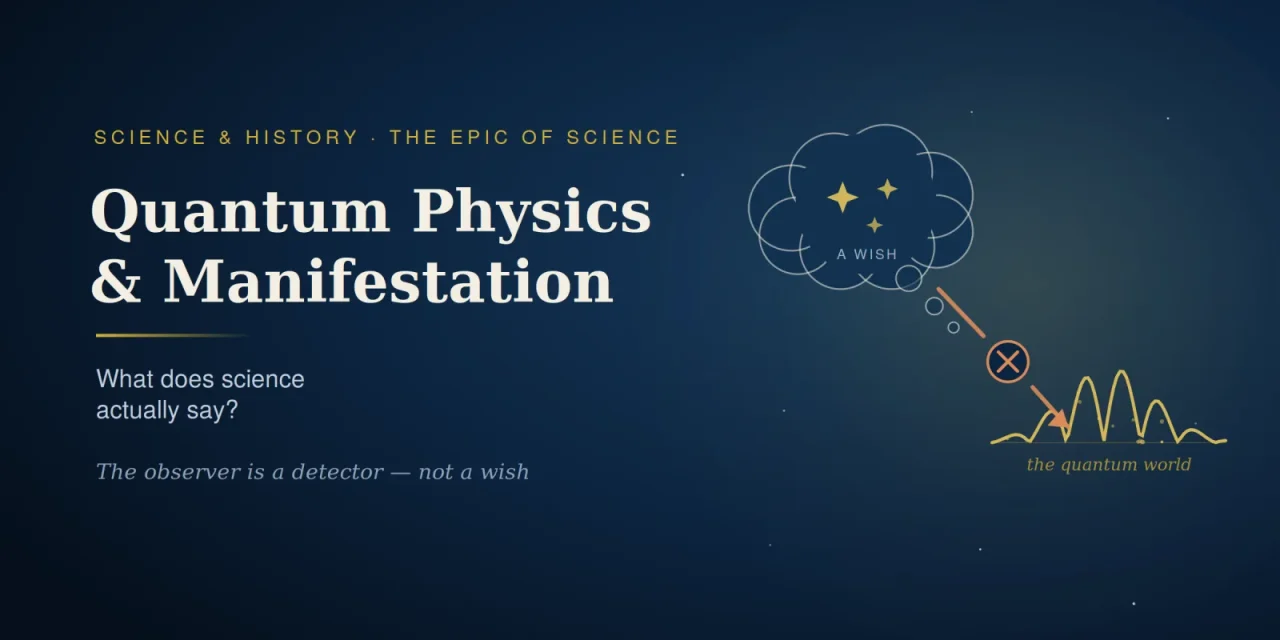
Quantum mechanics does not say that human thoughts reshape external reality. The “observer” in quantum physics is any physical interaction that extracts information from a system — a photon hitting a detector, an electron striking a screen — not a conscious mind making a wish. The supposed bridge between quantum physics and manifestation — the so-called quantum physics law of attraction — is not a simplification of real science but a misunderstanding of it, one that physicists have spent decades trying to correct. That single distinction — between a physical measurement and a human intention — is the hinge on which the entire debate turns. Understanding how that distinction got blurred requires knowing the real history: who said what, who was misquoted, and how genuine scientific uncertainty became a playground for pseudoscience.A Revolution That Left Even Its Founders Unsettled
To understand why quantum physics became entangled with ideas about manifestation, you first have to appreciate how genuinely disturbing quantum mechanics was — and remains — even to physicists. Before quantum theory, the physical world was understood through classical mechanics, a framework perfected by Newton and refined over two centuries. In that world, objects had definite positions and velocities. Causes preceded effects. The universe, in principle, was a great clockwork: know every particle’s state, and you could predict the future with perfect accuracy. This was not naïve faith; it was the picture that had launched the Industrial Revolution and predicted the orbits of planets to astonishing precision. Then, in the first three decades of the twentieth century, that picture was shattered. Max Planck’s work on blackbody radiation in 1900, Albert Einstein’s explanation of the photoelectric effect in 1905, Niels Bohr’s model of the atom in 1913, and the full formalism developed by Werner Heisenberg, Erwin Schrödinger, Max Born, and Paul Dirac in the mid-1920s revealed a subatomic world that operated by entirely different rules. Particles did not have definite properties until measured. They existed in superpositions — states of simultaneous possibility. The act of measurement seemed to force nature to “choose.” Heisenberg’s uncertainty principle, published in 1927, showed that certain pairs of properties — position and momentum, for instance — could not both be known precisely at the same time. This was not a limitation of instruments; it was a fundamental feature of reality. The philosophical shock was enormous. Even Einstein recoiled. His famous objection — often paraphrased as “God does not play dice” — expressed a deep unease with a universe that was, at bottom, probabilistic. The quantum physics manifesting itself in laboratories was stranger than anything philosophy had imagined — and nothing about that quantum physics manifesting in real experiments hinted at minds bending matter by will. And crucially, the theory’s founders disagreed bitterly about what it all meant. That disagreement — the so-called “interpretation problem” — has never been fully resolved, a tension that Philip Ball’s history of quantum mechanics’ tumultuous birth traces to the theory’s earliest days. It is the crack through which popular misunderstanding later poured.The Observer Problem and Its Hijacking
The trouble begins with a word: “observer.” In the Copenhagen interpretation — the framework associated primarily with Bohr and Heisenberg, and the dominant interpretation taught in physics classrooms for decades — a quantum system exists in a superposition of states until a measurement is made, at which point the wave function “collapses” to a single outcome. The language is suggestive. An “observation” seems to require an “observer.” And from there, it is a short and tempting leap to conclude that consciousness must play a role in quantum physics — that human awareness is the magic ingredient that solidifies reality. But this leap misunderstands what physicists mean by “measurement.” In quantum mechanics, a measurement is any interaction that correlates a quantum system with a larger physical system in a way that records information. A Geiger counter clicking, a photon being absorbed by a photographic plate, an electron leaving a track in a cloud chamber — these are all measurements. None of them require a sentient being to be watching. As the physicist Chad Orzel explains in How to Teach Quantum Physics to Your Dog, the quantum observer effect does not mean that consciousness creates reality; it means that the act of physical interaction — any physical interaction of the right kind — changes the system. A detector in an empty room works just as well as one watched by a Nobel laureate.This point was made forcefully and repeatedly by physicists throughout the twentieth century, yet a minority view persisted. The physicist Eugene Wigner did, in the 1960s, explore the idea that consciousness might play a role in wave-function collapse — a position sometimes called the “Wigner’s friend” thought experiment. John von Neumann’s mathematical formalism, published in his 1932 book on quantum mechanics, contained a step that some later interpreted as requiring a conscious observer, though historians of physics debate whether von Neumann himself intended that reading. These were genuine, if marginal, positions within the physics community. They were not, however, claims that thinking about a new car would make one appear in your driveway.
The popular conflation of quantum mechanics consciousness research with the law of attraction exploded into mainstream culture with the 2004 film What the Bleep Do We Know!? and the 2006 book The Secret. These works took the suggestive language of quantum mechanics — “observer,” “possibility,” “creating reality” — and welded it onto the much older tradition of New Thought, a nineteenth-century American metaphysical movement that taught that mind is the fundamental reality and that thought directly shapes material circumstances. The resulting hybrid, sometimes called “quantum woo” by its critics, claimed that the quantum physics law of attraction was not metaphor but literal science: that the observer effect meant your intentions could restructure the physical universe at the quantum level to manifest desired outcomes.
The physicist Sabine Hossenfelder has been among the most vocal critics of this conflation. On her widely read blog and public talks, she has argued that these claims misrepresent not just the details but the entire structure of quantum mechanics. The theory’s equations, she points out, are deterministic at the level of the wave function; probability enters only when we ask about the outcome of a specific measurement. There is no mechanism in quantum theory — none — by which a thought in a human brain could influence the behavior of particles outside that brain. The question “does quantum physics prove manifestation?” has a clear answer in mainstream physics: no. Recent experimental work continues to confirm standard quantum mechanics while ruling out exotic interpretations. The American Physical Society’s Physics magazine regularly reports the research through which physicists continue to test and refine quantum foundations — work that bears no resemblance to the claims of manifestation advocates.
The quantum observer effect law of attraction connection, then, is not a simplification of quantum physics. It is a substitution — replacing the technical meaning of “observer” with an everyday meaning, and then building an entire metaphysical system on the confusion. It is as if someone heard that a “bank” can hold a river and concluded that rivers are full of money.
Sorting the Real Debate from the Fantasy
To say that quantum mechanics does not support manifestation is not to say that the interpretation of quantum mechanics is settled. It emphatically is not. The Copenhagen interpretation, the many-worlds interpretation proposed by Hugh Everett III in 1957, the de Broglie–Bohm pilot wave theory, the decoherence program, objective collapse theories — these are live and active areas of debate among physicists and philosophers of physics. The question of what quantum mechanics means, as opposed to what it predicts, remains one of the deepest unsolved problems in the foundations of science.
But — and this is the crucial distinction — none of these serious interpretations endorse the idea that human thoughts manifest material outcomes. The many-worlds interpretation, for example, says that every quantum measurement causes the universe to branch into multiple realities, each containing a different outcome. That is a far cry from saying that you choose which branch you enter by thinking positively. Pilot wave theory restores determinism by adding hidden variables; it gives consciousness no special role at all. Decoherence explains the apparent collapse of the wave function through the interaction of a quantum system with its environment — billions of particles doing the “observing,” not a mind.
Wigner himself eventually abandoned his consciousness-based interpretation, moving toward other approaches later in his career. The few physicists who have continued to explore consciousness-related interpretations — such as the physicist Henry Stapp — remain far outside the mainstream, and their proposals have not generated confirmed experimental predictions that would distinguish them from standard quantum mechanics. The history of physics is littered with intriguing but unfruitful avenues of speculation, and intellectual honesty demands distinguishing between a genuine open question (what does quantum mechanics mean?) and a closed one (does quantum mechanics say your thoughts reshape external reality?).
Popular memory has badly distorted this landscape. Many people now believe that “quantum physics proved” that consciousness creates reality, a claim no major physics textbook supports. The distortion was made possible partly by the genuine strangeness of quantum mechanics — it really is counterintuitive, and its language really does invite misreading — and partly by a cultural hunger for scientific validation of spiritual beliefs. That hunger is understandable. But satisfying it with bad physics helps no one, least of all the people who are told their failures of “manifestation” reflect insufficient belief rather than the basic indifference of subatomic particles to human wishes.
Why Getting This Right Still Matters
The entanglement of quantum physics and manifestation is not merely a harmless quirk of pop culture. It matters because it erodes the public’s ability to distinguish real science from pseudoscience at a moment when that ability has never been more important. When quantum mechanics — the theoretical foundation of semiconductors, lasers, MRI machines, and much of modern technology — is presented as a cosmic wish-granting mechanism, it undermines trust in the actual scientific process. It teaches people that science is a buffet from which you can select the conclusions you like and ignore the rest.
It also obscures the genuinely profound questions that quantum mechanics raises — questions about the nature of reality, the limits of knowledge, and the relationship between mathematics and the physical world. These questions deserve serious engagement, not appropriation by self-help marketing. For readers interested in how the great debates and discoveries of science have actually unfolded — with all their complexity, their human drama, and their honest uncertainties — the Science & History archive at Epic of Science offers a richer and more accurate picture than any manifestation manual ever could.
Does quantum physics prove manifestation? No. The popular link between quantum physics and manifestation collapses under scrutiny: quantum mechanics describes the behavior of subatomic particles with extraordinary precision, but it contains no mechanism by which human thoughts influence external physical systems. The “observer” in quantum physics is a physical measuring apparatus, not a conscious mind making a wish. The connection between quantum physics and the law of attraction is based on a misunderstanding of technical terminology, not on experimental evidence.
The Strangeness That Remains
Here is what is worth holding onto after all the quantum woo has been cleared away: the universe really is stranger than classical physics imagined. Particles really do exist in superpositions. Entanglement really does connect distant systems in ways that defy everyday intuition. The measurement problem really is unsolved. These facts are not diminished by refusing to dress them up as a self-help technique — they are, if anything, made more astonishing.
The real story of quantum mechanics is not a story about the power of wishful thinking. It is a story about human beings confronting a reality that refused to conform to their expectations — and finding the courage to follow the mathematics wherever it led, even when it led somewhere deeply uncomfortable. Einstein spent the last decades of his life fighting a theory he had helped create, not because he was foolish, but because he understood, better than anyone, what was at stake. Bohr fought back not because he was certain, but because the evidence demanded it. That is what the pursuit of knowledge actually looks like: not a vision board, but a willingness to be wrong, to be unsettled, and to keep asking questions that have no easy answers.
The universe does not owe us comfort. But it does, if we are honest with it, offer us something better: the chance to understand it as it actually is, on its own magnificent and indifferent terms.
References
American Physical Society — Physics (APS), https://physics.aps.org/
Chad Orzel, How to Teach Quantum Physics to Your Dog (Scribner, 2009)
Sabine Hossenfelder, backreaction.blogspot.com — writings on quantum foundations and popular misconceptions