Contents
- The Aging Lion and His Young Collaborator
- Seeing Before Proving: What the Book Actually Does
- From Intuition to Rigor: The Mathematics Inside
- The Epistemological Turn: What Does It Mean to “See” a Theorem?
- A Book Born into Crisis
- The Long Shadow: Where Hilbert’s Vision Led
- The Question That Remains
- References and Further Reading
Geometry and the Imagination — Hilbert’s Classic Book Explained
What if the greatest mathematician of the twentieth century sat you down and, instead of lecturing on theorems and proofs, showed you what geometry looks like? Not the sterile exercises of a textbook, but the living shapes that haunt the space around us: soap bubbles stretching into minimal surfaces, curves twisting through four-dimensional space, polyhedra folding in on themselves with uncanny symmetry. This is exactly what Geometry and the Imagination, Hilbert’s celebrated 1932 masterpiece, sets out to do, and nearly a century later, its ambition remains breathtaking.
The book’s German title, Anschauliche Geometrie, is almost untranslatable. “Anschaulich” means something closer to “intuitive” or “visualizable” — geometry you can see with the mind’s eye before chaining it down with axioms. It was a radical gesture from a man who had spent decades building the most rigorous foundations mathematics had known. Why would David Hilbert, the architect of formalism itself, write a book that deliberately prioritized pictures over proofs? The answer tells us something profound about what mathematical understanding actually is and what it isn’t.
The Aging Lion and His Young Collaborator
By 1932, David Hilbert was seventy years old, and his dominance over European mathematics had lasted longer than most careers. From his chair at the University of Göttingen — then the unrivaled center of the mathematical world — he had reshaped number theory, integral equations, mathematical physics, and the very foundations of geometry. His 1899 work Grundlagen der Geometrie had rebuilt Euclidean geometry from scratch, replacing centuries of muddled axioms with a crystal-clear logical framework. Hilbert geometry, in that formal sense, was a monument to abstraction.
But the man behind the monument was restless. Hilbert had always believed mathematics should be accessible and that its deepest ideas possessed an elegance visible even to non-specialists. He found a kindred spirit in Stefan Cohn-Vossen, a young geometer with a gift for spatial thinking and an eye for beautiful diagrams. Together, Hilbert and Cohn-Vossen shaped lecture notes from Hilbert’s Göttingen courses into something unprecedented: a book that would take advanced geometric ideas — topology, differential geometry, crystallographic symmetry, the theory of surfaces — and present them with almost no formal prerequisites.
The collaboration was as poignant as it was productive. Cohn-Vossen, born in Breslau in 1902, was a rising star whose mathematical intuition Hilbert deeply admired. But history was already closing in. Within a year of the book’s publication, the Nazi regime began purging Jewish scholars from German universities, and Cohn-Vossen — barred from teaching in 1933 — was forced to leave the country. He fled first to Switzerland in 1934, then to the Soviet Union, where he died in Moscow in 1936 at just thirty-four. The Hilbert–Cohn-Vossen partnership produced only this single volume — but that volume became immortal.
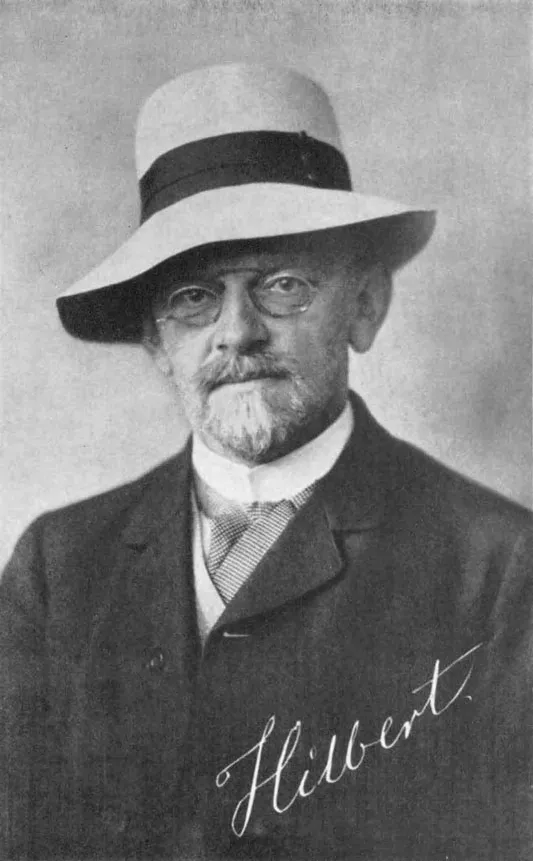
David Hilbert
Photographed around 1912 for a University of Göttingen faculty postcard series (public domain).
Seeing Before Proving: What the Book Actually Does
To understand why Geometry and the Imagination matters, you need to know what it is not. It is not a textbook with exercises at the end of each chapter. It is not a monograph for specialists. And it is certainly not a popularization that waters down its subject until the mathematics evaporates. Instead, think of it as a guided tour through a museum where every exhibit is a living geometric object, and your guide is the most accomplished mathematician alive.
The book opens with conic sections — the ellipses, parabolas, and hyperbolas that arise when a plane slices a cone — but treats them not as algebraic equations to be solved, but as shapes to be understood. How does an ellipse change as you tilt the cutting plane? What happens at the exact angle where an ellipse becomes a parabola? This approach, rooted in the tradition of David Hilbert, mathematics at its most visual, invites the reader to think geometrically before thinking symbolically.
From there, the chapters spiral into increasingly exotic territory. Regular polyhedra, lattice structures in crystallography, projective geometry, the topology of surfaces, differential geometry, and the kinematics of mechanisms — each topic is treated with the same philosophy. Hilbert and Cohn-Vossen present rich figures, physical models, and thought experiments. They ask the reader to imagine bending a surface without stretching it or to follow a curve as it passes through a singularity. The geometry visualization book par excellence, it trains a faculty most mathematics education neglects entirely: the ability to see abstract structure.
This is also what makes the book a paradox. Hilbert, the man who famously declared that one should be able to replace the words “points, lines, and planes” with “tables, chairs, and beer mugs” without affecting the validity of geometry’s theorems, here insists we look at the actual shapes. The formalist who stripped geometry of intuition wrote a love letter to intuition.
From Intuition to Rigor: The Mathematics Inside
The genius of Anschauliche Geometrie lies in how effortlessly it moves from picture to principle. Consider one of the book’s most celebrated discussions: the Euler characteristic of surfaces. Hilbert and Cohn-Vossen begin not with a formula but an observation. Take any convex polyhedron — a cube, a tetrahedron, a dodecahedron — and count its vertices \( V \), edges \( E \), and faces \( F \). No matter which polyhedron you choose, the same relationship holds.
This is Euler’s formula for polyhedra, and the book presents it not as an isolated fact but as the entry point to an entire world. What happens when the surface is not convex? What if it has a hole like a torus? Hilbert guides the reader to discover that for a torus, the count changes: \( V – E + F = 0 \). The Euler characteristic is not merely a number; it is a topological invariant, a quantity that remains unchanged no matter how you deform the surface as long as you do not tear or glue it.
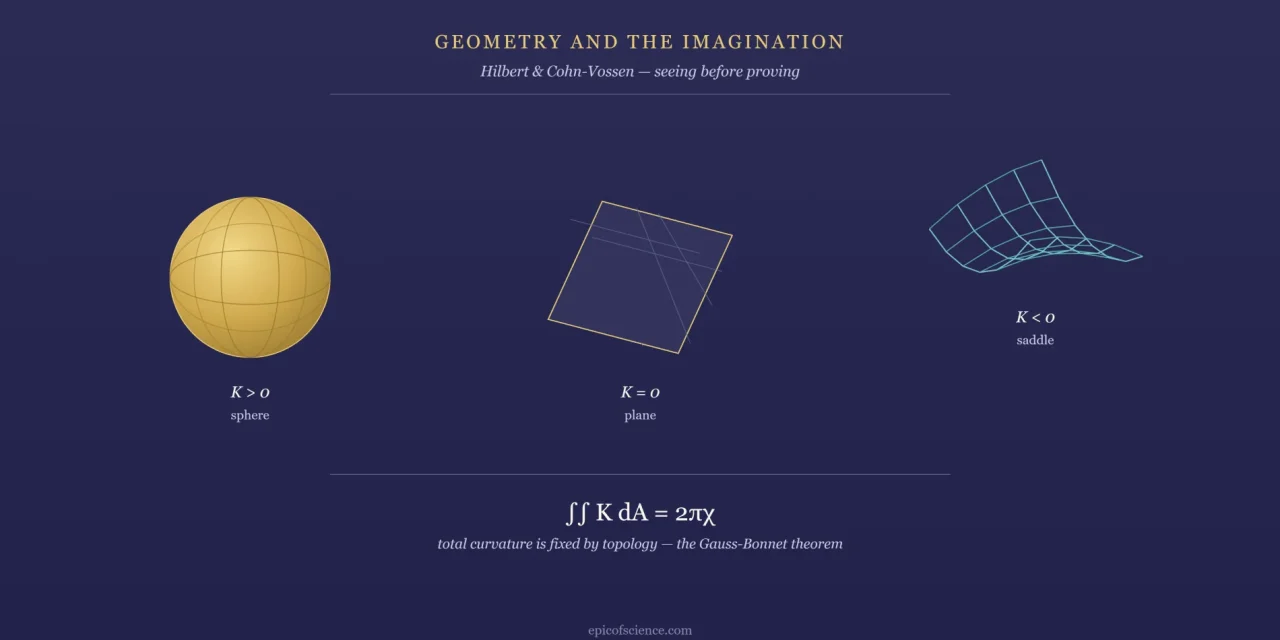
This Hilbert book review would be incomplete without mentioning the treatment of curvature. The book introduces Gaussian curvature through an intuitive device: imagine an ant walking on a surface. On a sphere, two ants starting side by side and walking “straight ahead” (along geodesics) gradually converge. On a saddle surface, they diverge. The sign of the Gaussian curvature \( K \) at a point encodes this behavior. For a sphere of radius \( r \), the curvature is constant and positive, given by \( K = \frac{1}{r^2} \). For a flat plane, \( K = 0 \). For a saddle, \( K < 0 \).
Hilbert then connects curvature to the Euler characteristic through the Gauss-Bonnet theorem, one of the most beautiful results in all of mathematics. For a closed surface \( S \), the total Gaussian curvature integrated over the entire surface equals \( 2\pi \) times the Euler characteristic:
Here \( \chi(S) \) denotes the Euler characteristic of the surface. For a sphere, \( \chi = 2 \), and the total curvature is \( 4\pi \). For a torus, \( \chi = 0 \), and the positive curvature on the outer rim exactly cancels the negative curvature on the inner rim. The formula says local geometry — the curvature you measure with a tiny ruler — is bound to global topology — the number of holes in the surface. This astonishing bridge between the local and the global is presented in the book not as a theorem to be memorized but as a revelation to be felt.
Throughout, the mathematical prose operates at a level challenging for modern readers. The absence of formal proofs does not mean the absence of rigor; it means the rigor is embedded in the geometric reasoning itself, in the careful progression from one visual insight to the next. Every diagram earns its place.
The Epistemological Turn: What Does It Mean to “See” a Theorem?
Here is where Geometry and the Imagination becomes more than a great mathematics book and transforms into a philosophical provocation. Hilbert’s title promises Anschauung — intuition, visualization, direct apprehension. But what kind of knowledge does geometric intuition provide? And is it the same kind of knowledge that a formal proof provides? Consider the Gauss-Bonnet theorem again. A rigorous proof of this result requires the machinery of differential forms, partitions of unity, and careful treatment of boundary terms. Hilbert and Cohn-Vossen offer none of this. Instead, they present examples, diagrams, and a narrative that makes the theorem feel inevitable. A reader who finishes their discussion knows, in some deep sense, why the theorem is true. But do they know that it is true in the way a logician would demand? This tension — between understanding and verification — runs through the entire book, and it reaches into fundamental questions about mathematical epistemology.
The most defensible reading of Hilbert’s project is that he believed mathematical knowledge is layered and that the foundational layer is not formal proof but geometric intuition. This may sound surprising from the father of formalism, but the contradiction is only apparent. Hilbert’s formalist program aimed to secure mathematics against paradox by encoding it in formal systems but he never claimed formalization was how mathematicians actually think. In his 1900 Paris lecture, he spoke of problems that “force themselves upon us” through the “external appearance of things.” The Anschauliche Geometrie is the fullest expression of this conviction: that before you can prove a theorem, you must see it, and that seeing it is itself a form of knowledge.
Immanuel Kant would have recognized this immediately. For Kant, geometry is grounded in the pure intuition of space — it is not merely an empirical observation about the world, nor a tautology of logic, but a synthetic a priori truth that arises from the very structure of human perception. Hilbert’s book, whether consciously or not, operationalizes the Kantian insight. Every chapter asks the reader to construct spatial intuitions and then discover that these intuitions carry mathematical content. The Euler characteristic is not derived from axioms in this book; it is seen to be necessary by anyone who carefully examines polyhedra. This suggests — and I find this genuinely unsettling in its implications — that mathematical truth may be partially constituted by the act of visualization, that the proof and the picture are not competing accounts of the same fact but two different modes of access to a reality that is richer than either one alone.
But there is a harder question lurking beneath this. Did Hilbert fully understand what he had created? The book treats topology, differential geometry, and group theory as separate chapters in a visual tour. Today, we know these subjects are aspects of a single deep structure — the theory of fiber bundles, characteristic classes, and gauge symmetry that underpins modern physics. The Gauss-Bonnet theorem that Hilbert presents as a beautiful curiosity turns out to be the simplest case of the Atiyah-Singer index theorem, one of the most powerful results of twentieth-century mathematics. It is possible — I would argue likely — that Hilbert sensed these connections without being able to articulate them, that his geometric intuition was reaching toward structures his formalism could not yet name. This is the most radical claim one can make about mathematical creativity: that a mathematician can discover something whose full meaning exceeds their own comprehension, that intuition can outrun proof.
A Book Born into Crisis
Geometry and the Imagination appeared at one of the darkest moments in the history of European intellectual life. In 1932, Germany’s Weimar Republic was collapsing, and the mathematical paradise of Göttingen — the institution Hilbert had spent a lifetime building — was about to be destroyed. Within months of the book’s publication, the Nazi government began dismissing Jewish and politically undesirable professors. Emmy Noether, Richard Courant, Hermann Weyl, and dozens of others were expelled or fled. When a Nazi official asked Hilbert whether mathematics at Göttingen had suffered from the departure of Jews, Hilbert reportedly replied: “Suffered? It hasn’t suffered. It simply doesn’t exist anymore.”
The book itself became a kind of refugee. The original German edition, published by Springer, circulated in an increasingly hostile environment. It was not until 1952 that P. Nemenyi’s English translation, published by AMS Chelsea Publishing, made the work widely available to anglophone readers. The translation preserved Hilbert’s lucid style remarkably well, though scholars have noted that certain nuances of Anschaulichkeit — the untranslatable quality of visual self-evidence — are inevitably diminished in English.
The book was not without its critics. Some mathematicians felt that Hilbert’s visual approach, however elegant, risked encouraging a superficial understanding — that students might believe they understood a theorem because they could picture it, without grasping the logical subtleties that a rigorous proof would reveal. Others argued that the selection of topics was idiosyncratic, reflecting Hilbert’s personal tastes rather than any coherent curriculum. But these objections never gained lasting traction. The book’s influence only grew with time, precisely because it filled a niche that no other work occupied: serious mathematics, presented with the directness of physical intuition.
The Long Shadow: Where Hilbert’s Vision Led
What is “Geometry and the Imagination” by Hilbert about?
Geometry and the Imagination by David Hilbert and Stefan Cohn-Vossen is a 1932 mathematics book that presents advanced geometric concepts — including topology, curvature, polyhedra, and projective geometry — through visual intuition rather than formal proofs. Originally titled Anschauliche Geometrie, it remains a classic introduction to geometric thinking for students and mathematicians.
The book’s legacy extends far beyond its own pages. It helped establish geometric visualization as a legitimate mode of mathematical reasoning at a time when the Bourbaki movement in France was pushing mathematics in the opposite direction — toward pure abstraction stripped of all pictures. Hilbert’s insistence that geometry must be seen anticipated the modern revolution in mathematical visualization, from computer graphics to the topological data analysis that drives contemporary machine learning research.
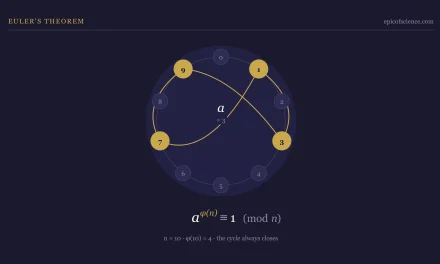
In physics, the geometric ideas Hilbert and Cohn-Vossen popularized — curvature, topology, symmetry groups — became the language of general relativity and quantum field theory. The Gauss-Bonnet theorem, so lovingly presented in their book, evolved into the index theorems and topological invariants that earned multiple Fields Medals and reshaped our understanding of space itself — the same topological reasoning that, in a far more elementary form, underlies Euler’s theorem on polyhedra and graphs. In computer science, the study of polyhedra and convexity, which fills the book’s early chapters, became foundational to computational geometry and optimization algorithms.
Perhaps most importantly, Geometry and the Imagination gave permission to generations of mathematicians to trust their visual instincts. Fields Medalist William Thurston, whose geometrization conjecture transformed topology, cited Hilbert’s emphasis on geometric intuition as a formative influence. The book demonstrated that rigor and imagination are not enemies but partners — that the most powerful mathematics emerges when formal reasoning and spatial intuition illuminate each other.
The Question That Remains
Close the book after its final chapter and a strange feeling lingers. You have been shown surfaces that cannot exist in three-dimensional space, symmetries that govern the arrangement of atoms in crystals, curves that fill entire planes. You have seen, in the deepest sense of that word. And yet you know that seeing is not the same as proving, that the picture in your mind — however vivid — is a shadow of something that lives in a space your senses cannot reach.
Hilbert spent his last years in Göttingen, increasingly isolated, watching the world he had built dismantled by forces that cared nothing for mathematics. He died in 1943, in the middle of a war. His epitaph, carved on his tombstone, reads: “Wir müssen wissen. Wir werden wissen.” — We must know. We shall know. But geometry and the imagination Hilbert gave us ask a prior question, one his own book answers only by raising it again: is mathematical knowledge something we achieve through seeing, or does the seeing only begin after the knowing? And if the picture and the proof illuminate different faces of the same truth — what is the shape of the thing they both describe?
References and Further Reading
Hilbert, D. and Cohn-Vossen, S. Geometry and the Imagination. Translated by P. Nemenyi. AMS Chelsea Publishing, 1952. Available via AMS Chelsea Publishing.
Reid, Constance. Hilbert. Springer-Verlag, 1970. The standard biography of David Hilbert.
Mathematics Stack Exchange. Various discussions on the pedagogical value and mathematical content of Anschauliche Geometrie.
Kant, Immanuel. Critique of Pure Reason. “Transcendental Aesthetic,” 1781.