Contents
- A Classic Gateway to Quantum Weirdness — But Is It Still Worth Reading?
- The Short Verdict
- What Makes a Good Quantum Physics Introduction?
- Inside the Book: What Gribbin Covers and How He Covers It
- Who Should Read It — and Who Should Look Elsewhere
- Where to Go from Here
- A Book That Earned Its Place on the Shelf
- References
A Classic Gateway to Quantum Weirdness — But Is It Still Worth Reading?
If you have browsed lists of quantum physics popular science books, you have almost certainly encountered In Search of Schrödinger’s Cat by John Gribbin. First published in August 1984 by Bantam Books, this slim volume became one of the best-selling introductions to quantum mechanics ever written and has remained in print for decades. But a book written before the fall of the Berlin Wall makes promises to readers in a world with quantum computers on the horizon. So the honest question is: does In Search of Schrödinger’s Cat still deserve its reputation, and is it the right book for you?
This review is for the curious general reader, the science student weighing their first popular-science purchase, or the lifelong learner who wants to understand quantum theory without wading through equations. I have read Gribbin’s book cover to cover and will tell you exactly what it does well, where it stumbles, and who should look elsewhere.
The Short Verdict
In Search of Schrödinger’s Cat remains one of the clearest, most historically rich introductions to quantum theory for general readers. If you want a single, affordable paperback that walks you from blackbody radiation through the Einstein–Bohr debates to the many-worlds interpretation — and you do not mind that it predates recent experimental breakthroughs — this Schrödinger’s cat book is still an excellent starting point.
That said, it is not flawless. The book’s age means it cannot cover quantum computing, quantum entanglement experiments that earned Nobel Prizes in the 2020s, or ongoing refinements to decoherence theory. Readers wanting the most current picture of the field will need to supplement Gribbin with a more recent title. But as a foundation and first encounter with the ideas that shook twentieth-century physics, few popular accounts are better structured or more compellingly written.
What Makes a Good Quantum Physics Introduction?
Before evaluating any Schrödinger’s cat book, it helps to know what separates the best quantum physics popular science titles from the forgettable ones. Writing about quantum mechanics for a lay audience is formidable: the subject is mathematically dense, conceptually counterintuitive, and full of jargon that can intimidate or mislead. A great popular-science treatment must balance at least four things at once.
First, historical context matters. Quantum theory did not spring fully formed from one mind; it emerged from decades of argument, failed models, and reluctant paradigm shifts. A book that skips this history deprives the reader of the intellectual drama that makes the ideas stick. Second, conceptual honesty is essential. The best authors resist the temptation to make quantum mechanics sound tidy. They acknowledge the genuine strangeness—the measurement problem, nonlocality, superposition—without pretending a clever analogy resolves the puzzle. Third, accessibility should not come at the cost of accuracy. Oversimplification is a chronic problem in popular physics writing, and the best authors find ways to be clear without being wrong. Fourth, the writing must be engaging. Quantum physics is fascinating, but a leaden prose style can make even Schrödinger’s thought experiment feel like a tax document.
John Gribbin, a Cambridge-trained astrophysicist and one of the most prolific science writers of the late twentieth century, built his career on hitting these marks consistently. His reputation as a communicator is well established across dozens of titles. The question is whether this particular book — arguably his most famous — lives up to the standard.
Inside the Book: What Gribbin Covers and How He Covers It
In Search of Schrödinger’s Cat is structured as a roughly chronological journey through the development of quantum theory. Gribbin begins with the crisis of classical physics at the turn of the twentieth century: the ultraviolet catastrophe, Planck’s reluctant introduction of the quantum, and Einstein’s photoelectric-effect paper. This opening section is one of the book’s great strengths. Gribbin’s writing shines when it places ideas in their human context: the confusion of physicists, resistance of the establishment, and slow accumulation of evidence that something fundamental had to change. Readers who enjoy history of science will find these early chapters absorbing.
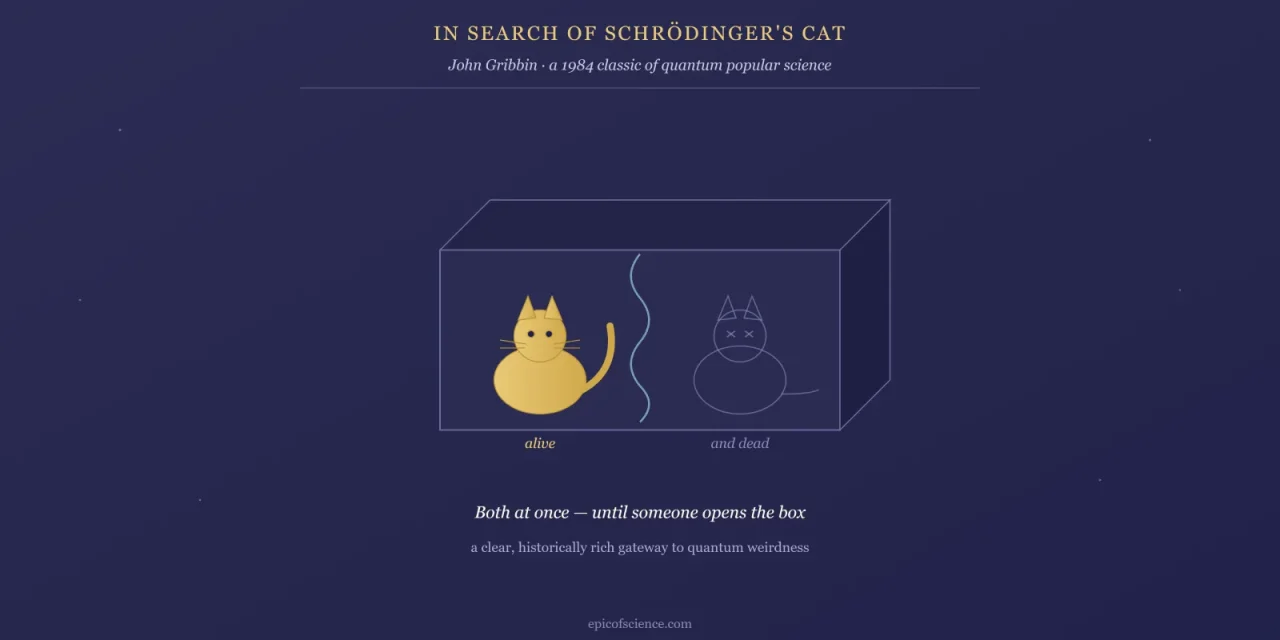
The middle portion of the book tackles the formalism and interpretation of quantum mechanics: wave-particle duality, the uncertainty principle, Schrödinger’s wave equation, and the Copenhagen interpretation. Gribbin does not shy away from the conceptual difficulty here. He explains superposition and the measurement problem with patience and a knack for choosing analogies that illuminate rather than distort. The famous thought experiment of Schrödinger’s cat, the book’s namesake, is presented not as a cute paradox but as a genuine philosophical challenge that physicists still argue about. This is where Gribbin’s quantum physics style earns its reputation: he trusts the reader enough to present the weirdness honestly, and his prose is clean enough to carry even a skeptical audience through it.
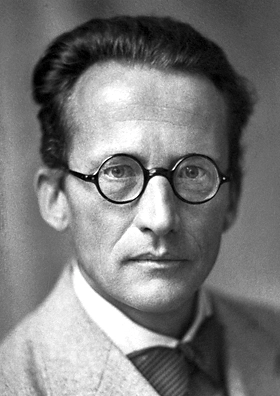
domaine public — portrait de l'album Nobel 1933, couvert par la règle suédoise sur les photographies antérieures à 1944/1969.
Erwin Schrödinger in 1933, the year he shared the Nobel Prize with Dirac. His cat arrived two years later, as an argument rather than a curiosity. — Image: Nobel Foundation, public domain.
The later chapters are where the book becomes most distinctive and debatable. Gribbin devotes significant space to the many-worlds interpretation of quantum mechanics and does not hide his sympathy for it. At the time of writing, this was a somewhat contrarian position; the Copenhagen interpretation still dominated textbooks and popular discussion. Gribbin’s willingness to take the many-worlds idea seriously and present it as a coherent alternative is one reason the book attracted so much attention. However, readers should be aware that his treatment can feel like advocacy rather than neutral exposition. He presents the case for many-worlds with genuine enthusiasm, and while he acknowledges objections, the balance tilts in one direction. This is not necessarily a flaw—every author has a perspective—but readers looking for a quantum reality book that gives equal time to all major interpretations may want to be aware of this emphasis.
The book also touches on the Einstein-Podolsky-Rosen paradox, Bell’s theorem, and the implications of quantum nonlocality. These sections are well handled for their time but lack the experimental confirmation that came later. The Aspect experiments of the early 1980s are discussed, but the more definitive loophole-free Bell tests of 2015 and the Nobel Prize awarded in 2022 to Aspect, Clauser, and Zeilinger for their work on entanglement could not be included. This is the book’s most significant limitation: it captures the state of the debate when many key questions were still open, and some have since been answered or sharpened by experiment.
Stylistically, the book is a pleasure. Gribbin writes in clear, unpretentious English. He avoids equations almost entirely; there is no mathematical prerequisite beyond basic arithmetic, and he uses metaphor judiciously. The pace is brisk without feeling rushed, and at roughly 300 pages (depending on the edition), the book is compact enough to read in a few sittings. For readers who have never encountered quantum mechanics outside vague pop-culture references, this is an accessible entry point, and it is easy to see why it has sold so well. As one of the most well-known quantum physics popular science books of the twentieth century, its influence on subsequent science writing is hard to overstate: many later authors, from Brian Greene to Carlo Rovelli, have acknowledged the trail that Gribbin and his contemporaries blazed.
The weaknesses are mostly consequences of age. The book cannot discuss quantum computing, quantum teleportation experiments, or the modern decoherence program that has reshaped how physicists think about the measurement problem. It also reflects the interpretive landscape of its era, so some perspectives that have gained prominence since, such as QBism or relational quantum mechanics, are absent. While Gribbin’s prose is clear, it occasionally drifts toward the breathless, particularly in later chapters discussing the implications of many-worlds. A more restrained hand might have served the material better in those passages.
Who Should Read It — and Who Should Look Elsewhere
If you are a complete beginner, someone who has heard of Schrödinger’s cat but could not explain what the thought experiment demonstrates, this book is an excellent first read. Gribbin assumes no prior knowledge of physics, and his historical approach means you absorb the ideas in roughly the order physicists discovered them. The lack of mathematics makes it accessible to readers from any background, and the narrative momentum keeps you turning pages. For a first encounter with quantum weirdness, few books in the genre are better crafted.
If you are a science student looking for something to complement your coursework, the book is useful as a supplement but not a substitute. It gives you historical and conceptual context many textbooks skip and may deepen your intuition for interpretive questions behind the formalism. But it will not help you solve problem sets, and its treatment of physics is necessarily simplified. Think of it as enrichment reading, not study material.
If you are a reader who has already consumed several quantum physics popular science books, perhaps Feynman’s QED, Greene’s The Elegant Universe, or more recent titles, Gribbin’s book may feel familiar. The ground it covers is well-trodden, and more recent authors incorporate experimental developments Gribbin could not. In this case, you might find greater value in a book focusing on a specific aspect of quantum theory in more depth or one that engages with interpretive debates as they stand today.
If you are specifically interested in the quantum reality book debate, the question of what quantum mechanics tells us about the nature of the world, Gribbin is a good starting point but an incomplete guide. His sympathy for the many-worlds interpretation gives the book a clear perspective, which some readers will appreciate and others find limiting. For a broader survey of interpretive positions, you may want to follow this book with a more recent title covering the full spectrum of contemporary views.
Where to Go from Here
If this review has convinced you to pick up the book, its Open Library entry lists the edition and publication details. The paperback has stayed in print for decades and used copies are typically inexpensive, and if your local library has a science section, a copy is likely already on the shelf.
Once you have read Gribbin, the natural next step depends on what hooked you most. If the historical narrative was the highlight, you might look into Gribbin’s follow-up, Schrödinger’s Kittens and the Search for Reality, which extends the story. If the interpretive questions fascinated you, more recent treatments of the measurement problem and competing interpretations will bring you up to date. If you want more mathematical rigor, that is a sign you may be ready for an introductory textbook rather than another popular account.
For a broader overview of recommended reading in physics and mathematics — from popular science to textbooks to online courses — the Resources section at Epic of Science is a good place to explore further options. You will find guidance tailored to different levels and interests so that you can plan your next read with confidence.
A question many readers ask: is In Search of Schrödinger’s Cat suitable for someone with no science background at all? The answer is yes. Gribbin assumes no prior physics knowledge, uses virtually no mathematics, and builds ideas from the ground up. It is one of the best quantum physics popular science starting points available, and its accessibility is a large part of why it has endured.
A Book That Earned Its Place on the Shelf
In Search of Schrödinger’s Cat is not a perfect book. It shows its age in places, it leans toward one interpretation more than a strictly neutral account would, and it cannot speak to the remarkable experimental progress of the last few decades. But it does something that very few science books manage: it makes you feel the shock that physicists themselves felt when the quantum world first revealed its strangeness. John Gribbin’s quantum physics writing at its best is vivid, honest, and deeply respectful of both the science and the reader.
For a first encounter with quantum mechanics — the kind that leaves you genuinely unsettled and eager to learn more — this remains one of the most reliable recommendations in the genre. It has introduced millions of readers to the deepest questions in physics, and it can still do the same for you.
References:
Gribbin, John. In Search of Schrödinger’s Cat: Quantum Physics and Reality. Bantam Books.
John Gribbin bibliography and background: various published sources.