Contents
- Quantum Mechanics Advanced — Topics Beyond the Undergraduate Level
- The Physicists Who Needed More
- Why Undergraduate Quantum Mechanics Runs Out
- From Wavefunctions to Operators: Second Quantization and Path Integrals
- Second Quantization
- Path Integrals
- IMAGE: The Loop That Corrects the Electron
- What the Formalism Knows That We Do Not
- Resistance, Debate, and the Road to Quantum Field Theory
- Where Advanced Quantum Mechanics Leads
- What is quantum mechanics at the graduate level?
- The Question That Remains
- References
Quantum Mechanics Advanced — Topics Beyond the Undergraduate Level
Here is a fact that should unsettle anyone who finished an undergraduate quantum mechanics course feeling confident: the theory you learned cannot describe the creation or destruction of a single particle. It cannot explain why the electron has its mass, why the vacuum is not truly empty, or why identical particles are fundamentally indistinguishable in a way that has no classical parallel. The Schrödinger equation you spent semesters mastering operates in a fixed Hilbert space with a fixed number of particles. Yet the universe, at every scale where advanced quantum mechanics is necessary, is a place where particles appear from nothing, annihilate into light, and exist as excitations of fields permeating all of spacetime. The bridge between the quantum mechanics you know and the quantum mechanics that actually describes nature is not a minor extension. It is a conceptual revolution as profound as the leap from classical to quantum thinking. What lies on the other side of that bridge — second quantization, path integrals, the beginnings of quantum field theory — is not just harder mathematics. It is a different way of thinking about what a particle is, what a measurement means, and what the formalism is about.
The Physicists Who Needed More
The story of advanced quantum mechanics is not a story of one breakthrough but of accumulating dissatisfaction. By the early 1930s, the first generation of quantum physicists — Heisenberg, Schrödinger, Dirac, Born, Jordan, Pauli — had constructed a formalism of breathtaking power. It predicted the hydrogen spectrum, explained the stability of atoms, and gave a mathematical structure to the uncertainty principle. And yet almost immediately, the theory’s architects knew it was incomplete.
Dirac, in particular, embodied this tension. His relativistic wave equation, published in 1928, predicted the electron’s spin and magnetic moment with striking accuracy — but it also predicted states of negative energy that seemed to make no physical sense. Dirac’s initial response was to propose that nearly all negative-energy states were already filled, forming a “sea” of electrons, and that a hole in this sea would behave like a positively charged particle. When Carl Anderson detected the positron experimentally in 1932, the prediction was vindicated — but the conceptual framework was deeply strange. A single-particle equation had forced physicists to confront a multi-particle, indeed an infinite-particle, reality. The Dirac equation was simultaneously a triumph and a sign that advanced quantum mechanics required entirely new mathematical structures.
Meanwhile, Pascual Jordan and others were already developing what we now call second quantization — the idea that the quantum formalism should be applied not just to particles but to fields themselves. This was not a smooth, consensus-driven process. There were false starts, competing notations, and genuine confusion about what the new formalism meant physically. The polished textbook presentation of quantum field theory as a logical extension of ordinary quantum mechanics obscures the decades of intellectual struggle that produced it.
Why Undergraduate Quantum Mechanics Runs Out
Think of undergraduate quantum mechanics as a language with a limited vocabulary. It can describe a particle in a box, a harmonic oscillator, or a hydrogen atom — systems with a fixed number of particles and energies low enough that relativity is irrelevant. You learn to solve the Schrödinger equation, compute expectation values, and apply perturbation theory. This is powerful but like describing the weather in a single room while ignoring the atmosphere.
The limitations become clear when you ask certain questions. How does light interact with matter at the level of individual photons being created and absorbed? Why do two electrons in a helium atom resist being in the same quantum state — not due to a force, but a fundamental symmetry constraint? What happens when a particle moves fast enough that its kinetic energy is comparable to its rest mass energy? These questions arise in chemistry, condensed matter physics, nuclear physics, and astrophysics. They cannot be answered within single-particle, nonrelativistic quantum mechanics.
An analogy helps here, if you watch where it breaks. Undergraduate quantum mechanics is like studying waves on a single, fixed string. You can find the normal modes, compute the frequencies, and describe how the string vibrates. Graduate quantum mechanics is like realizing the string itself can be created, cut, and joined with other strings, and that the “particles” are not beads on the string but the vibrations themselves. The analogy breaks down because in quantum field theory, the “vibrations” are not disturbances of a material medium. They are the fundamental entities, with nothing underneath vibrating. The field is not made of anything more basic. This is one of the deepest conceptual shifts in physics and marks the threshold of graduate-level quantum mechanics.
From Wavefunctions to Operators: Second Quantization and Path Integrals
The mathematical heart of advanced quantum mechanics lies in two formalisms that look very different but are, in a precise sense, equivalent: second quantization and path integrals. Understanding both is essential for anyone entering graduate quantum mechanics, and the interplay between them is one of the most beautiful structures in theoretical physics.
Second Quantization
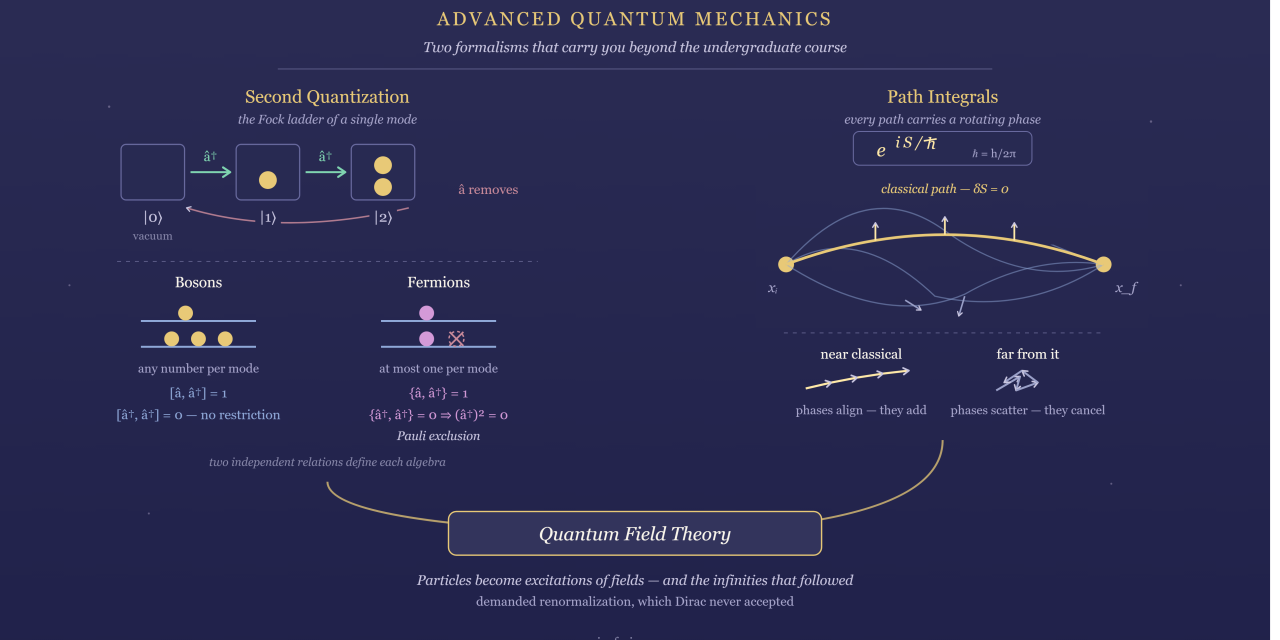
In undergraduate quantum mechanics, you treat a particle’s position or momentum as an operator, while the wavefunction \( \psi(x) \) is an ordinary function — a complex number assigned to each point in space. Second quantization promotes the wavefunction itself to an operator, \( \hat{\psi}(x) \), acting on a more abstract space called Fock space. This Fock space can accommodate any number of particles: zero, one, a hundred, or a continuum. The creation operator \( \hat{a}^\dagger_k \) adds a particle in mode \( k \), while the annihilation operator \( \hat{a}_k \) removes one. The commutation relations between these operators encode whether the particles are bosons or fermions. For bosons, \( [\hat{a}_k, \hat{a}^\dagger_{k’}] = \delta_{kk’} \), and for fermions, the commutator is replaced by an anticommutator: \( \{\hat{a}_k, \hat{a}^\dagger_{k’}\} = \delta_{kk’} \).
This is not just a notational convenience. The antisymmetry of the fermionic algebra is what enforces the Pauli exclusion principle — not as an additional postulate, but as a mathematical consequence of the formalism. Two identical fermions cannot occupy the same state because \( \hat{a}^\dagger_k \hat{a}^\dagger_k = 0 \); applying the same creation operator twice gives zero. The exclusion principle, in this framework, is not a rule imposed from outside. It is built into the algebraic structure of the theory.
Path Integrals
Richard Feynman, building on a remark by Dirac, introduced path integrals as an alternative formulation of quantum mechanics. The central object is the propagator — the probability amplitude for a particle to travel from one point to another. In the path integral approach, this amplitude is computed by summing over all possible paths the particle could take, weighting each path by \( e^{iS/\hbar} \), where \( S \) is the classical action evaluated along that path.
The symbol \( \int \mathcal{D}[x(t)] \) denotes a sum — technically, a functional integral — over every conceivable trajectory connecting the initial point \( x_i \) to the final point \( x_f \). Classical mechanics emerges naturally: when the action \( S \) is much larger than \( \hbar \), paths near the classical trajectory dominate the sum because their phases vary slowly. In contrast, wildly non-classical paths cancel out through destructive interference. This is the principle of stationary phase and how the path integral formalism recovers Newton’s laws as an approximation.
What makes path integrals indispensable for a quantum field theory intro is their natural generalization to fields. Instead of summing over all paths of a particle, you sum over all possible field configurations — every possible shape the field could take across all of spacetime. This is the foundation of the modern approach to QFT basics, and it is the framework in which the Standard Model of particle physics is most naturally expressed. The experiments that have confirmed the predictions of quantum electrodynamics — the anomalous magnetic moment of the electron, measured and predicted to agree to better than one part in a trillion — are, at bottom, calculations performed within this path integral framework.
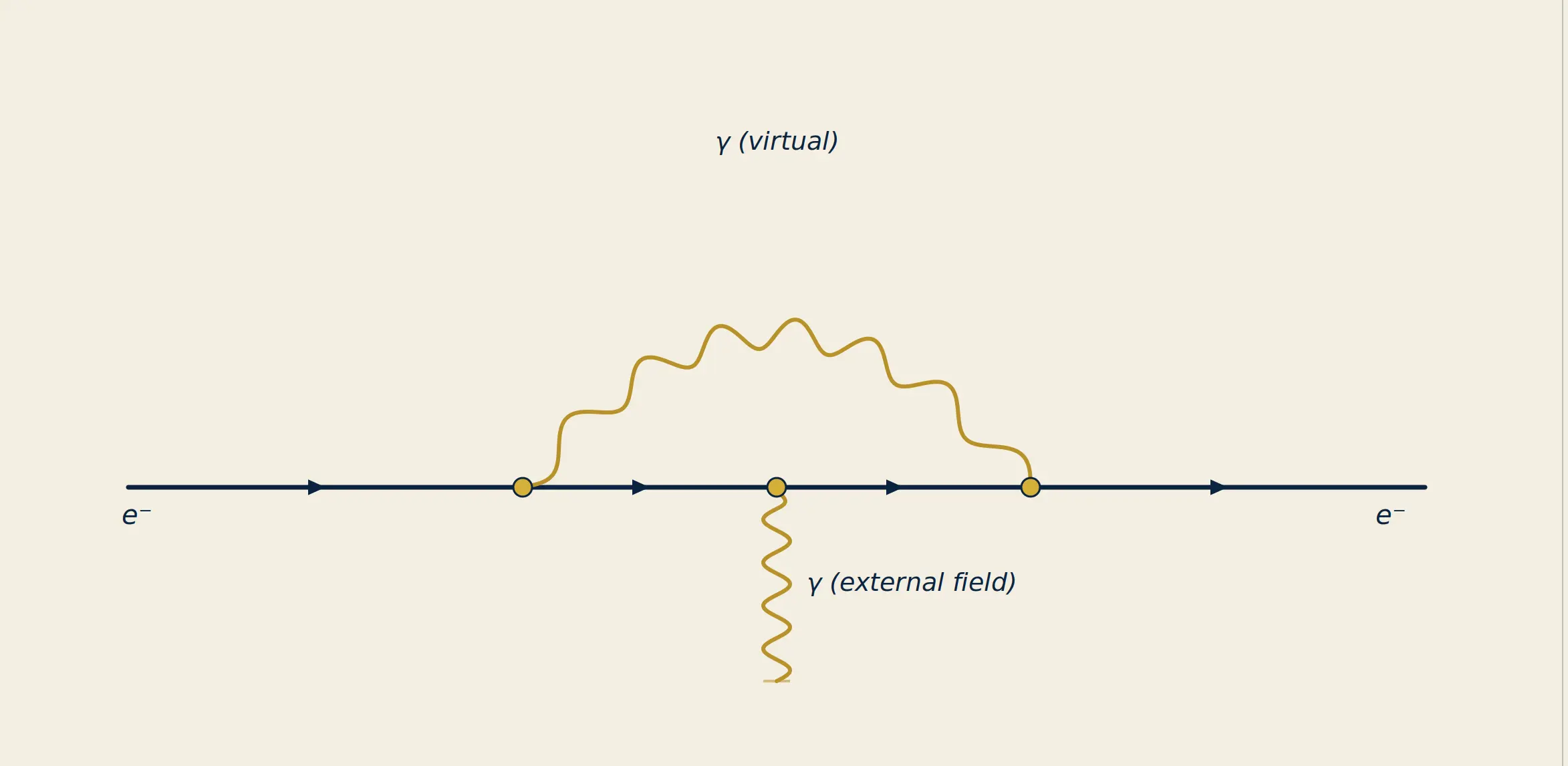
The Loop That Corrects the Electron
This diagram represents the one-loop vertex correction — the leading term in the advanced quantum mechanics calculation of the electron’s anomalous magnetic moment, a prediction confirmed by experiment to better than one part in a trillion.
What the Formalism Knows That We Do Not
There is a standard myth about the progression from undergraduate to graduate quantum mechanics — that the transition is simply about learning harder mathematics, that the conceptual work was finished by Bohr and Heisenberg in the 1920s, and everything since is “just calculation.” This is backward. The conceptual questions become more acute as you enter second quantization, path integrals, and quantum field theory. The formalism grows more powerful, but the gap between its predictions and what we can say it means widens at the same rate.
Consider what the path integral really says. It tells us to compute an observable quantity — a transition amplitude — by summing over an infinite number of unobservable histories. No experiment detects a particle traversing all possible paths simultaneously. We measure only the result: where the particle arrives and with what probability. The intermediate paths are not observed, and the formalism does not require they be “real” in any sense. This raises a question that Feynman himself, despite his hostility to philosophy, could not fully escape: is the path integral a description of nature or a calculation device? If it is a description, nature is doing something incomprehensibly vast at every instant — exploring every possible history and selecting among them by interference. If it is merely a device, then what is the theory actually about?
The most defensible reading, I think, is that the path integral is a striking example of what Bas van Fraassen calls an empirically adequate theory — one that correctly predicts all observations without requiring that its internal machinery correspond to anything in the world. Van Fraassen, in The Scientific Image, argued that the goal of science is empirical adequacy rather than truth about unobservable entities. The path integral seems almost designed to illustrate his point: it works perfectly, and it resists every attempt to say what is “really happening” between measurements.
But here is what I find genuinely unsettling about this resolution. The path integral formalism does not merely predict; it unifies. The same mathematical structure that gives quantum mechanics also gives statistical mechanics (through the Wick rotation \( t \to -i\tau \)), connects quantum amplitudes to thermodynamic partition functions, and reveals deep relationships between symmetries and conservation laws via Noether’s theorem at the quantum level. If the formalism were merely a convenient fiction, why would it exhibit this internal coherence — linking physics domains that seem unrelated? Eugene Wigner’s worry about “the unreasonable effectiveness of mathematics in the natural sciences” is nowhere more pressing. The mathematics seems to know more about the physical world than any interpretation we can attach. This suggests — and I think the evidence supports this — that the formalism tracks a genuine structure in nature, even if we cannot visualize or narrate it in ordinary language. The choice between “the math describes reality” and “the math is just a tool” may be a false dichotomy. The mathematics may be the most faithful description we have, and its resistance to translation into stories about particles and trajectories may reflect the limits of human storytelling more than the theory.
Resistance, Debate, and the Road to Quantum Field Theory
The path from ordinary quantum mechanics to quantum field theory was not a triumphal march. It was an argument lasting decades that nearly broke some participants. The central crisis arrived in the late 1930s and 1940s, when attempts to compute quantum electrodynamic processes — an electron emitting and reabsorbing a photon, for example — yielded infinite answers. Not just large answers, but genuinely divergent integrals that seemed to render the theory meaningless.
The response, developed independently by Tomonaga, Schwinger, and Feynman in the late 1940s, was renormalization: a systematic procedure absorbing infinities into redefinitions of the particle’s observed mass and charge. Dyson showed the three approaches were equivalent. The results were spectacularly confirmed by experiment. But the procedure troubled many physicists deeply. Dirac never accepted it. In a 1975 lecture, he objected that the theory ‘does involve neglecting infinities which appear in its equations, arbitrarily neglecting them,’ and insisted this ‘is just not sensible mathematics.’ Weinberg recalled Dirac always called renormalization sweeping infinities under the rug. His objection was not merely aesthetic; he believed a theory requiring subtraction of infinities could not be fundamental. Whether he was right is still an open question. The Standard Model is a renormalizable quantum field theory, and its predictions are the most precisely confirmed in science — yet many theorists suspect it is an effective theory, valid only up to some energy scale, with a deeper structure beneath.
The lecture notes from MIT OCW 8.321 provide an excellent primary resource for studying how these ideas are introduced at the graduate level, beginning from the operator formalism and building toward the conceptual infrastructure needed for field theory. The course follows a lineage that runs through Sakurai’s Modern Quantum Mechanics, one of the most influential graduate textbooks of the past four decades, and reflects the way these topics are actually taught — not as settled doctrine but as a framework whose foundations are still being examined.
Where Advanced Quantum Mechanics Leads
The topics covered in a graduate quantum mechanics course — second quantization, path integrals, symmetry groups, scattering theory, and the elements of quantum field theory — are not endpoints. They are the prerequisites for nearly every frontier of modern physics. Condensed matter physics uses second quantization as its daily language: superconductivity, superfluidity, and the quantum Hall effect are all described in terms of creation and annihilation operators acting on many-body states. Particle physics is built entirely on quantum field theory, from the electroweak unification to quantum chromodynamics. Even quantum computing, often presented as an application of undergraduate quantum mechanics, increasingly draws on field-theoretic concepts — topological quantum computation, for instance, relies on ideas from topological quantum field theory.
What is quantum mechanics at the graduate level?
Quantum mechanics at the graduate level extends the undergraduate formalism to handle variable particle numbers, relativistic effects, and field-theoretic descriptions of nature. Core topics include second quantization, path integrals, scattering theory, symmetry groups, and the conceptual foundations of quantum field theory. These tools are essential for research in particle physics, condensed matter, and quantum information.
The deeper you go into the history and structure of physics, the more clearly you see that the boundary between “quantum mechanics” and “quantum field theory” is not a wall but a gradient. The same principles — superposition, unitarity, the operator structure of observables — persist across the transition. What changes is the ontology: the theory stops being about particles and starts being about fields, and the particles become emergent phenomena, localized excitations of something more fundamental. This is the sense in which learning quantum mechanics at the graduate level is not just learning more physics — it is learning to think about physics differently.
The Question That Remains
After all the formalism — after second quantization and path integrals, after renormalization and the Standard Model, after predictions confirmed to twelve decimal places — a question persists that no amount of calculation can answer. The quantum field theory intro you encounter in graduate school teaches you to compute with extraordinary precision. It does not tell you what the quantum field is. Is it a physical entity that fills spacetime, an assignment of operators to every point in the continuum? Or is it a mathematical structure that organizes our predictions about experimental outcomes, no more “real” than a coordinate system? The formalism is silent on this question. It gives the same answers regardless of what you believe the field to be. And that silence — the gap between the theory’s predictive perfection and its interpretive opacity — may be the deepest open problem in the foundations of physics. It is the question that waits for you on the other side of every equation.
References
MIT OpenCourseWare, 8.321 Quantum Theory I, Fall 2017. ocw.mit.edu
Sakurai, J. J., and Napolitano, J., Modern Quantum Mechanics, 2nd ed. (Cambridge University Press, 2017).
Weinberg, S., Lectures on Quantum Mechanics, 2nd ed. (Cambridge University Press, 2015).
van Fraassen, B., The Scientific Image (Oxford University Press, 1980).
Wigner, E., “The Unreasonable Effectiveness of Mathematics in the Natural Sciences,” Communications in Pure and Applied Mathematics 13 (1960): 1–14.