
A Letter That Shook Two Worlds
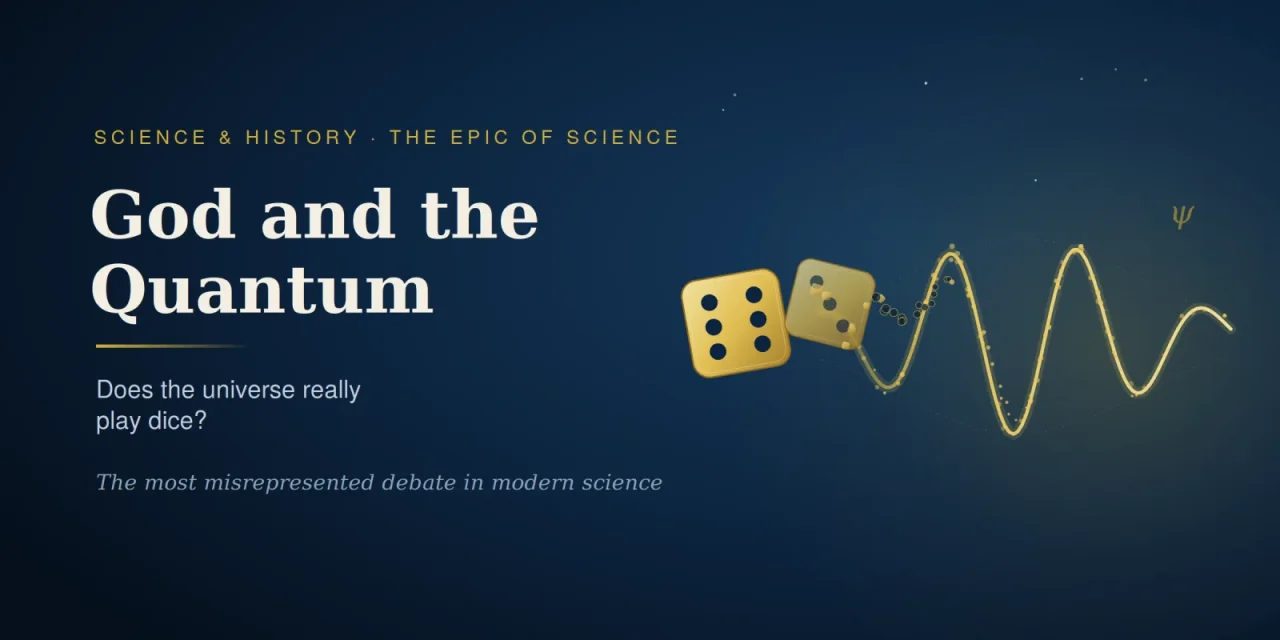
In December 1926, Albert Einstein wrote a letter to physicist Max Born that became one of the most quoted sentences in science history. “Quantum mechanics is certainly imposing,” Einstein conceded before adding the famous objection often paraphrased as “God does not play dice” — the line that linked god and quantum physics in popular imagination for a century. The original German — “Jedenfalls bin ich überzeugt, daß der nicht würfelt” — is subtler and more personal than the slogan it became, but the protest’s force was unmistakable. Einstein was not preaching theology. He insisted that a universe governed by fundamental randomness offended his deepest intuition about how nature should be ordered. Yet by invoking God, he ensured his objection would echo beyond physics, into pulpits, philosophy seminars, and late-night dormitory arguments about the meaning of existence.
That collision between what quantum theory reveals about reality and what humans have long believed about God is one of the most persistent and misrepresented debates in modern thought. The question of god and quantum physics has drawn Nobel laureates, New Age mystics, Anglican priests, and atheist polemicists, each claiming the quantum world as evidence for their side. What does the science actually say? How did a theory about subatomic particles become the most fought-over territory between science and religion?
The Central Insight
Quantum physics neither proves nor disproves God. It shattered the old clockwork determinism that once made God seem unnecessary — but the strange new world it revealed, with its irreducible uncertainty and observer-entangled measurements, is genuinely open to both theistic and atheistic interpretation. The debate says as much about the limits of science as about the nature of divinity. That claim needs earning. To do so, we must understand three things: the mechanistic worldview quantum theory destroyed, the people who built the new theory and fought bitterly over its meaning, and the long, tangled history of thinkers who tried to recruit the quantum world for God or against him. Each thread is richer, stranger, and more contested than popular accounts suggest.The Clockwork Universe and Its God Problem
To grasp why quantum physics and god became so entangled, you need to feel the weight of the preceding worldview. By the late nineteenth century, physics seemed almost finished. The universe Newton described and Laplace refined was a colossal machine: every particle obeyed deterministic laws, and every future state was in principle calculable from the present. This “clockwork universe” posed a specific theological problem. If everything was determined by prior causes stretching back to the beginning of time, where did God fit? The French mathematician Pierre-Simon Laplace reportedly told Napoleon he had “no need of that hypothesis” — though historians note the anecdote is likely embellished and may not have unfolded as neatly as popular telling suggests. For many believers, the clockwork universe was not hostile to faith but actually supportive of it. Natural theology, the tradition running from Thomas Aquinas through William Paley, argued that the very orderliness of the machine implied a Designer. The laws of physics were God’s legislation. If the cosmos ran like a watch, someone had wound it. This was a respectable intellectual position, and it would be smug hindsight to dismiss it — the argument from design was the default framework for educated Europeans for centuries, and figures as rigorous as Newton himself saw the mathematical harmony of nature as evidence of divine intelligence. But determinism also carried a sting. If the universe was a closed causal chain, then prayer, free will, miracles, and divine intervention were strictly impossible or required ad hoc exceptions to the laws that supposedly testified to God’s wisdom. By the late 1800s, the tension between quantum physics and spirituality — or between physics and any spiritual agency — was already being felt though not yet named. Materialist philosophers of the nineteenth century, from Ludwig Büchner to Ernst Haeckel, pressed the point ruthlessly: nature was matter in motion, and spirit was an illusion. Into this seemingly closed and suffocating world, quantum mechanics would arrive like a crowbar.The Revolution and Its Theologians
The quantum revolution unfolded over roughly three decades, from Max Planck’s reluctant introduction of the quantum of energy in 1900 to the consolidation of quantum mechanics in the late 1920s. The story involved dozens of physicists across Europe, but three figures stand at the center of the debate about what the new physics meant for the deepest questions: Niels Bohr, Albert Einstein, and Werner Heisenberg.
Bohr, working in Copenhagen, developed what became known as the Copenhagen interpretation — the idea that quantum systems do not possess definite properties until they are measured, and that the act of observation plays an irreducible role in determining outcomes. Heisenberg, Bohr’s protégé, formulated the uncertainty principle in 1927, demonstrating that certain pairs of physical properties — position and momentum, for instance — cannot both be known to arbitrary precision simultaneously. This was not a limitation of instruments; it was a feature of nature itself. The deterministic clockwork had cracked open.
Einstein resisted. His objection was not religious in any conventional sense — Einstein’s God was closer to Spinoza’s God, an impersonal order woven into reality’s fabric, not a personal deity who answers prayers. His conviction that “God does not play dice” (used repeatedly in correspondence, most famously with Born) expressed a profound philosophical commitment: nature must be rational, complete, and deterministic at a deeper level. Einstein believed quantum randomness signaled the theory was incomplete, not that reality was fundamentally probabilistic. The celebrated Bohr-Einstein debates, conducted through thought experiments at the Solvay Conferences of 1927 and 1930, were genuine clashes over reality’s nature. The phrase “quantum physics god does not play dice” has entered popular culture as a theological statement, but in context it was epistemological — a claim about what a complete physical theory should look like.
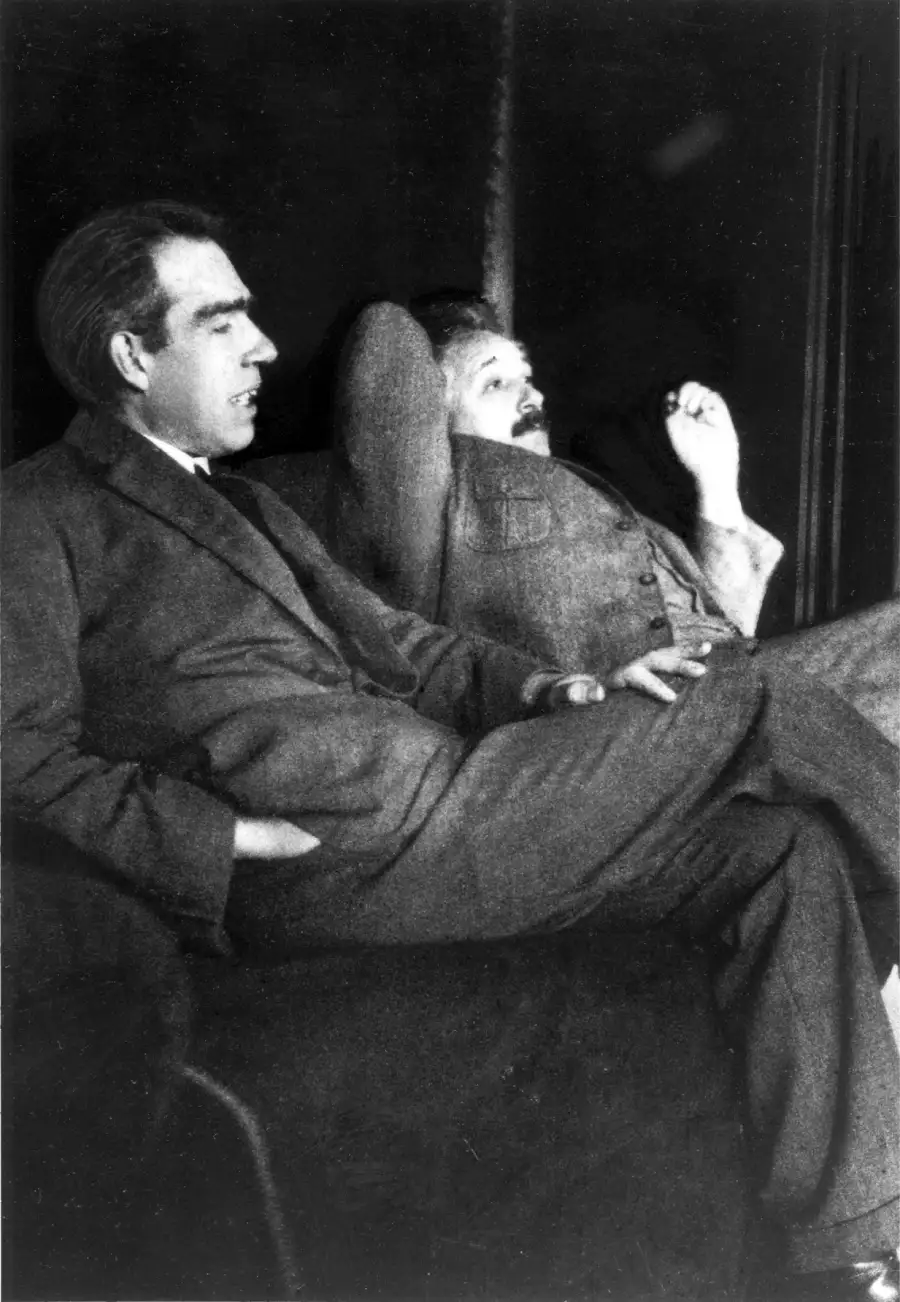
Niels Bohr and Albert Einstein at Paul Ehrenfest's home in Leiden, December 1925. Photo: Paul Ehrenfest, public domain, via Wikimedia Commons.
In December 1925, Niels Bohr and Albert Einstein were photographed in friendly discussion at the Leiden home of their friend Paul Ehrenfest. Within two years, their disagreement over quantum mechanics and the role of chance in nature would become one of the most famous debates in the history of science.
Meanwhile, a different kind of theological engagement was emerging. Heisenberg reflected on the intersection of physics and religion, and in later writings discussed how the new physics reopened questions nineteenth-century materialism had prematurely closed. He was careful not to claim quantum mechanics proved God but argued it shattered the naive materialist certainty that made God seem superfluous. The physicist and Anglican priest John Polkinghorne, writing decades later, developed this thread into a sustained argument: the openness and indeterminacy of quantum physics created “ontological space” — room in reality’s fabric for divine action without violating nature’s laws. Polkinghorne was no crank; he had been a professor of mathematical physics at Cambridge before ordination, and his work is one of the most intellectually serious attempts to relate religion and quantum mechanics.
At the other pole, physicists like Steven Weinberg and Victor Stenger argued that quantum randomness, far from making room for God, made God less necessary than ever. If subatomic events are genuinely random with no hidden cause, invoking a divine hand is not merely unnecessary — it is incoherent. The universe does not need a dice-thrower; the dice throw themselves. Paul Davies, in his influential book The Mind of God, took a more nuanced middle ground, arguing that the universe’s rational intelligibility — the fact that mathematics, a product of human minds, can describe reality’s deepest structures — is a profound mystery neither science nor theology has fully explained.
The question of consciousness in quantum physics — whether the human mind plays a special role in collapsing the quantum wave function — added another layer of confusion and excitement. Physicist Eugene Wigner suggested in the 1960s that consciousness might be necessary to complete the measurement process, an idea eagerly adopted by writers interested in quantum physics and spirituality. But as the Stanford Encyclopedia of Philosophy’s entry on quantum approaches to consciousness makes clear, Wigner’s proposal remains highly controversial among physicists. Most mainstream interpretations of quantum mechanics — including decoherence-based approaches — do not require consciousness to play any special physical role. The idea has been enormously influential in popular culture, fueling books and films claiming quantum physics proves the power of thought to shape reality, but the scientific consensus is far more cautious.
What the Evidence Actually Settled — and What It Didn’t
So who won? The short answer is that Bohr won the physics and Einstein lost — but the theological question was never settled by the physics at all. In 1964, the physicist John Bell derived his famous theorem, showing that no theory of local hidden variables could reproduce all the predictions of quantum mechanics. Subsequent experiments, most notably those by Alain Aspect and collaborators in the early 1980s, confirmed the quantum predictions and ruled out the kind of deterministic completion Einstein had hoped for. Nature, at the quantum level, really does appear to involve irreducible indeterminacy. Einstein’s intuition about a deeper clockwork was, as far as current evidence can tell, wrong.
But this did not settle the god question, because god and quantum physics were never really the same question. Einstein’s “God” was a metaphor for rational order; Polkinghorne’s God was the personal deity of Christianity; Wigner’s invocation of consciousness was a proposal about physics, not theology; and the New Age appropriation of quantum language was, in most cases, neither rigorous physics nor rigorous theology. Each of these thinkers was asking a different question and using the word “quantum” to mean something different.
Attempts to find quantum physics bible connections — the idea that scriptural passages anticipate quantum discoveries — have circulated in popular religious literature. Still, they rely on highly metaphorical readings of both the physics and the texts. Claims that passages about God “holding all things together” or speaking the universe into existence are descriptions of quantum entanglement or wave-function collapse require a degree of interpretive flexibility that most biblical scholars and most physicists would find strained. This does not mean the questions are uninteresting — the relationship between the order described by physics and the order affirmed by theology is a genuinely deep philosophical problem — but it does mean that the popular quantum physics bible genre tends to oversimplify both sides of the equation.
Historians of science, too, caution against a triumphalist narrative in either direction. The physicist and historian Helge Kragh has noted that quantum mechanics was used to support vitalism, free will, mysticism, and atheism within its first few decades — often by the same set of equations. The theory’s interpretive openness is not a bug but a feature of its strangeness. What quantum mechanics reveals is that the deepest level of physical reality behaves in ways that defy our evolved intuitions about how things “should” work. Whether this defiance points toward God, away from God, or simply sideways from the question of God depends on philosophical commitments that the physics itself cannot adjudicate.
Why the Question Won’t Go Away
The debate over god and quantum physics endures because it touches the rawest nerve in the relationship between science and human meaning. Every generation seems to rediscover the question of quantum physics and god and argue it afresh. Quantum mechanics is the most successful predictive theory in the history of science — its predictions have been confirmed to extraordinary precision — and yet its interpretation remains genuinely contested. That interpretive gap is where theology, philosophy, and popular imagination rush in. The question is not whether they should — curiosity about what the universe means is as human as curiosity about how it works — but whether the conversation is conducted honestly.
The honest version of the conversation acknowledges several things at once: that quantum indeterminacy genuinely shattered the old deterministic materialism that made God seem unnecessary; that this shattering does not, by itself, constitute evidence for God; that the role of consciousness in quantum measurement is far less settled and far less mystical than popular accounts suggest; and that serious thinkers on all sides — Polkinghorne, Davies, Weinberg, Bohr — have engaged these questions with rigor and good faith. The dishonest version cherry-picks equations, manufactures quotations, and treats the word “quantum” as a magic spell that proves whatever the speaker already believed.
For readers interested in exploring the broader landscape of how science and ideas intersect across history, the Science & History section at Epic of Science offers a wide range of narratives that trace how human knowledge has been fought over, refined, and sometimes transformed. The story of quantum physics and religion is one chapter in a much longer epic — the ongoing human attempt to reconcile what we can measure with what we most deeply hope.
Does quantum physics prove God? No. Does it disprove God? No. What it does is demolish a particular kind of confident materialism while simultaneously refusing to hand the keys to any particular theology. The universe, at its most fundamental level, is stranger than either the nineteenth-century materialist or the medieval theologian imagined — and that strangeness is itself worth contemplating.
The Strangeness Beneath
There is a moment in many physicists’ education when the equations suddenly feel less like descriptions and more like incantations — when the math works perfectly and yet the reality it describes seems to elude every metaphor. Niels Bohr reportedly said that anyone who is not shocked by quantum mechanics has not understood it, and while the exact wording varies across sources, the sentiment captures something real. The quantum world is not simply counterintuitive; it resists the categories — subject and object, cause and effect, observer and observed — that human beings have relied on for millennia to make sense of experience.
This is why god and quantum physics will continue to be argued over long after the current generation of physicists and theologians is gone. The argument is not really about equations or scripture. It is about what kind of universe we inhabit — one that is, at bottom, mindless and mechanical, or one that is, at bottom, responsive to something we might dare to call meaning. Quantum mechanics does not answer that question. But it broke open the old certainties on both sides, and in doing so it performed the most valuable service any scientific theory can offer: it made us less sure of what we thought we knew, and therefore more honest in our searching.
The dice, if they are being thrown, have not yet stopped rolling.
References
Stanford Encyclopedia of Philosophy — “Quantum Approaches to Consciousness.” https://plato.stanford.edu/entries/qt-consciousness/
Polkinghorne, John. Quantum Physics and Theology: An Unexpected Kinship. Yale University Press, 2007.
Davies, Paul. The Mind of God: The Scientific Basis for a Rational World. Simon & Schuster, 1992.
Einstein, Albert. Letter to Max Born, December 4, 1926. Published in The Born-Einstein Letters, Macmillan, 1971.
Bell, John S. “On the Einstein Podolsky Rosen Paradox.” Physics 1, no. 3 (1964): 195–200.


Trackbacks/Pingbacks