
Contents
- A Gem That Began Before Complex Life Existed
- The Core Idea
- What Makes Diamond Diamond — And Why It Seems Impossible
- Pressure, Heat, and Carbon: How Nature Builds a Diamond
- From Mantle to Surface: The Kimberlite Express
- Synthetic Diamonds, Lasting Myths, and Why the Real Story Matters
- Holding a Billion Years in Your Hand
- References
A Gem That Began Before Complex Life Existed
Somewhere beneath your feet — roughly 150 to 200 kilometers down, where the temperature exceeds a thousand degrees Celsius and the pressure would crush a submarine into foil — carbon atoms are locking together in a pattern so rigid and so perfect that nothing on Earth is harder. That process has been going on for more than a billion years.
The glittering stone on a jeweler’s velvet tray is not merely old; it is, in many cases, older than the earliest animals that left fossils. So how are diamonds made? The answer begins with a simple element, carbon, placed in conditions so extreme that our everyday intuitions about matter break down entirely. And the journey from deep mantle to daylight is one of the most violent and improbable delivery systems in geology — an eruption so fast and rare that most of the diamonds on Earth’s surface arrived in volcanic events that have not been repeated in tens of millions of years.
The Core Idea
Natural diamonds are formed when carbon — often locked in minerals or fluids deep within Earth’s mantle — crystallizes under pressures of roughly 5 gigapascals and temperatures above 1,000 °C, then reaches the surface only through rare, explosive volcanic eruptions called kimberlite or lamproite pipes. The entire diamond forming process can span from hundreds of millions to more than three billion years, making diamonds among the oldest objects a human being can hold.
What Makes Diamond Diamond — And Why It Seems Impossible
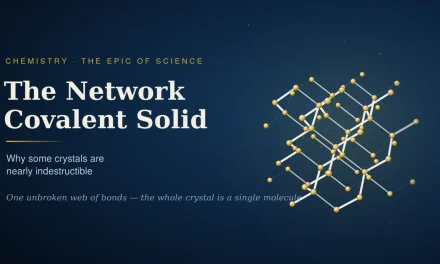
Carbon is astonishingly versatile. At the surface of the Earth, its most stable crystalline form is graphite — the soft, slippery grey mineral in pencil lead. Carbon atoms in graphite arrange themselves in flat hexagonal sheets that slide easily over one another, which is why graphite feels greasy and writes so smoothly. Diamond, by contrast, is a three-dimensional lattice in which every carbon atom bonds covalently to four neighbors in a tetrahedral arrangement, creating a structure of extraordinary rigidity. The same element, the same number of protons and electrons, yet utterly different properties — because the geometry of bonding has changed.
The puzzle is this: at ordinary pressure and temperature, graphite is thermodynamically more stable than diamond. If you could wait long enough (on a timescale far beyond any human patience), a diamond sitting on a desk would, in principle, convert to graphite. So where did diamonds come from, and how is diamond formed in nature if the surface conditions actually favor a completely different crystal? The answer lies in the extraordinary environment of the upper mantle, where pressure tips the thermodynamic balance the other way. Understanding how is diamond obtained from the Earth means understanding a world we can never visit — one we know only by its emissaries: the diamonds themselves and the strange volcanic rocks that carry them upward.
This is not merely a geological curiosity. The process of diamond formation has taught geochemists an enormous amount about the composition and behavior of the deep Earth. Tiny mineral inclusions trapped inside diamonds — garnets, olivines, pyroxenes — serve as time capsules sealed at mantle depth, preserving information about pressures, temperatures, and fluid compositions that no drill has ever reached. Diamonds in rock form, still embedded in their host kimberlite or eclogite, are scientific instruments as much as gemstones.
Pressure, Heat, and Carbon: How Nature Builds a Diamond
The diamond forming process requires two things simultaneously: immense pressure and very high temperature. In Earth’s upper mantle, at depths of approximately 150 to 250 kilometers (and sometimes deeper), pressures reach roughly 5 gigapascals — about 50,000 times the atmospheric pressure at sea level. Temperatures in this zone range from approximately 1,000 °C to 1,300 °C or more, depending on the local geotherm. Under these conditions, the dense, tightly bonded diamond structure becomes the thermodynamically favored form of carbon, and graphite becomes the unstable phase. If carbon is available — dissolved in mantle fluids, locked in carbonate minerals, or present in eclogitic rocks — it can crystallize as diamond.
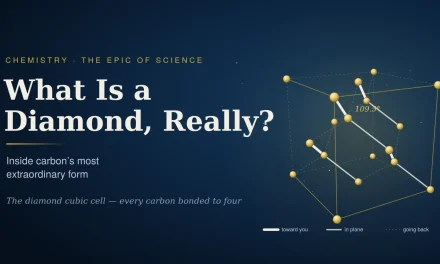
But how does a diamond form at the atomic level? Carbon atoms, freed from their host minerals or fluids by changes in temperature, pressure, or redox conditions, nucleate into the diamond lattice. Each carbon atom forms four covalent bonds to its neighbors, each bond directed toward the corners of a tetrahedron with bond angles of about 109.5°. This sp3 hybridization — every bond a strong sigma bond, every orbital fully engaged — is what gives diamond its legendary hardness. There are no weak planes, no layers to shear, no electrons loosely delocalized as in graphite’s sp2 sheets. The result is the hardest known natural material, scoring 10 on the Mohs scale.
How long does it take for a diamond to form? This is one of the questions that most surprises people. The answer is: it varies enormously, and in many cases the process is staggeringly slow. Studies of carbon and nitrogen isotopes within natural diamonds, as well as radiometric dating of their mineral inclusions, suggest that some diamonds grew over periods of hundreds of millions of years — and the oldest known diamonds are more than three billion years old, dating to the Archean eon. How old are diamonds? Many of the gem-quality stones mined in southern Africa and elsewhere crystallized between about 1 and 3.3 billion years ago, according to research summarized by the Gemological Institute of America (GIA). Some may have grown relatively rapidly during specific fluid-infiltration events; others appear to have added successive layers of carbon over immense timescales. The notion that diamonds form quickly — the way rock candy grows overnight in a sugar solution — is thoroughly incorrect. These are objects that accumulated atom by atom in a world of astonishing patience.
Not all diamonds form in the same way or from the same source of carbon. Geochemists generally distinguish two main types based on their host rock. Peridotitic diamonds crystallize in the peridotite that dominates the subcontinental lithospheric mantle, while eclogitic diamonds form in eclogite, a rock derived from ancient oceanic crust that has been subducted deep into the mantle. The carbon sources differ: peridotitic diamond carbon may come from primordial mantle carbon or from carbonate-rich fluids, while eclogitic diamonds often incorporate carbon that was once at the surface — organic carbon or carbonate sediments carried down by subduction. This distinction, supported by carbon isotope studies published in journals such as Nature Geoscience, is remarkable: some of the carbon in a diamond on your finger may once have been part of a living organism on an ancient seafloor, recycled deep into the Earth and reborn under pressure. According to the U.S. Geological Survey (USGS), understanding these different formation environments has been critical for diamond exploration, because the geological setting determines where diamonds can be found at the surface.
There is also a rarer and more exotic category: superdeep diamonds, which originate at depths of 300 kilometers or more — some possibly from the transition zone between the upper and lower mantle, or even deeper. These stones sometimes contain inclusions of high-pressure mineral phases that do not survive at the surface except when armored inside the diamond lattice. They offer a window into parts of the Earth that are otherwise completely inaccessible.
From Mantle to Surface: The Kimberlite Express
A diamond can sit in the mantle for a billion years and never reach the surface. The fact that we find any diamonds at all is due to one of the most dramatic volcanic phenomena on the planet: kimberlite eruptions. Kimberlite is a rare, volatile-rich igneous rock that originates at great depth and ascends through the lithosphere at extraordinary speed — some researchers estimate ascent rates of meters per second, fast enough to carry diamonds upward before they can convert to graphite in the lower-pressure, still-hot conduit. These eruptions are violent, carving deep, narrow, carrot-shaped pipes through the crust and blasting debris across the surface.
The history of diamonds as objects of human fascination is ancient, but scientific understanding of how diamonds are mined and where they originate is surprisingly modern. When were diamonds first discovered by humans? Diamonds were known in India at least two millennia ago, and India remained the world’s primary source until the eighteenth century. Brazilian deposits were found in the 1720s, shifting the global supply. But the discovery that transformed the diamond industry — and geology — occurred in South Africa in the late 1860s, when diamonds were found near the Orange River and, shortly after, in the yellow ground (later recognized as weathered kimberlite) near what would become the city of Kimberley. Who discovered the geological origin of diamonds in kimberlite? The connection between diamonds and the unusual blue-grey volcanic rock was recognized in the 1870s, and the rock was named kimberlite after the city.
This recognition was a turning point: it meant that diamonds were not just river-gravel curiosities but products of deep-Earth volcanism, and it opened the door to systematic exploration.
Today, where can diamonds be found? Major sources include countries across southern and central Africa (South Africa, Botswana, the Democratic Republic of the Congo, Angola, Namibia), Russia (particularly the Yakutia region of Siberia), Canada (the Northwest Territories), and Australia (the Argyle mine, now closed, which was the world’s largest source of pink diamonds). India, where the history of diamonds begins in the human record, is no longer a major producer. The common thread linking all these sites is the presence of ancient, thick, stable continental lithosphere — the kind of deep geological root beneath a craton where mantle conditions favor diamond stability and where kimberlite pipes have, at various times in Earth’s history, punched through to the surface. How are diamonds mined from these pipes? Both open-pit and underground methods are used to extract the kimberlite or lamproite ore, which is then crushed and processed to liberate the diamonds — a process that yields only a small number of gem-quality stones per ton of rock.

Photo: Lubor Ferenc, via Wikimedia Commons, CC BY-SA 4.0.
The Big Hole at Kimberley — a kimberlite pipe opened from above. The rock that fills these carrot-shaped conduits takes its name from this town.
Synthetic Diamonds, Lasting Myths, and Why the Real Story Matters
The question “how do you make a diamond?” has a laboratory answer as well as a geological one. Since the mid-twentieth century, scientists and engineers have learned to create diamonds synthetically. The first reproducible synthesis of diamond was achieved in the 1950s using high-pressure, high-temperature (HPHT) presses that replicate, in miniature, the conditions of the mantle. More recently, chemical vapor deposition (CVD) has emerged as a powerful method: a carbon-containing gas (often methane) is broken down in a low-pressure chamber, and carbon atoms deposit onto a seed crystal, building up a diamond layer by layer. How long does it take to make a diamond synthetically? Depending on size and method, days to weeks — a striking contrast with the billion-year timescale of natural formation. Synthetic diamonds are now widely used in industry (cutting, grinding, thermal management) and increasingly in the gem market.
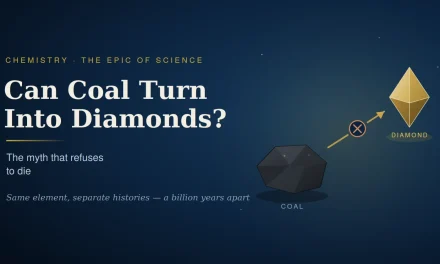
A persistent myth deserves dismantling here: the idea that diamonds are formed from coal. This is one of the most widespread misconceptions in popular science, and it is almost certainly wrong for the vast majority of natural diamonds. Coal is formed from terrestrial plant material and is found in sedimentary rocks of Paleozoic age or younger — typically less than about 400 million years old. Most natural diamonds, as noted above, are far older than any coal deposit, and they form at depths far below where coal exists. While it is true that subducted organic carbon can contribute to diamond formation in some eclogitic settings, the carbon source is ancient marine organic matter and carbonate sediment, not coal seams. The “diamonds from coal” story is a dramatic simplification that does not reflect how diamonds are created in nature.
How long do diamonds last? In a practical sense, diamonds are extraordinarily durable. The strong covalent bonding makes diamond chemically inert at ordinary temperatures; it will not dissolve, corrode, or degrade under any conditions a person is likely to encounter. Thermodynamically, diamond is metastable at surface pressure — graphite is the stable form — but the kinetic barrier to conversion is so enormous that no diamond has ever been observed to spontaneously transform into graphite at room temperature and pressure. For every meaningful human timescale, a diamond is, as the marketing slogan claims, forever. For readers curious about how chemistry connects to the broader sweep of human knowledge — from the elements to the forces that bind matter — our Chemistry section explores these questions across many topics.
One question people often ask: how does a diamond look like in its natural state, before cutting and polishing? Rough diamonds can be surprisingly unimpressive — translucent, greasy-looking octahedra, sometimes coated in a dull skin. The brilliant fire and sparkle of a finished gem are products of cutting geometry that exploits diamond’s very high refractive index (about 2.42) and strong dispersion. The raw stone, fresh from the kimberlite, hints at beauty but does not yet display it.
Holding a Billion Years in Your Hand
There is something philosophically staggering about a diamond. The carbon atoms in that stone may have been part of the primordial mantle when the Earth was still young, or they may have cycled through an ancient ocean floor, been swallowed by a subduction zone, and spent a billion years reassembling themselves into the hardest natural structure known — all before being blasted to the surface in a volcanic eruption that lasted hours. How are diamonds made? By patience and violence, by chemistry and geology conspiring across timescales that dwarf human civilization. The next time you see a diamond — in a ring, in a drill bit, in a museum — consider that you are looking at an object that survived a journey no human being could undertake, from a place no human being has visited, carrying information about a world we can only infer. That is not marketing. That is the plain, extraordinary truth of carbon under pressure.
References
USGS — Diamond (Industrial and Gem), Mineral Commodity Summaries. https://www.usgs.gov
Gemological Institute of America (GIA) — “How Diamonds Form.” GIA Education Resources.
Stachel, T. & Harris, J. W. (2008). “The origin of cratonic diamonds — constraints from mineral inclusions.” Ore Geology Reviews, 34(1–2), 5–32.
Shirey, S. B. & Shigley, J. E. (2013). “Recent advances in understanding the geology of diamonds.” Gems & Gemology, 49(4), 188–222.
Various studies in Nature Geoscience on mantle diamond formation, superdeep diamonds, and carbon cycling.