
The Density Was Wrong
In 1875 the French chemist Paul-Émile Lecoq de Boisbaudran isolated a new metal, named it gallium, and measured its density at about 4.7 grams per cubic centimetre. A letter arrived from St Petersburg telling him the measurement was wrong and the density should be nearer 5.9. Its author, Dmitri Mendeleev, had never held the metal and was working from a table he constructed. Lecoq repurified his gallium and measured it again. The value was 5.904. This is an instructive fun fact about the periodic table because it shows the table as an instrument of prediction rather than a record of what was already known: it corrected an experiment carried out two thousand kilometres away.
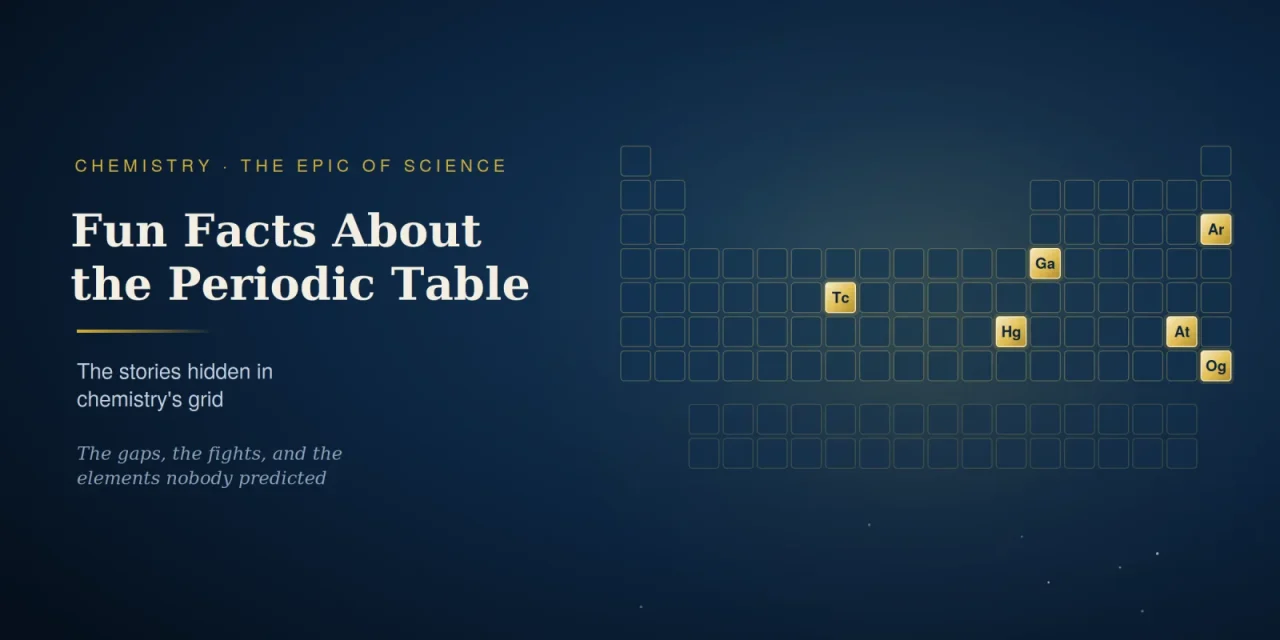
Gallium was one of three elements Mendeleev described before anyone found them, in squares he deliberately left empty. That decision, more than any feature of the layout, is why his version of the table survived and his rivals’ did not. For most of the nineteenth century chemistry had a classification problem: roughly sixty known substances, no agreed principle connecting them, and mounting evidence that an underlying order existed. The most durable fun facts about the periodic table come from the search for that order — who was mocked for finding it too early, which gaps produced the most consequential predictions in nineteenth-century chemistry, and why several of the newest boxes carry names chosen in the middle of a Cold War dispute.
The Heart of It
The periodic table is usually taught as a finished object — a reference chart, static and authoritative. It is better understood as the record of an argument that ran for more than a century. The most interesting facts about the periodic table are historical rather than chemical: the blank squares Mendeleev dared to leave empty, the discoveries that proved him right within his lifetime, the correction that replaced his organising principle entirely, and the naming disputes that made the seventh period a matter for international arbitration.
That framing matters because it changes what the table is for. It also explains why the fun facts about the periodic table are transmitted more reliably than the chemistry that produced them: a disputed prediction is easier to recall than a valence rule. Treated as a chart, the table supplies information. Treated as a historical document, it records a method: trusting a regularity enough to predict what has not yet been observed and accepting public refutation if the prediction fails. Almost every piece of periodic table trivia worth repeating is an instance of that method, and the most interesting facts are those where it came close to failing.
Chemistry Before the Grid
The problem was not a shortage of attempts. Several chemists identified a regularity before anyone could systematise it. Johann Wolfgang Döbereiner observed as early as 1829 that certain elements fell into triads — chlorine, bromine, iodine; calcium, strontium, barium — where the middle member’s atomic weight was near the average of the other two. It was suggestive but ignored because three-element patterns can be found in almost any list if you look hard enough.
The French geologist Alexandre-Émile Béguyer de Chancourtois came closer in 1862, plotting the elements as a spiral wound around a cylinder so chemically similar elements lined up vertically. His paper was published in a geological journal without the diagram that made the scheme intelligible and attracted almost no attention. In 1865 the English chemist John Newlands proposed his “law of octaves,” noting that when elements were listed by increasing atomic weight, properties recurred at every eighth position, like notes on a musical scale.
Newlands presented the idea to the Chemical Society in 1866 and was met with scepticism and ridicule. One member, George Carey Foster, asked whether he had considered arranging the elements alphabetically instead. The Society declined to publish the paper. Newlands was partly the author of his own difficulty — the musical analogy claimed more regularity than his data supported, and his scheme broke down badly among the heavier elements — but the episode reminds us that the pattern was visible to several people before it was accepted from anyone.
Two chemists produced schemes that survived scrutiny. Julius Lothar Meyer in Germany and Dmitri Mendeleev in Russia arrived at broadly similar arrangements at almost the same moment; Mendeleev published in 1869, Meyer in 1870, working independently. Meyer’s version was in some respects the more systematic, built around a graph of atomic volume against atomic weight. Credit has gone largely to Mendeleev.
The Gaps That Made Mendeleev Famous
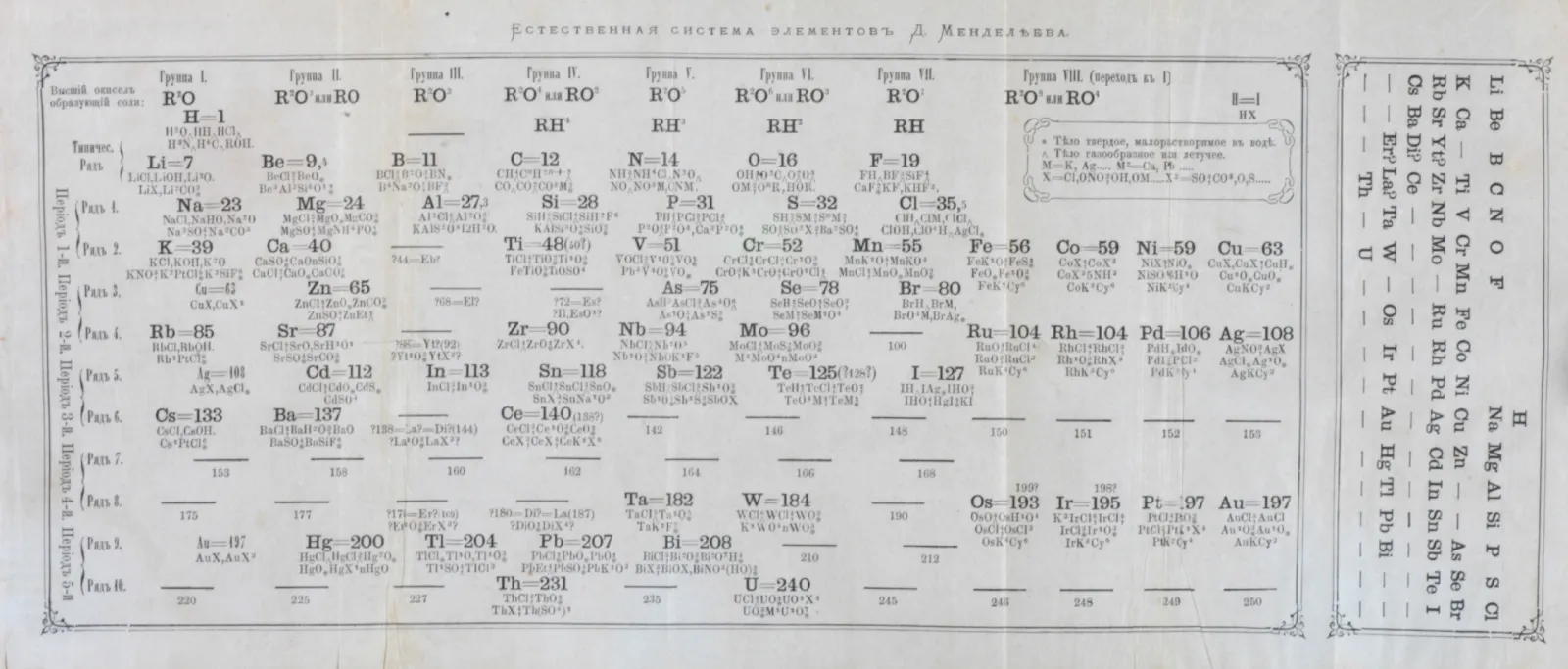
Mendeleev did something his rivals did not. Where the pattern demanded an element that nobody had ever seen, he left the square empty and described the missing occupant in advance — its approximate atomic weight, its density, the colour of its oxide, the way it would behave with acids. He called them eka-aluminium, eka-boron and eka-silicon, using a Sanskrit prefix meaning “one,” as in one place beyond the known element. It was an unusual thing to publish. Each blank square was a falsifiable claim, and three of them exposed the scheme to three independent refutations.
No refutation came. Gallium, isolated in 1875, matched eka-aluminium closely enough that Mendeleev could correct its measured density by post. Lecoq had discovered the element; the table had specified it in advance.
Scandium followed in 1879, isolated by Lars Fredrik Nilson, matching eka-boron. Germanium arrived in 1886 in the hands of Clemens Winkler, matching eka-silicon so precisely that Winkler himself remarked on the resemblance. Within eleven years, a table built on atomic weights and an assumption of periodicity had correctly described three substances that were unknown when the predictions were made. The empty squares, not the filled ones, are what made the arrangement persuasive.
The nearest the scheme came to failing arrived from a direction nobody had allowed for. Between 1894 and 1898 Lord Rayleigh and William Ramsay isolated argon, and then helium, neon, krypton and xenon — a family of almost unreactive gases for which the table had left no gaps at all. Mendeleev had predicted individual missing elements; he had not predicted a missing column. His first response was to dispute the result, proposing that argon might be a triatomic form of nitrogen rather than a new element. The measurements held. By 1902 he had accepted the gases and endorsed the solution Ramsay proposed: an additional group appended to the table, which absorbed all of them without disturbing the periods already in place. Surviving an unanticipated family of elements was a more demanding test than any of the successful predictions.
One of Mendeleev’s original gaps held out far longer than the three that made his name. The square below manganese — element 43, Mendeleev’s eka-manganese — was not found despite repeated searches, for a reason nobody could have known at the time: it has no stable isotopes. Every atom of it decays. It was finally produced in 1937 by Carlo Perrier and Emilio Segrè, working with a piece of molybdenum foil that had been bombarded in the Berkeley cyclotron. They named it technetium, from the Greek for artificial, because it was the first element created by human beings rather than found. An element predicted by the table could now be synthesised rather than searched for. The arrangement that had begun with deliberate blanks was at last continuous, and it is that completed table, with its full set of groups and periods, that bodies such as the Royal Society of Chemistry now publish in interactive form.
Hover to magnify
?44=Eb?, ?68=El?, ?72=Es? — are predicted atomic weights for elements nobody had yetfound. They became scandium, gallium and germanium. Image: Science History Institute (public domain).
The Fights Behind the Names
Element names look like neutral labels. Several were the negotiated outcome of a dispute.
The clearest case unfolded in the second half of the twentieth century, in what chemists called the Transfermium Wars — a series of priority disputes over elements beyond fermium, element 100. Laboratories in Berkeley, California and Dubna, in the Soviet Union, produced single atoms of superheavy elements at the limit of detection, each claiming discovery and proposing names that flattered its own side. Element 104 was rutherfordium to the Americans and kurchatovium to the Soviets, after Igor Kurchatov, the physicist who led the Soviet atomic bomb project. For years, which name you used revealed which side of the Iron Curtain your textbook was printed on. The International Union of Pure and Applied Chemistry finally imposed a settlement in 1997: rutherfordium for 104, dubnium for 105 in acknowledgement of the Soviet laboratory, and so on down the row.
The settlement also resolved a smaller quarrel. The Berkeley team wanted element 106 named after Glenn Seaborg, who co-discovered plutonium and reorganised the lower rows of the table by proposing the actinide series. IUPAC objected because Seaborg was still alive and briefly assigned the name elsewhere. American chemists refused to accept the ruling and kept using seaborgium. The 1997 compromise let the name stand, establishing by exception that a living person could be honoured on the grid. The precedent was used only once more, in 2016, when element 118 was named oganesson after Yuri Oganessian, whose team in Dubna was central to synthesising it.
That same year completed the seventh period. Nihonium, moscovium, tennessine and oganesson — elements 113, 115, 117 and 118 — received their formal names, filling the last empty boxes of the row. Nihonium, from Nihon, one of the Japanese names for Japan, was the first element named for a discovery made in Asia, produced at the RIKEN institute. An arrangement devised by a Russian chemist to classify the elements known in 1869 now carries place-names from Japan, Russia, Tennessee and California in its final row.
Older names record older usage. The symbols that appear to contradict their elements — W for tungsten, Na for sodium, K for potassium, Pb for lead, Au for gold, Hg for mercury — survive from the Latin and German names displaced by English: wolfram, natrium, kalium, plumbum, aurum, hydrargyrum. Niobium spent a century and a half being called columbium in the United States and niobium in Europe, a transatlantic disagreement that IUPAC settled in favour of niobium in 1949, and which lingers in some American metallurgical trade usage today. A single small quarry at Ytterby, on an island near Stockholm, supplied the ores behind four element names: yttrium, ytterbium, terbium and erbium. No other single locality has given its name to as many elements.
The Weird Elements, and the Reasons Behind Them
Periodic table trivia is more satisfying when the oddity has a cause, and the properties that make certain elements notable are not a miscellany. They divide into two groups by origin. One set of anomalies is produced by the behaviour of the outermost electrons, which the columns of the table encode. The other is produced by the stability of the nucleus, which the table does not encode. Most genuinely weird elements are anomalous for one reason or the other, and the distinction explains which oddities the arrangement predicts and which it cannot.
The electronic anomalies cluster where the outer electrons are held unusually tightly or loosely. Mercury is the only metal liquid at ordinary room temperature, melting at −38.83 degrees Celsius; relativistic contraction of its 6s orbital binds those electrons more tightly to the nucleus, weakening the metallic bonding between atoms. Gallium and caesium melt just above room temperature — gallium at 29.76 degrees, caesium at 28.5 — low enough that a gallium spoon will soften in a cup of hot tea. At the opposite extreme, caesium holds its single outer electron so loosely that it is the most reactive metal obtainable in usable quantities, igniting on contact with water. Francium, directly below it, should be more reactive still, though nobody has assembled enough to confirm this. Fluorine attracts electrons more strongly than any other element and is the most reactive non-metal, which is why it resisted isolation until 1886; several chemists who attempted it were injured, and some died. Bromine, in the same column, is the only non-metal liquid at room temperature.
The nuclear anomalies have nothing to do with chemical behaviour. Astatine is generally reckoned the rarest naturally occurring element on Earth, with estimates suggesting the entire crust holds only a few dozen grams at any moment, continuously created and destroyed by radioactive decay. Nobody has seen a visible quantity of it and nobody will: a sample large enough to look at would vaporise itself with its own decay heat. Promethium, element 61, has no stable isotope either, which is why it was missing from the table until identified in 1945 at Oak Ridge among the fission products of uranium; it was named after Prometheus, the Titan who stole fire. Technetium, the gap that held out until 1937, belongs to the same category. In each case the element is absent or vanishingly rare not because the chemistry forbids it, but because the nucleus will not hold together long enough for the chemistry to matter.
At the bottom of the table the two causes converge and neither can be tested properly. The heaviest elements exist for fractions of a second, in quantities of a few atoms, and their chemistry is inferred from theory rather than measured. Oganesson sits beneath the noble gases but is predicted to be a solid rather than a gas, making it a group member that does not behave like its group. Whether the rows can be extended further depends partly on the hypothesis of an “island of stability,” a region of superheavy nuclei that might, if reached, last long enough to be studied. That question belongs to the unfinished part of the subject rather than its trivia, and it is the kind of problem our Chemistry section takes up in more detail like this example.
Correcting the Record
Two corrections are worth making before the trivia is repeated as established fact. The first concerns the most repeated story about the table’s creation: that Mendeleev saw the complete arrangement in a dream. He did tell a version of this to the geologist Alexander Inostrantsev, and the anecdote has been reprinted ever since. Historians treat it with considerable caution. Mendeleev’s surviving working papers show days of methodical effort, successive drafts and rearrangements — sustained work rather than a single overnight insight. The dream, if it happened at all, arrived at the end of the work rather than in place of it.
The second correction is more consequential. Mendeleev ordered his elements by atomic weight, and in three places the ordering forced him to choose between his pattern and his data. He put tellurium before iodine even though tellurium is heavier, because their chemical behaviour demanded it, and he assumed the atomic weights would eventually be revised. They were not. In 1913 the young English physicist Henry Moseley showed, through X-ray spectra, that the true organising principle was atomic number — the count of protons in the nucleus — not atomic weight. Mendeleev’s exceptions were not exceptions at all; he had been right for a reason he could not have known. Moseley was killed at Gallipoli two years later, at twenty-seven.
The sequence is characteristic of the whole episode: a table assembled from incomplete data, defended with unusual confidence, confirmed by discoveries its author did not live to see, and later rebuilt on a principle he never suspected existed. Mendeleev himself was nominated for the Nobel Prize and never received it: the chemistry committee recommended him in 1906, but the Academy awarded that year’s prize to Henri Moissan, the chemist who had isolated fluorine. Mendeleev died the following year. The table outlived him, the disputes continued, and the empty squares continued to be filled — the last four of them only a decade ago. This is why the best fun facts about the periodic table are never merely decorative: each marks a point at which the arrangement was tested.
Almost every box on the printed table was once an open question. A small number of them still are.
References
Royal Society of Chemistry — Periodic Table. rsc.org/periodic-table
Sam Kean, The Disappearing Spoon (New York: Little, Brown and Company, 2010).
Science History Institute — biographical and historical collections on Dmitri Mendeleev, Henry Moseley, and the discovery of the elements.


Trackbacks/Pingbacks