What happens when you gather the greatest mathematical minds on Earth in a single auditorium every four years and ask them to show each other what they’ve found? The answer is something that has been happening since 1897 — an institution so powerful it can crown careers, redirect entire fields, and alter the trajectory of human knowledge. The International Congress of Mathematicians is not merely a conference. It is the closest thing mathematics has to a supreme court, a world stage, and a sacred ritual, rolled into one.
Picture Zurich in late summer 1897. Two hundred and eight mathematicians from sixteen countries filed into the Eidgenössische Technische Hochschule, the same polytechnic where Einstein was beginning his studies. They came by train from Berlin, Paris, St. Petersburg, and Rome — not to compete, but to do something more radical: to speak across national borders at a time when nationalism was tearing Europe apart. What they created that week would survive two world wars, the Cold War, and the digital revolution, and give rise to the most prestigious prize in all of mathematics.
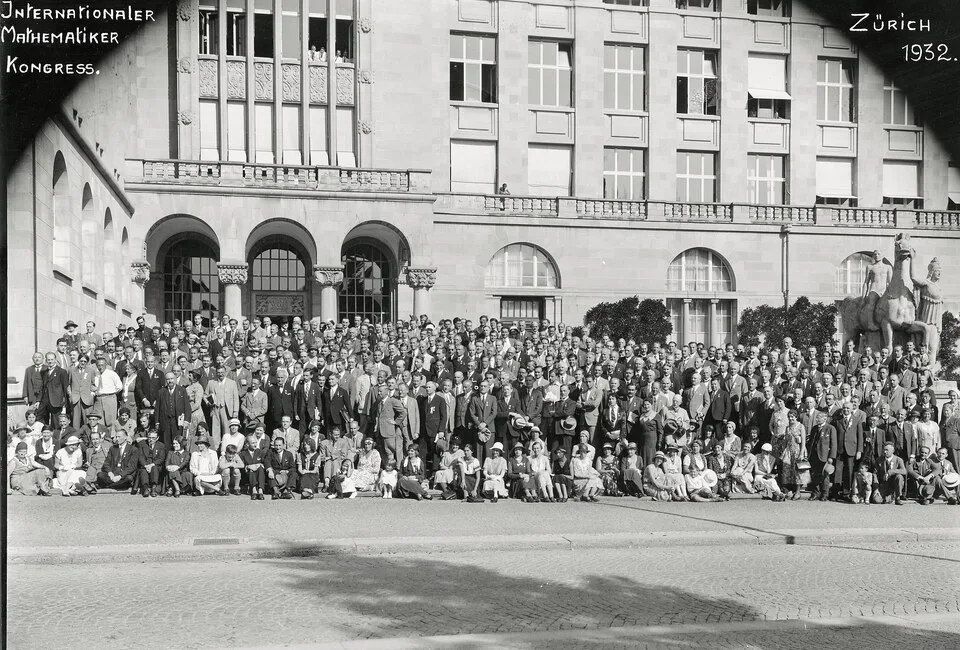
Delegates at the International Congress of Mathematicians, Zurich, 1932.
Photograph: ETH-Bibliothek Zürich, Bildarchiv (public domain).
Zurich, 1897: The Dream of a Universal Mathematics
The man who made it happen was not a towering mathematical genius, but a supreme organizer with a radical conviction. Ferdinand Rudio, a Swiss mathematician and historian of science at ETH Zurich, believed mathematics could not flourish in national silos. He had watched German mathematicians ignore French results and French mathematicians dismiss Italian methods, seeing this fragmentation as a wound in the body of knowledge itself. So he wrote hundreds of letters to mathematicians across Europe, proposing something unprecedented: a gathering with no national allegiance, no political agenda, only the shared language of proof.
The first International Congress of Mathematicians convened on August 9, 1897. A keynote lecture by Henri Poincaré, already the most famous mathematician alive, was presented on the relationship between pure analysis and mathematical physics — though Poincaré, unable to attend, did not deliver it in person. Adolf Hurwitz spoke about the development of analytic function theory. The atmosphere was electric—not with celebrity flash, but with the quiet voltage of people realising they belonged to the same intellectual civilisation. Many Fields Medal winners celebrated at later congresses would trace their intellectual lineage to the rigour and cross-border collaboration these first meetings established.
The congress resolved to meet again in four years, in Paris. That 1900 meeting became legendary—not for organisational achievement, but for a single lecture. David Hilbert stood before the assembled mathematicians and posed twenty-three unsolved problems he believed would shape the future of mathematics. He was right. Those problems guided research for the entire twentieth century, and several remain open today. The congress had proven itself not just as a meeting, but as the stage where the future of mathematics could be declared.
What the ICM Actually Is — And Why It Matters More Than Any Journal
To understand why ICM mathematics carries extraordinary weight, forget what you know about academic conferences. Most scholarly gatherings are trade shows — researchers present narrow results to small specialist audiences, and the proceedings gather dust. The International Congress of Mathematicians operates on a different principle. It is the only event where the entire discipline of mathematics convenes under one roof, from algebraic geometry to applied statistics, from number theory to mathematical biology.
Think of it this way: if mathematics were a vast continent, most conferences would be like town meetings—useful, local, focused on one neighbourhood. The ICM is the continental parliament. Every four years, delegates from every region of the mathematical landscape come together to report on their territory, hear what has been discovered in distant provinces, and collectively decide — through the sheer force of attention — which ideas matter most.
The congress achieves this through a carefully layered structure. Plenary speakers, chosen by the International Mathematical Union, deliver broad lectures intended for the entire mathematical community. Invited sectional speakers present more specialized work. And then there are the prizes. The Fields Medal, awarded at the opening ceremony of each ICM since 1936, is the most famous — often called the Nobel Prize of mathematics, though that comparison, as we shall see, obscures as much as it reveals. The congress also awards the Nevanlinna Prize (now the IMU Abacus Medal) for contributions to information science, the Gauss Prize for applied mathematics, and the Chern Medal for lifetime achievement. Each prize carries the weight of the entire mathematical community’s judgment, because the selection committees draw from the deepest wells of expertise on Earth.
The history of mathematics congresses reveals something profound about how knowledge advances. Unlike the sciences, where experiments generate data that can be independently verified, mathematics progresses through consensus about proof. A theorem is true when the community agrees the proof is valid, and the ICM is the supreme arena where that consensus forms. Being invited to speak at the congress is a career-defining honor — a signal that the global community considers your work among the most significant of the era.
The Fields Medal and the Architecture of Mathematical Glory
The Fields Medal was born from a combination of idealism and frustration. John Charles Fields, a Canadian mathematician who organised the 1924 ICM in Toronto, was troubled by two things: the absence of a major international prize in mathematics, and the bitter national rivalries that nearly destroyed international mathematical cooperation after World War I. German mathematicians had been excluded from the 1920 and 1924 congresses — a political wound that took decades to heal. Fields envisioned a prize explicitly international, rewarding brilliance regardless of nationality, and stipulated it should recognize not only past achievement but also the promise of future accomplishment.
Fields died in 1932, but his bequest funded the medal, which was first awarded in 1936 at the ICM in Oslo to Lars Ahlfors of Finland and Jesse Douglas of the United States. The medal carries a relief portrait of Archimedes and the Latin inscription “Transire suum pectus mundoque potiri” — to transcend one’s spirit and take hold of the world. Consider the mathematics that Ahlfors was honored for: his work on Riemann surfaces and conformal mappings, which established deep connections between geometry and complex analysis. A conformal mapping preserves angles locally — if two curves cross at a right angle in the original domain, their images cross at a right angle in the mapped domain. Formally, a function \( f: U \to \mathbb{C} \) is conformal at a point \( z_0 \) if it is holomorphic and its derivative satisfies \( f'(z_0) \neq 0 \). This seemingly simple condition encodes a remarkable rigidity: the function cannot distort the local geometry of shapes.
Ahlfors extended this theory to its limits, proving results about the type problem for Riemann surfaces — the question of whether a given surface is conformally equivalent to the complex plane \( \mathbb{C} \) or to the open unit disk \( \{z \in \mathbb{C}: |z| \lt 1\} \). The distinction matters enormously because the two cases carry fundamentally different analytic structures. On the plane, bounded holomorphic functions are constant (by Liouville’s theorem), while on the disk, a rich family of bounded holomorphic functions exists. Ahlfors developed his theory of covering surfaces to attack this problem, creating tools that mathematicians still use nearly a century later.
The most consequential — and controversial — feature of the Fields Medal is its age restriction. Recipients must be under forty years of age in the year of the congress. This rule, sometimes attributed to Fields himself though the historical evidence is ambiguous, has shaped the culture of mathematics in ways both inspiring and troubling. It creates a sense of urgency: if you are going to do your greatest work, the medal implies, you should do it young. The World Mathematics Congress thus becomes not just a celebration of achievement but a kind of clock, ticking down toward a deadline that the international math olympiad prodigies of each generation feel acutely. The 2022 ICM, whose award ceremony took place in Helsinki while most lectures ran online, honored Hugo Duminil-Copin, June Huh, James Maynard, and Maryna Viazovska — the second woman ever to receive the prize, recognized for her proof that the \( E_8 \) lattice provides the densest sphere packing in eight dimensions.
Does Mathematics Gather, or Does It Create? — The Epistemology of the Congress
Here is the question that the existence of the International Congress of Mathematicians forces us to confront, and it is far stranger than it first appears: when the greatest mathematicians in the world assemble to present their results, are they reporting on a reality that exists independently of them — like geologists describing the rock formations of an unexplored canyon — or are they performing something closer to a collective act of creation, bringing mathematical objects into existence through the very process of proving theorems about them?
The Platonist answer is seductive and, I think, ultimately the most defensible reading of what actually happens at these congresses. When Viazovska proved that the \( E_8 \) lattice achieves the densest sphere packing in eight dimensions, she did not invent that fact. The \( E_8 \) lattice is a fixed combinatorial and geometric object with properties that are what they are regardless of whether anyone investigates them. The density of this packing, approximately \( \pi^4 / 384 \approx 0.25367 \), was true before Viazovska was born, before the ICM existed, before human beings existed. Her proof was an act of discovery — difficult, creative, heroic — but the thing discovered was already there. This suggests, and I find this genuinely unsettling, that the mathematical universe is not a human artefact but a landscape we explore. The ICM is something like a cartographers’ guild, periodically convening to update the map.
But Imre Lakatos would have pressed back hard against this picture. In his Proofs and Refutations, Lakatos argued that mathematical knowledge is not built by the clean logical deduction of the textbook but by a messy, dialectical process of conjecture, proof, counterexample, and revision. The ICM, viewed through Lakatos’s lens, is not a temple of eternal truths but a marketplace of provisional claims — claims that gain authority precisely because they survive the scrutiny of the assembled community. A proof is accepted not because it corresponds to some Platonic fact, but because no one in the room (or in the wider community the room represents) can find a flaw in it. The truth of a theorem, on this view, is social before it is metaphysical.
What does it mean for a proof to be “correct” when even the greatest mathematicians sometimes disagree? Consider the ongoing verification of large proofs in mathematics — Hales’s proof of the Kepler conjecture required computer verification that took years of additional work. The ICM serves as a filter, but it is a human filter, subject to human limitations. If a flaw were found tomorrow in a result that had been celebrated at the congress, would the mathematics change, or only our knowledge of it? The Platonist says the mathematics was always what it was; we were wrong about our map. Lakatos says the map is all we have, and redrawing it is not a correction but a transformation.
There is a deeper puzzle still. Why does the ICM work at all? Why should it be the case that mathematicians from wildly different cultures, trained in different schools, speaking different native languages, can gather and agree on the validity of a proof? The universality of mathematical consensus — far stronger than consensus in any empirical science — suggests that mathematics taps into something objective. Even Lakatos, who insisted on the social character of mathematical knowledge, never denied that mathematical reasoning has a compulsive force unlike anything else in human intellectual life. The most honest position may be this: the International Congress of Mathematicians functions as though Platonism is true, and the extraordinary success of that function is itself the strongest argument for Platonism that we possess.
Wars, Boycotts, and the Politics of Pure Thought
The history of the ICM is inseparable from the history of the twentieth century’s catastrophes. The congress met in 1912 in Cambridge, England, and then not again until 1920 in Strasbourg — a meeting from which German, Austrian, Hungarian, and Bulgarian mathematicians were excluded by the victorious Allied nations. This exclusion was not subtle; it was written into the statutes of the International Research Council, which oversaw the congress at the time. Mathematics, supposedly the most universal of all human activities, had been weaponized by nationalism.
The scars lasted decades. The German mathematical community, which had been the most powerful in the world before 1914, was humiliated by its exclusion. When the restrictions were finally lifted for the 1928 congress in Bologna, the great David Hilbert led a German delegation in what amounted to a triumphal return. “Mathematics knows no races,” he declared — a statement that would become bitterly ironic when the Nazi regime began purging Jewish mathematicians from German universities just five years later. The official records of the International Mathematical Union document how the congress navigated these crises, sometimes with courage and sometimes with painful compromise.
The Cold War created new fractures. Soviet mathematicians were often prevented by their government from attending congresses held in Western countries. Grigory Margulis, awarded the Fields Medal in 1978, was not permitted to travel to Helsinki to receive it. The medal was collected on his behalf, a silent monument to the absurdity of states controlling the movement of people whose work transcends all borders. The 2022 ICM was originally planned for St. Petersburg. Still, Russia’s invasion of Ukraine forced a relocation to Helsinki, with most lectures delivered virtually — a reminder that the dream of a politics-free mathematical community has never been fully realized.
From Zurich to ICM 2026 and Beyond
The legacy of the International Congress of Mathematicians extends far beyond the walls of any single meeting hall. Every major development in twentieth- and twenty-first-century mathematics has been shaped, directly or indirectly, by the congress. Hilbert’s 1900 problems, announced at the ICM in Paris, drove research in foundations, number theory, algebraic geometry, and mathematical physics for over a hundred years. The roster of fields medal winners has canonized figures like Alexander Grothendieck, whose reinvention of algebraic geometry at the 1958 and 1962 congresses reshaped the entire discipline, and of Grigori Perelman, who was awarded the medal in 2006 for proving the Poincaré conjecture but famously declined it.
In July 2026, ICM 2026 convened in Philadelphia — the first congress held in the United States since 1986 — where the discipline confronted new questions about accessibility, diversity, and the role of computation in proof. Because the Fields Medal is given only at each ICM, there was no medal in 2024; the years between congresses fill instead with speculation about who will next reshape the landscape. That anticipation was answered on 23 July 2026, when the International Mathematical Union named four new laureates — Yu Deng, John Pardon, Jacob Tsimerman, and Hong Wang — for work resolving problems that had stood open for as long as a century. Wang became only the third woman to win the medal in its ninety-year history, after Maryam Mirzakhani in 2014 and Maryna Viazovska in 2022. The next congress, the IMU has announced, will move to the United Kingdom and Ireland in 2030. The relationship between the congress and competitions like the international math olympiad is also worth noting: many Fields medalists, including Terence Tao, were olympiad prodigies before they became research mathematicians, and the pipeline from competition to congress represents one of mathematics’ most distinctive cultural institutions.
The congress has also become a bellwether for which areas of mathematics are ascendant. The invited lectures at each ICM serve as a snapshot of the field’s collective priorities. In recent decades, the rise of probabilistic methods, the deepening connections between number theory and algebraic geometry, and the growing role of mathematical biology and data science have all been legible in the congress programs, making the ICM an indispensable record of how the discipline evolves.
The Question That Won’t Close
Every four years, the ritual repeats. Mathematicians gather. Lectures are given. Medals are awarded. And for a few days, the illusion holds — or perhaps it is not an illusion at all — that mathematics is a single, unified civilization with its own parliament, its own heroes, its own sense of what matters. The International Congress of Mathematicians has survived wars, pandemics, and the fragmentation of the modern university. It has survived because mathematicians need it, not for career advancement or networking, but for something more fundamental: the confirmation that the work they do in isolation connects to a larger, shared enterprise of understanding.
But here is what lingers after the lectures end and the delegates scatter back to their universities: if mathematics really is one unified landscape, as the congress implicitly claims, why does it keep producing truths that no single human mind can hold? Each ICM reveals more territory, but the territory grows faster than our capacity to survey it. Are we approaching a point where the mathematical world will be too vast for any congress to represent — or is the act of gathering itself what keeps the landscape coherent? Perhaps the deepest theorem proved at every International Congress of Mathematicians is one that is never stated aloud: that understanding is possible, and that it is worth pursuing together.
References and Further Reading
International Mathematical Union. “ICM Proceedings and History.” mathunion.org/icm.
Fields Medal Official Records, International Mathematical Union.
O’Connor, J.J., and Robertson, E.F. “International Congress of Mathematicians.” MacTutor History of Mathematics Archive, University of St Andrews.
Lakatos, Imre. Proofs and Refutations: The Logic of Mathematical Discovery. Cambridge University Press, 1976.
Barany, Michael J. “Distributions in Postwar Mathematics.” Ph.D. dissertation, Princeton University, 2016.