
Contents
- A Clerk’s Letter That Stunned Cambridge — Why Every Ramanujan Book Begins with an Impossible Story
-
The Life Behind the Legend — Ramanujan in Madras and Cambridge
-
What Makes a Ramanujan Book Different from Other Mathematical Biographies
- Inside the Mathematics — From the Notebooks to the Hardy-Ramanujan Collaboration
-
Contested Legacy — The Debates That Shaped How We Read Ramanujan
A Clerk's Letter That Stunned Cambridge — Why Every Ramanujan Book Begins with an Impossible Story
In January 1913, a letter arrived at Trinity College, Cambridge, addressed to mathematician G. H. Hardy. Inside were nine pages of formulas—dense, strange, many unknown to Western mathematics—written by a 25-year-old shipping clerk from Madras with no university degree. Hardy stayed up until midnight with his colleague J. E. Littlewood, trying to determine if the letter was from a crank or a genius. By the end of the night, he was certain: the author was a mathematician of the rarest kind. That author was Srinivasa Ramanujan, and the best way to understand his extraordinary life is through a great Ramanujan book
What makes Ramanujan’s story so irresistible to biographers and difficult to write well is that it defies every convention of how mathematical greatness happens. He had almost no formal training. He worked in isolation. He claimed many results came to him in dreams, dictated by the goddess Namagiri. Yet his formulas, once tested by rigorous proof, proved not just correct but visionary. His life was tragically short; he died at 32. But the books about him have ensured his legacy stretches far beyond his years.
The Single Idea That Explains Everything
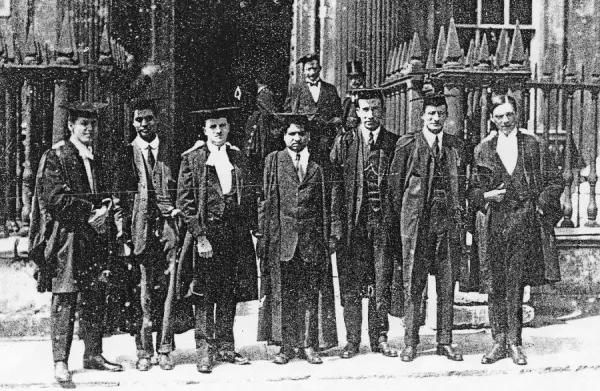
Ramanujan (centre) with G. H. Hardy (far right) at Cambridge, c. 1914–1919. Photo by Charles F. Wilson (public domain).
By age twelve, he had exhausted every mathematics textbook available. At fifteen, a friend lent him G. S. Carr’s A Synopsis of Elementary Results in Pure and Applied Mathematics, a dry compendium of about five thousand theorems with almost no proofs. For most students, Carr’s book would have been a doorstop. For Ramanujan, it became a universe. He worked through it obsessively, filling notebooks with his own results, extending theorems beyond what Carr had imagined, and developing a private mathematical language no one around him could read.
His academic career collapsed. He won a scholarship to the Government Arts College in Kumbakonam but lost it because he neglected every subject except mathematics. He tried again at Pachaiyappa’s College in Madras and failed his English composition exam. By every institutional measure, he was a dropout. Yet he continued filling notebooks—the now-legendary pages later recognized as some of the most original mathematical thinking of the twentieth century. When he finally secured a clerical position at the Madras Port Trust, his supervisor, S. N. Aiyar, encouraged him to write to Hardy. The rest of the story unfolded in Cambridge, in war, illness, and a collaboration that transformed number theory forever.
What Makes a Ramanujan Book Different from Other Mathematical Biographies
Consider what a biographer faces when writing about Ramanujan. His greatest work—the notebooks—is largely inaccessible to non-specialists. The cultural context spans colonial India and Edwardian England, two worlds with radically different assumptions about knowledge, class, and merit. The emotional arc is devastating: a brief, luminous collaboration followed by illness and early death. The central mystery—how did Ramanujan know what he knew?—remains unsolved. No Ramanujan book can avoid grappling with that question, and the best make it the beating heart of the narrative.
Robert Kanigel’s The Man Who Knew Infinity, published in 1991, remains the definitive popular account. Kanigel, a science journalist, spent years researching in both India and England, and his achievement was to make the man who knew infinity feel not like a myth but like a person — someone who was homesick, who struggled with the English cold, who missed his mother’s cooking and the rituals of his Brahmin faith. The book does not shy away from the mathematics, but it never lets the equations eclipse the human being behind them.
What separates a great Ramanujan biography from a merely competent one is the willingness to sit with discomfort. Ramanujan’s mathematics did not emerge from the standard pipeline of education and mentorship. It appeared, seemingly, from nowhere—or from a tradition of mathematical thinking in South India that Western historians often failed to acknowledge. A book that treats Ramanujan only as a curiosity, a savant plucked from obscurity by a benevolent English professor, misses the deeper story. The best accounts—Kanigel’s above all—ask what it means that an entire mathematical tradition existed outside European academia, producing results Europe had never imagined.
Inside the Mathematics — From the Notebooks to the Hardy-Ramanujan Collaboration
To understand why Srinivasa Ramanujan books fascinate mathematicians and lay readers alike, you need at least a glimpse of what Ramanujan actually did. His work spanned continued fractions, infinite series, partitions of integers, modular forms, and a dozen other fields. Let us focus on one result that captures both the beauty and strangeness of his thinking: the Hardy-Ramanujan asymptotic formula for the partition function.
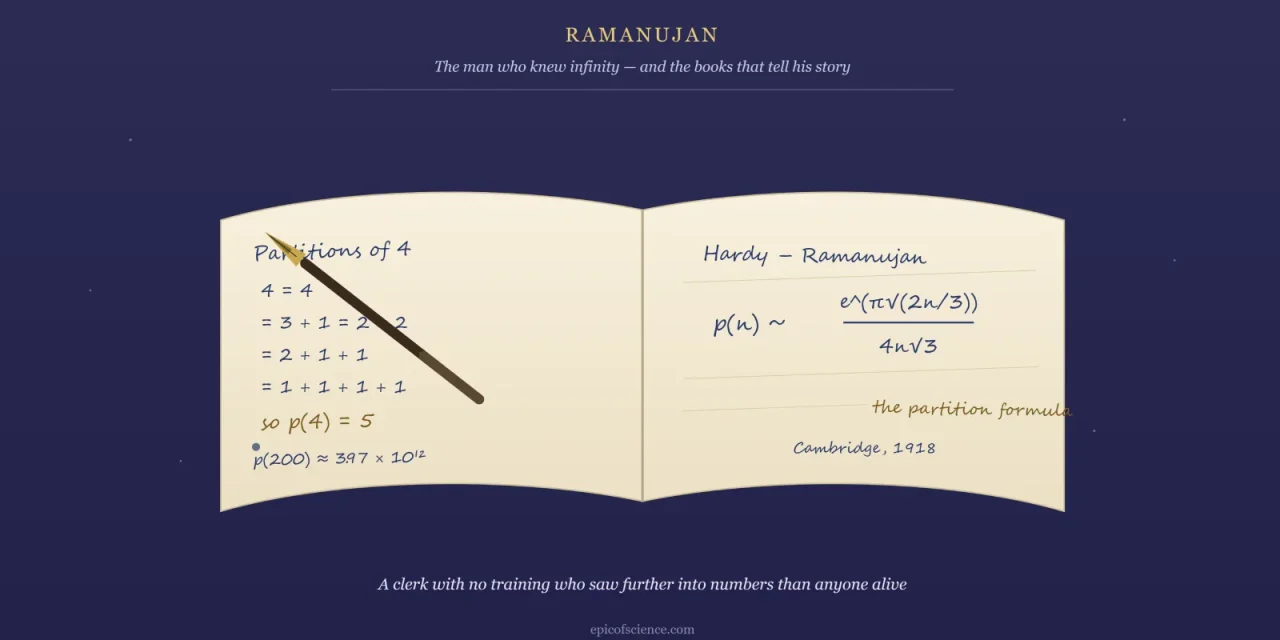
A partition of a positive integer \( n \) is a way of writing \( n \) as a sum of positive integers, where order does not matter. The number 4, for instance, has five partitions: \( 4 \), \( 3+1 \), \( 2+2 \), \( 2+1+1 \), and \( 1+1+1+1 \). The function \( p(n) \) counts these partitions and grows with astonishing speed. By the time you reach \( n = 200 \), \( p(200) \) is approximately \( 3.97 \times 10^{12} \)—nearly four trillion ways to decompose a single number into sums. The question driving the Hardy-Ramanujan collaboration was deceptively simple: can we find a formula that tells us approximately how large \( p(n) \) is for any \( n \)?
In 1918, Hardy and Ramanujan published their answer, and it was stunning. They showed that \( p(n) \) is asymptotically approximated by a formula involving exponentials and square roots, a result that no one had anticipated could exist in such elegant form.
\[ p(n) \sim \frac{1}{4n\sqrt{3}} \exp\!\left(\pi \sqrt{\frac{2n}{3}}\right) \]
The symbol \( \sim \) means the ratio of the left side to the right side approaches 1 as \( n \) grows large. Remarkably, a problem about counting—an inherently discrete, combinatorial question—is answered by a formula involving \( \pi \) and \( e \), the two most famous constants of continuous mathematics. The partition function lives in the world of whole numbers, yet its behavior is governed by the geometry of circles and the calculus of exponential growth. This kind of connection appears throughout the Ramanujan notebook pages: bridges between mathematical continents no one else had thought to connect.
Hardy later refined this result, working with Ramanujan’s ideas, into the famous “circle method,” which became one of the most powerful tools in analytic number theory. But the initial insight—that partitions could be attacked using complex analysis and modular functions—was Ramanujan’s. Hardy said the asymptotic series they developed was one of the most remarkable formulae in all of mathematics. The collaboration between Hardy and Ramanujan, the atheist rationalist and the intuitive mystic, was one of the great intellectual partnerships of the twentieth century. Every serious Ramanujan book must reckon with how two such different minds produced extraordinary work together.
The Epistemological Mystery — How Did Ramanujan Know?
Here is the question that haunts every reader of every Ramanujan biography, and it is a question that no biographer has satisfactorily answered: how did he know? Ramanujan produced thousands of results, many without proofs, many later verified to be correct, and some so far ahead of their time that mathematicians are still unpacking them a century later. He attributed his insights to divine inspiration — specifically, to the Hindu goddess Namagiri, who he said would place formulas on his tongue in dreams. Hardy, a committed atheist, found this explanation exasperating. But neither Hardy nor anyone since has offered a better one.
The most defensible reading of Ramanujan’s case is that it exposes a deep crack in our standard epistemology of mathematics. We normally assume mathematical knowledge is produced through proof—that to know a theorem is to demonstrate it from axioms through logical steps. This is the view David Hilbert championed: mathematics is a formal system, and its truths are statements derivable within that system. But Ramanujan knew things he could not prove. He knew them with a certainty that proved justified again and again. This is not supposed to be possible under Hilbert’s framework, yet it happened.
Imre Lakatos, the Hungarian philosopher of mathematics, argued in Proofs and Refutations that mathematical knowledge does not advance through the clean accumulation of proven theorems but through a messy, dialectical process of conjecture, counterexample, and revision. Lakatos focused on the social process of mathematical discovery—how communities of mathematicians negotiate the meaning and validity of results. But Ramanujan’s case pushes Lakatos’s insight further into genuinely unsettling territory. Here was a mathematician who conducted that dialectical process almost entirely alone, without a community or corrective peer pressure, yet arrived at truths the community took decades to verify. This suggests—and I find this both thrilling and philosophically disorienting—that the structures Ramanujan explored have an objective existence independent of the social processes we use to validate them. He was not constructing mathematics; he was perceiving it, like a naturalist perceives the anatomy of a species that has always existed but was never cataloged.
This pushes us toward a Platonic position: mathematical objects exist before and independent of human minds. The partition function did not begin to exist when Hardy and Ramanujan wrote their formula; it was always there, governing the combinatorial structure of integers, waiting for someone—anyone, anywhere—to notice. Ramanujan’s life shows, with uncomfortable clarity, that access to this Platonic realm is not gated by institutional credentials, cultural context, or even rigorous proof. It is gated by something else—something we might call mathematical intuition or pattern recognition operating at a depth we do not understand. That “something else” remains, after a century of biography and analysis, fundamentally mysterious. Every Ramanujan book circles this mystery. None solves it. The honest ones admit as much.
Contested Legacy — The Debates That Shaped How We Read Ramanujan
Ramanujan’s legacy has never been simple. The history of how his work was received reveals as much about the biases of the mathematical establishment as about Ramanujan himself. When his results first arrived in England, Hardy recognized their brilliance, but other mathematicians were less generous. Some dismissed his lack of rigor. Others questioned whether his results could be trusted without formal proofs. The tension between intuitive discovery and rigorous demonstration—a tension running through the entire history of mathematics—was embodied in Ramanujan’s existence.
After Ramanujan died in 1920, his notebooks passed through several hands before landing with mathematician Bruce Berndt at the University of Illinois. Berndt spent more than two decades editing and proving the results in Ramanujan’s Notebooks, a monumental five-volume work published between 1985 and 1998. Berndt’s project was a kind of argument: by systematically verifying Ramanujan’s claims, he showed that most were correct, and many were profoundly original. The “lost notebook,” discovered by George Andrews in the Wren Library at Trinity College in 1976, contained more unpublished results, many related to mock theta functions—a concept so advanced its full mathematical framework was not developed until Sander Zwegers’s work in 2002.
Robert Kanigel’s The Man Who Knew Infinity, reviewed in the New York Review of Books, shaped public understanding of Ramanujan perhaps more than any academic study. If you want to see how it compares with other portraits of mathematical genius, our guide to books about mathematicians places it alongside the rest of the field. The 2015 film adaptation starring Dev Patel brought the story to an even wider audience, though it inevitably compressed and dramatized the historical record. What both the book and the film did well was refuse to reduce Ramanujan to either a colonial tragedy or a feel-good narrative of discovered genius. The reality, as always, was messier and more interesting than either frame could contain.
Where Ramanujan’s Ideas Live Today
What is the best book about Ramanujan?
The best book about Ramanujan for general readers is Robert Kanigel’s The Man Who Knew Infinity (1991), which combines rigorous research with compelling narrative. For readers interested in the actual mathematics, Bruce Berndt’s Ramanujan’s Notebooks (five volumes, 1985–1998) remains the definitive scholarly source, systematically proving and contextualizing thousands of Ramanujan’s original results.
The reach of Ramanujan mathematics into contemporary science is staggering. His work on modular forms and q-series laid the groundwork for Andrew Wiles’s 1995 proof of Fermat’s Last Theorem —a connection Ramanujan could never have anticipated. His mock theta functions, once considered mathematical curiosities, now appear in string theory and the physics of black holes, where they describe the entropy of certain quantum states. The circle method pioneered in the Hardy Ramanujan collaboration became a standard tool in additive number theory, used to attack problems ranging from Goldbach’s conjecture to Waring’s problem.
In computer science, Ramanujan’s formulas for \( \pi \) — rapidly converging infinite series — became the basis for modern algorithms used to compute billions of digits of \( \pi \). The Chudnovsky brothers’ famous algorithm, which held the record for the most digits of \( \pi \) computed, was directly inspired by Ramanujan’s series. Even in pure mathematics, the Ramanujan conjecture — his prediction about the size of the tau function’s values — was eventually proved by Pierre Deligne in 1974 as a consequence of the Weil conjectures, earning Deligne the Fields Medal. A clerk from Kumbakonam had anticipated one of the deepest results in algebraic geometry.
The living legacy of Srinivasa Ramanujan books is not merely commemorative. These texts continue to serve as active research sources, as mathematicians return to the notebooks and discover that Ramanujan’s unproven claims, once properly understood, open doors to entirely new fields. His influence on the broader landscape of mathematics grows, paradoxically, with each passing decade.
The Unfinished Notebook
Ramanujan died on April 26, 1920, in a small house in Kumbakonam, not far from where he was born. He was thirty-two years old. In the last months of his life, weakened by what was likely hepatic amoebiasis contracted during his years in England, he was still writing — still filling pages with formulas, still reaching toward results he could sense but not quite grasp. His last letter to Hardy contained the first examples of mock theta functions, accompanied by the quiet admission that he had found “a very interesting function” but could not yet explain its full behavior.
A century later, mathematicians are still explaining it for him. The notebooks remain partially unexplored. The formulas keep yielding new theorems. And the central question of Ramanujan’s life — whether mathematical truth is something we build or something we find — remains as open as it was the night Hardy sat up reading a clerk’s letter by lamplight, realizing that somewhere in southern India, a man with no credentials and no training had seen further into the structure of numbers than anyone alive.
References
Robert Kanigel, The Man Who Knew Infinity: A Life of the Genius Ramanujan (Charles Scribner’s Sons, 1991). Bruce C. Berndt, Ramanujan’s Notebooks, Parts I–V (Springer-Verlag, 1985–1998). The Man Who Knew Infinity (film), directed by Matt Brown (IFC Films, 2015). G. H. Hardy, Ramanujan: Twelve Lectures on Subjects Suggested by His Life and Work (Cambridge University Press, 1940). Imre Lakatos, Proofs and Refutations (Cambridge University Press, 1976).



Trackbacks/Pingbacks